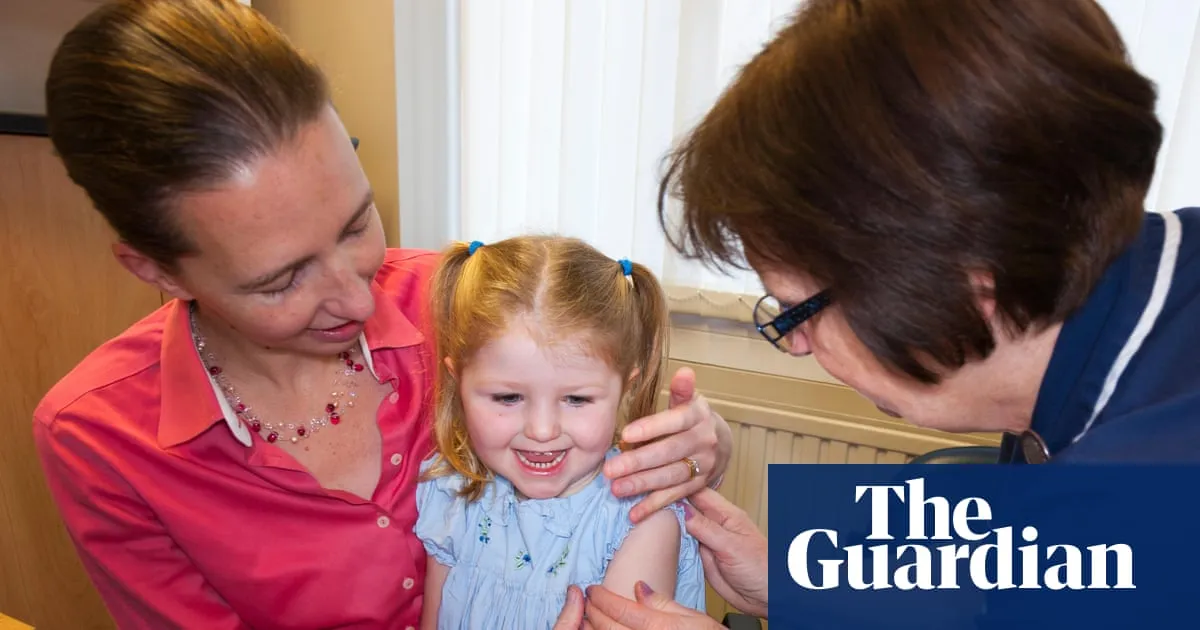
The UK has lost its status as a measles-free country after a rise in deaths from the disease and fall in the proportion of children having the MMR jab in recent years.The World Health Organization said it no longer classified Britain as having eliminated measles because the disease had become re-established.The UK is one of six countries in Europe and central Asia that the WHO says is no longer measles-free, the others being Spain, Austria, Armenia, Azerbaijan and Uzbekistan.The WHO had adjudged the UK to have eliminated the disease between 2021 and 2023, but recent increases in the number of recorded cases – there were 3,681 in 2024 – and rises in the number of outbreaks and deaths has led to a rethink.There were 20 deaths from measles in the six years between 2019 and 2025, the same number as in the 19 years between 1999 and 2018.Doctors, public health experts and local councils said the WHO’s decision reflected the country’s diminishing uptake of the MMR vaccination, which they linked to vaccine hesitancy and parents’ difficulty in getting appointments for their child to be immunised.Dr Simon Williams, a public health researcher at Swansea University, said: “It’s sad to see the UK losing its measles elimination status, although it’s not surprising given outbreaks in recent years. Measles is an eminently preventable disease but vaccine coverage of MMR has declined. We are seeing vaccine hesitancy growing in the UK, as in many countries, and social media-based conspiracies about MMR are a factor.”He said the decision by the UN health body “is a wake-up call that more needs to be done” to get rates of MMR in children in the UK back up to the 95% that the organisation says is needed to eliminate measles, mumps and rubella altogether through herd immunity.The WHO’s European regional verification commission for measles and rubella elimination said it “noted with concern the loss of measles elimination status in some member states, including some with high-performing immunisation programmes”.It highlighted the fact that the vast majority of people across Europe who had contracted either disease were not immunised and it urged governments to revamp their vaccination efforts in order to “close all remaining immunity gaps, focusing especially on vulnerable and hard-to-reach populations”.Dr Vanessa Saliba, a consultant epidemiologist at the UK Health Security Agency, said: “Infections can return quickly when childhood vaccine uptake falls. Measles elimination is only possible if all eligible children receive two MMRV doses before school. Older children and adults who missed vaccination must be caught up.”Children in Britain are offered two doses of the MMR jab, at 12 and 18 months old, but coverage has declined over the last decade. The most recent annual data shows that uptake of the first MMR jab in England fell from 91.9% in 2015-16 to 88.9% in 2024-25.Similarly, the proportion of five-year-olds who have had a second MMR vaccine, which the WHO recommends to ensure immunity, fell from a peak of 88.2% in 2015-16 to 83.7% in 2024-25.Dr Helen Stewart, the officer for health improvement at the Royal College of Paediatrics and Child Health, said: “The UK measles resurgence is a failure of policy, not parenting. While vaccine hesitancy plays a role in low vaccine uptake, the reality is that there are many who simply need better support and easier access to appointments.“When appointments are difficult to get and support isn’t there, the system ends up failing the very families who need it most.”In a report last year, the college said many patients were unable to get their child vaccinated because they “simply can’t access services that work for them”. It said they faced difficulty booking appointments, transport problems and a lack of access to the same GP every time they sought help, which made them less likely to seek vaccination.
SRCThe Guardian - World News
LANGEN
LEANCenter-Left
WORDS631
ENT11
MON · 2026-01-26 · 21:00 GMTBRIEF NSR-2026-0126-10782
NSR-2026-0126-10782News Report·EN·Public Health
UK loses WHO status as measles-free after rise in deaths and fall in jab uptake
The UK has lost its measles-free status from the World Health Organization (WHO) due to a resurgence of the disease. This decision follows a rise in measles cases, outbreaks, and deaths, alongside a decline in MMR vaccination rates.
Denis Campbell Health policy editorThe Guardian - World NewsFiled 2026-01-26 · 21:00 GMTLean · Center-LeftRead · 3 min
The Guardian - World NewsFIG 01
Reading time
3min
Word count
631words
Sources cited
3cited
Entities identified
11entities
Quality score
100%
§ 01
Briefing Summary
AI-generatedNEWSAR · AI
The UK has lost its measles-free status from the World Health Organization (WHO) due to a resurgence of the disease. This decision follows a rise in measles cases, outbreaks, and deaths, alongside a decline in MMR vaccination rates. The WHO had previously recognized the UK as measles-free between 2021 and 2023, but recent data prompted a reclassification. The UK is among six European and Central Asian countries to lose this status. Public health experts attribute the declining vaccination rates to vaccine hesitancy and difficulties in accessing immunization appointments. The WHO urges the UK and other affected nations to strengthen vaccination efforts to achieve the 95% coverage needed for measles elimination.
Confidence 0.90Sources 3Claims 5Entities 11
§ 02
Article analysis
Model · rule-basedFraming
Public Health
Political Strategy
Tone
Measured
AI-assessed
CalmNeutralAlarmist
Factuality
0.80 / 1.00
Factual
LowHigh
Sources cited
3
Well sourced
FewMany
§ 03
Key claims
5 extracted01
Uptake of the first MMR jab in England fell from 91.9% in 2015-16 to 88.9% in 2024-25.
statistic
Confidence
1.00
02
There were 20 deaths from measles between 2019 and 2025.
statistic
Confidence
1.00
03
There were 3,681 measles cases in 2024.
statistic
Confidence
1.00
04
The UK has lost its status as a measles-free country.
factualWorld Health Organization
Confidence
1.00
05
Vaccine hesitancy is growing in the UK.
quoteDr Simon Williams
Confidence
0.90
§ 04
Full report
3 min read · 631 words§ 05
Entities
11 identifiedKey playerOppositionContextPositiveNeutralNegative
People1
Organizations3
§ 06
Keywords & salience
8 termsmeasles
1.00
vaccination
0.90
mmr vaccine
0.80
vaccine hesitancy
0.70
disease elimination
0.60
who status
0.50
public health
0.50
outbreaks
0.40
§ 07
Topic connections
Interactive graph No topic relationship data available yet. This graph will appear once topic relationships have been computed.