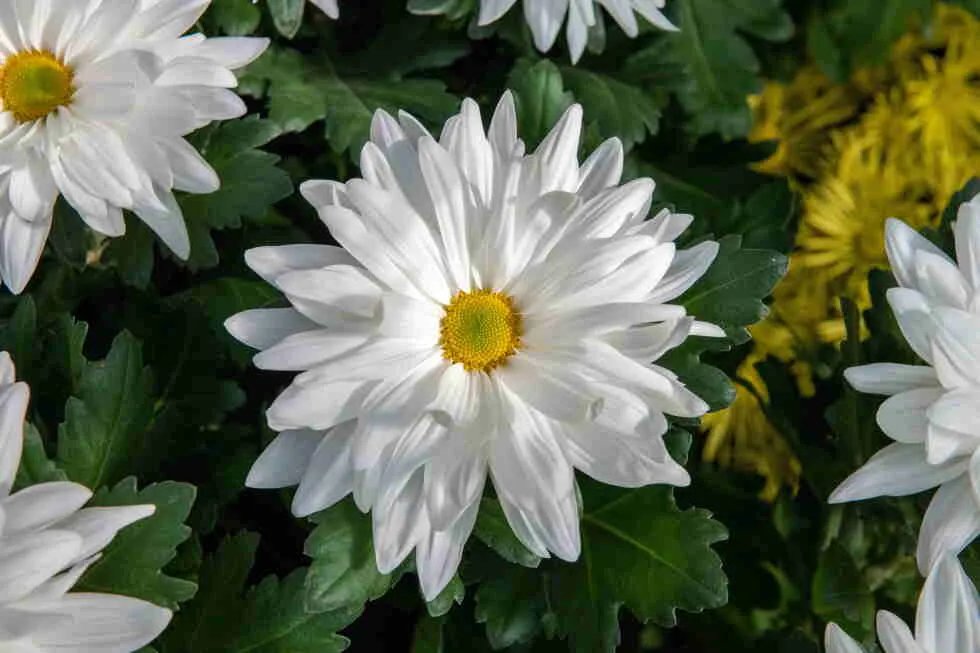
A guide to choosing mums for the fall garden — beyond the classic cushion 1 of 4 | White daisy mums appear in full bloom at Longwood Gardens’ annual Chrysanthemum Festival in Kennett Square, Pa., on Nov. 5, 2020. (Hank Davis/Longwood Gardens via AP) 2 of 4 | Pink Homecoming mums appear in full bloom at Longwood Gardens’ annual Chrysanthemum Festival in Kennett Square, Pa., on Nov. 9, 2023. (Candie Ward/Longwood Gardens via AP) 3 of 4 | Spider mums appear in full bloom at Longwood Gardens’ annual Chrysanthemum Festival in Kennett Square, Pa., on Oct. 28, 2019. (Cathy Matos/Longwood Gardens via AP) 4 of 4 | A bed of pink cushion mums appear in full bloom at Longwood Gardens’ annual Chrysanthemum Festival in Kennett Square, Pa., on Oct. 3, 2025. (Amy Simon Berg/Longwood Gardens via AP) By Jessica Damiano Updated 6:02 AM MESZ, September 1, 2026 Add AP News on Google Add AP News as your preferred source to see more of our stories on Google. Share Share Facebook Copy Link copied Print Email X LinkedIn Bluesky Flipboard Pinterest Reddit September marks the beginning of the great summer-to-fall garden transition and, although most summer plants still have life left in them, many gardeners are turning their attention to the iconic chrysanthemum. The majority of mums sold in pre-planted containers at the garden center are typical “cushion” mums. I wouldn’t garden without them, but there are plenty of other interesting options for gardeners looking to branch out. Botanists worldwide recognize approximately 40 species of wild chrysanthemums. Over centuries, hundreds of thousands of varieties and cultivars have been bred from them, making the plant family one of the largest in the world. The National Chrysanthemum Society has wrangled the whole lot into 13 exhibition-judging categories, each based on flower shape. Many of those, however, are too delicate to grow outdoors or require specialized handling that is not easily attainable in the garden, so they are not offered by the horticultural trade. Still, there are plenty of beautiful, eye-catching and even unusual types available to home gardeners to make your fall garden stand out. Many mums are perennial and will return year after year if planted early enough for their roots to become established before frost. If you intend to plant perennial mums, beware of so-called florist mums, which are often sold in foil-wrapped pots at supermarkets and chain stores, as they are intended as a one-season fall decoration. Always check plant tags for information about hardiness in your horticultural zone. These plants add color to gardens and pots when summer flowers fade 3 MIN READ Blossom of snow: A starry symbol of the Alps makes an unusual addition to rock gardens 4 MIN READ How one gardener’s neighbors shared their land to help her start a flower business 4 MIN READ At the supermarket or garden center, you also will likely encounter perennial cushion mums. When in bloom, the compact, mounding plants resemble a cushion covered in small double flowers in white, yellow, lavender, pink, purple, red, orange, bronze or rust. The plants usually begin blooming in late summer or early fall and continue for four to six weeks. Most cushion mums are hardy in zones 5-9, with some able to survive winters down to zones 3 or 4. Daisy chrysanthemum blooms resemble their namesake flower, with a flat, central “eye” surrounded by individual petals (sometimes in multiple rows). Like all “spray mums,” each stem branches at its end to hold several white, gold, yellow, pink, lavender, violet, orange, rust, bronze or even two-tone flowers. Most mums of this type are suited for zones 5-9, but some exceptionally cold-tolerant varieties, such as Mammoth, are hardy down to zone 3. You’re less likely to find Fuji, or spider, mums at retail stores, but they’re worth seeking out at specialty nurseries or catalogs. Their exotic blooms, comprised of elongated, tube-like petals with curved ends, were named for their resemblance to spiders with spindly legs. Mostly hardy down to zone 5, the plants make wonderful additions to the mid- and late-fall garden, as their four- to eight-week bloom period often doesn’t begin until early November. Homecoming, or Football, mums are the largest, showiest members of the Chrysanthemum family. The plants grew in popularity in the first half of the 20th century because of their use as corsages at college homecoming parades and festivities. Today, the plants with huge, densely packed flowers and inward-curved petals can be grown as perennials in home gardens in zones 5-9. You are most likely to find Homecoming mums at specialty nurseries or in mail-order catalogs. When it comes to extraordinary fall plants, mum’s the word. For more AP gardening stories, go to https://apnews.com/hub/gardening.
SRCAssociated Press (AP)
LANGEN
LEANCenter
WORDS784
ENT12
TUE · 2026-09-01 · 04:23 GMTBRIEF NSR-2026-0901-107955
NSR-2026-0901-107955News Report·EN·Human Interest
A guide to choosing mums for the fall garden — beyond the classic cushion
This article guides gardeners on choosing chrysanthemums beyond the common cushion mum for fall gardens. While cushion mums are widely available and hardy, other varieties like daisy, spider, and homecoming mums offer unique blooms and can be perennial if planted properly.
Associated Press (AP)Filed 2026-09-01 · 04:23 GMTLean · CenterRead · 4 min
Associated Press (AP)FIG 01
Reading time
4min
Word count
784words
Sources cited
0cited
Entities identified
12entities
Quality score
100%
§ 01
Briefing Summary
AI-generatedNEWSAR · AI
This article guides gardeners on choosing chrysanthemums beyond the common cushion mum for fall gardens. While cushion mums are widely available and hardy, other varieties like daisy, spider, and homecoming mums offer unique blooms and can be perennial if planted properly. Gardeners should check plant tags for hardiness zones and avoid florist mums, which are typically single-season decorations. Daisy mums have a flat center with surrounding petals, spider mums feature elongated, tube-like petals resembling spiders, and homecoming mums are the largest with densely packed, inward-curved petals. These less common types can be found at specialty nurseries or through mail-order catalogs, providing diverse options for fall garden color.
Confidence 0.90Claims 5Entities 12
§ 02
Article analysis
Model · rule-basedFraming
Human Interest
Environmental
Tone
Measured
AI-assessed
CalmNeutralAlarmist
Factuality
0.70 / 1.00
Factual
LowHigh
Sources cited
0
No named sources
FewMany
§ 03
Key claims
5 extracted01
Botanists worldwide recognize approximately 40 species of wild chrysanthemums.
factual
Confidence
1.00
02
The majority of mums sold in pre-planted containers at the garden center are typical “cushion” mums.
factual
Confidence
1.00
03
September marks the beginning of the great summer-to-fall garden transition.
factual
Confidence
1.00
04
Florist mums, often sold in foil-wrapped pots at supermarkets, are intended as a one-season fall decoration.
factual
Confidence
0.90
05
Many mums are perennial and will return year after year if planted early enough for their roots to become established before frost.
factual
Confidence
0.90
§ 04
Full report
4 min read · 784 words§ 05
Entities
12 identifiedKey playerOppositionContextPositiveNeutralNegative
Organizations8
§ 06
Keywords & salience
9 termschrysanthemum
1.00
fall garden
0.90
garden center
0.70
cushion mums
0.60
perennial mums
0.60
flower shape
0.50
chrysanthemum festival
0.40
longwood gardens
0.40
horticultural trade
0.40
§ 07
Topic connections
Interactive graph No topic relationship data available yet. This graph will appear once topic relationships have been computed.