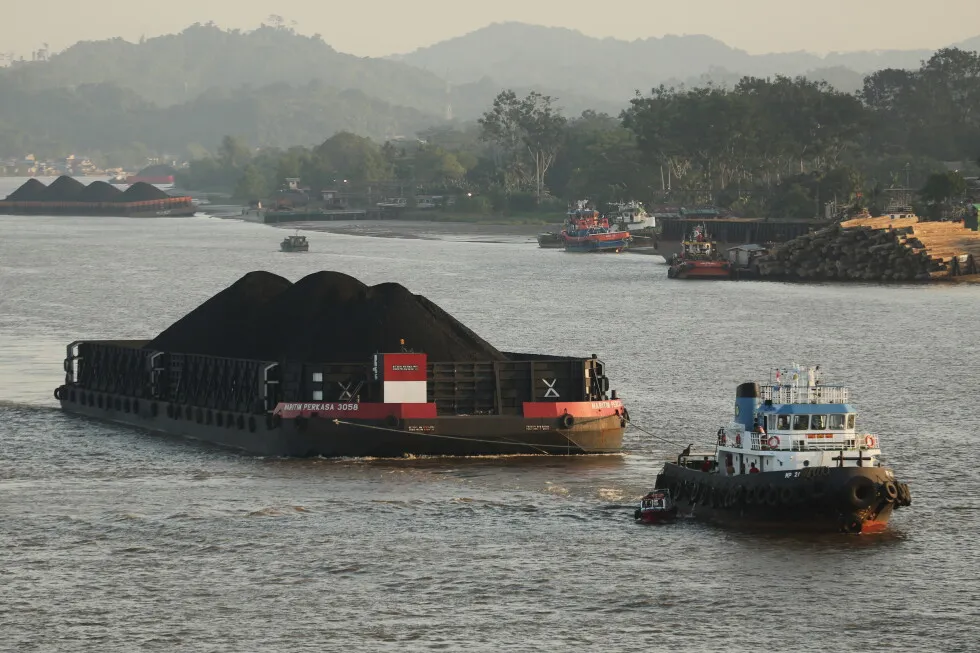
Indonesia doubles down on coal to power its aluminum expansion 1 of 5 | A tug boat pulls a barge loaded with coal on Mahakam River in Samarinda, East Kalimantan, Indonesia, on Aug. 19, 2026. (AP Photo/Ahmad Mulia Panjaitan) 2 of 5 | A tug boat pulls a barge loaded with coal on the Mahakam River in Samarinda, East Kalimantan, Indonesia, on Aug. 19, 2026. (AP Photo/Ahmad Mulia Panjaitan) 3 of 5 | A truck operates at a coal mine near Samarinda, East Kalimantan, Indonesia, on Aug. 19, 2026. (AP Photo/Ahmad Mulia Panjaitan) 4 of 5 | A barge is fully loaded with coal on the Mahakam River in Samarinda, East Kalimantan, Indonesia, on Aug. 19, 2026. (AP Photo/Ahmad Mulia Panjaitan) 5 of 5 | Tug boats pull barges loaded with coal on Mahakam River in Samarinda, East Kalimantan, Indonesia, on Aug. 19, 2026. (AP Photo/Ahmad Mulia Panjaitan) 1 of 5 | A tug boat pulls a barge loaded with coal on Mahakam River in Samarinda, East Kalimantan, Indonesia, on Aug. 19, 2026. (AP Photo/Ahmad Mulia Panjaitan) 1 of 5 A tug boat pulls a barge loaded with coal on Mahakam River in Samarinda, East Kalimantan, Indonesia, on Aug. 19, 2026. (AP Photo/Ahmad Mulia Panjaitan) Add AP News on Google Add AP News as your preferred source to see more of our stories on Google. Share 2 of 5 | A tug boat pulls a barge loaded with coal on the Mahakam River in Samarinda, East Kalimantan, Indonesia, on Aug. 19, 2026. (AP Photo/Ahmad Mulia Panjaitan) 2 of 5 A tug boat pulls a barge loaded with coal on the Mahakam River in Samarinda, East Kalimantan, Indonesia, on Aug. 19, 2026. (AP Photo/Ahmad Mulia Panjaitan) Add AP News on Google Add AP News as your preferred source to see more of our stories on Google. Share 3 of 5 | A truck operates at a coal mine near Samarinda, East Kalimantan, Indonesia, on Aug. 19, 2026. (AP Photo/Ahmad Mulia Panjaitan) 3 of 5 A truck operates at a coal mine near Samarinda, East Kalimantan, Indonesia, on Aug. 19, 2026. (AP Photo/Ahmad Mulia Panjaitan) Add AP News on Google Add AP News as your preferred source to see more of our stories on Google. Share 4 of 5 | A barge is fully loaded with coal on the Mahakam River in Samarinda, East Kalimantan, Indonesia, on Aug. 19, 2026. (AP Photo/Ahmad Mulia Panjaitan) 4 of 5 A barge is fully loaded with coal on the Mahakam River in Samarinda, East Kalimantan, Indonesia, on Aug. 19, 2026. (AP Photo/Ahmad Mulia Panjaitan) Add AP News on Google Add AP News as your preferred source to see more of our stories on Google. Share 5 of 5 | Tug boats pull barges loaded with coal on Mahakam River in Samarinda, East Kalimantan, Indonesia, on Aug. 19, 2026. (AP Photo/Ahmad Mulia Panjaitan) 5 of 5 Tug boats pull barges loaded with coal on Mahakam River in Samarinda, East Kalimantan, Indonesia, on Aug. 19, 2026. (AP Photo/Ahmad Mulia Panjaitan) Add AP News on Google Add AP News as your preferred source to see more of our stories on Google. Share Updated [hour]:[minute] [AMPM] [timezone], [monthFull] [day], [year] BANGKOK (AP) — Resource-rich Indonesia is expanding its production of aluminum as the Iran war disrupts supplies, relying on its abundant coal reserves to power new smelters that run contrary to efforts to curb carbon emissions that cause climate change.Prices have risen due to fuel shortfalls and attacks on infrastructure that have slowed production in the Middle East of the lightweight, silverish metal used in everything from kitchen foil and power lines to smartphones and cars.In working to raise its limited manufacturing capacity, Indonesia has a strong ally in China, which makes 60% of the world’s aluminum but is keen to reduce pollution and emissions from smelters on its own shores. Chinese companies have invested in about three-quarters of the planned Indonesian projects.Here’s what to know about Indonesia’s ambitious aluminum plans: Iran war strains global aluminum supplyThe Middle East usually makes about 9% of the world’s aluminum, but output from the region is expected to drop 44% this year from 2025, according to Fastmarkets, a commodities information agency.Energy shortfalls drove Emirates Global Aluminium to back out of deals and Qatar Aluminium Ltd. to slash production, while Iranian strikes damaged Aluminium Bahrain’s facilities. 1 MIN READ 1 MIN READ 3 MIN READ A metric ton of aluminum traded for between $3,150 and $3,250 before the Iran war. But the conflict drove up that price to as high as $3,780 per metric ton in June. It’s now trading near $3,400 a metric ton.The war has magnified the potential for other regions, like Southeast Asia, to replace Middle East production, said Andy Farida of Fastmarkets.“When that supply is so unsure, end users look for alternatives,” he said. “The war has really accelerated this transformation and put Indonesia on the map.” Indonesia looks to build its aluminum outputAluminum is one of the most used metals in the world and its production is highly energy intensive. The process starts with the mining of bauxite ore, which is refined into alumina and then smelted into aluminum.By the end of the decade, Indonesia wants to quadruple its alumina output to 32.5 million metric tons and ramp up aluminum production from around 1 million metric tons in 2025 to 14.5 million metric tons by 2030, according to the Centre for Research on Energy and Clean Air. The Finland-registered nonprofit is tracking 32 prospective off-grid coal plants, built by private companies to exclusively power aluminum smelters. These are known as “captive coal” facilities.There is limited public data on the emissions from these types of plants, according to Syahdiva Moezbar, with CREA in Jakarta. “This captive coal boom all over Indonesia is essentially not tracked. That is why it’s very concerning,” he said.Such plans are contrary to Indonesia’s promises to cut its use of coal, the most heavily polluting major fossil fuel and a significant source of planet-warming emissions. They also threaten to cause more damage at a time when the expansion of Indonesia’s globally important nickel industry is sacrificing local environments for industrialization.The aluminum industry accounts for about 2% of annual global greenhouse gas emissions, equaling about 1.1 billion tons of carbon dioxide equivalent each year, according to the World Economic Forum. That’s more than the total annual emissions of most countries.If all Indonesia’s planned projects begin operating by 2030, CREA estimates that the country’s own bauxite reserves will be depleted in less than 12 years. China has a big stake in Indonesia’s aluminum boomChina has invested between $5.5 billion and $6 billion in Indonesia’s aluminum industry, according to CREA, which forecasts this to surge to $30 billion by 2030.After Beijing set a domestic cap on aluminum production to curb overcapacity in 2017, Chinese companies expanded into other countries that have fewer restrictions, like Indonesia, according to Putra Adhiguna, with the Jakarta-based Energy Shift Institute.Indonesia categorizes nickel and aluminum as “transition minerals” since they can be used in so-called clean technologies, such as electric vehicle batteries and solar panels.That’s left a loophole for companies to maintain that these nickel and aluminum investments, which are fueled by coal, are in keeping with climate change commitments, despite the fact that Chinese President Xi Jinping pledged to stop funding overseas coal plants in 2021. It is unclear what final products Indonesia-origin metals, like aluminum and nickel, will end up in, said Binbin Mariana with the environmental advocacy group Market Forces.“It is a huge loophole, an elephant can go through the loophole,” she said. “You say it’s a green product, but it is powered by coal... That’s definitely greenwashing.”Rush to build smelters threatens local communitiesAluminum smelters could run on cleaner energy like hydropower, but this would take longer and cost more.Indonesia is prioritizing speed to capitalize on the window of opportunity that the Iran war has created, said Adhiguna, with the Energy Shift Institute. “The speed factor is really what is causing the havoc,” he said. “This is really running against the grain, against the spirit, of the commitment to the climate movement,” he said.Building more captive coal for aluminum will worsen the toxic haze that often blankets Southeast Asian cities, like Jakarta, according to Muhammad Al Amin, with the Indonesian Forum for Environment.The environmental advocacy nonprofit, also known as WALHI, has campaigned against increasing the use of coal on the Indonesian island of Sulawesi, which is a nickel production hub.“If companies want to expand captive coal to aluminum, I think it is very bad news and a very bad development,” he said. “We have seen it, we have felt it — how communities suffer from the captive coal impact.”___Associated Press writer Edna Tarigan in Jakarta contributed to this report.___The Associated Press’ climate and environmental coverage receives financial support from multiple private foundations. The AP is solely responsible for all content. Find AP’s standards for working with philanthropies, a list of supporters and funded coverage areas at AP.org. Delgado covers climate and energy issues across Southeast Asia for The Associated Press. He is based in Bangkok.
SRCAssociated Press (AP)
LANGEN
LEANCenter
WORDS1 514
ENT8
TUE · 2026-09-01 · 07:23 GMTBRIEF NSR-2026-0901-107990
NSR-2026-0901-107990News Report·EN·Economic Impact
Indonesia doubles down on coal to power its aluminum expansion
Indonesia is significantly expanding its aluminum production, leveraging its abundant coal reserves to power new smelters. This move comes amid disruptions to global aluminum supplies caused by the Iran war, which has increased prices and reduced Middle Eastern output.
By
ANTON L. DELGADOAssociated Press (AP)Filed 2026-09-01 · 07:23 GMTLean · CenterRead · 7 min
Associated Press (AP)FIG 01
Reading time
7min
Word count
1 514words
Sources cited
0cited
Entities identified
8entities
Quality score
100%
§ 01
Briefing Summary
AI-generatedNEWSAR · AI
Indonesia is significantly expanding its aluminum production, leveraging its abundant coal reserves to power new smelters. This move comes amid disruptions to global aluminum supplies caused by the Iran war, which has increased prices and reduced Middle Eastern output. China is a major investor in these Indonesian projects, seeking to shift its own polluting smelters elsewhere. This expansion, however, directly contradicts Indonesia's climate commitments, as the energy-intensive aluminum production will rely heavily on coal, the most polluting fossil fuel. Environmental groups express concern over the increased carbon emissions and potential damage to local environments.
Confidence 0.90Claims 4Entities 8
§ 02
Article analysis
Model · rule-basedFraming
Economic Impact
Environmental
Tone
Measured
AI-assessed
CalmNeutralAlarmist
Factuality
0.70 / 1.00
Factual
LowHigh
Sources cited
0
No named sources
FewMany
§ 03
Key claims
4 extracted01
The article is datelined from Bangkok.
factual
Confidence
1.00
02
The article is from AP News, dated August 19, 2026.
factual
Confidence
1.00
03
The article includes multiple photo captions depicting coal barges and mines in East Kalimantan.
factual
Confidence
1.00
04
Indonesia is doubling down on coal to power its aluminum expansion.
factual
Confidence
1.00
§ 04
Full report
7 min read · 1 514 words§ 05
Entities
8 identifiedKey playerOppositionContextPositiveNeutralNegative
Organizations1
Locations4
§ 06
Keywords & salience
8 termsaluminum expansion
1.00
coal power
1.00
indonesia
0.90
energy policy
0.80
industrial development
0.70
resource utilization
0.60
east kalimantan
0.50
mining
0.40
§ 07
Topic connections
Interactive graph Network visualization showing 51 related topics
View Full Graph Person Organization Location Event|Click node to navigate|Edge numbers = shared articles