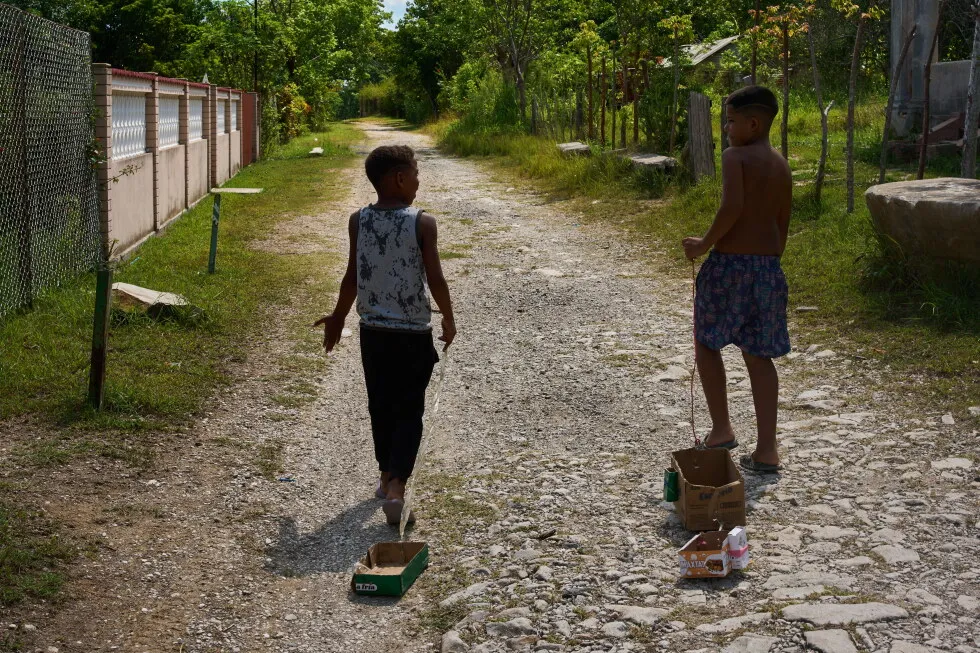
Children drag toys made from cardboard boxes as they walk in Minas, in Cuba’s Havana province, Monday, Aug. 31, 2026. (AP Photo/Ramon Espinosa) By DÁNICA COTO Updated 3:16 PM MESZ, September 1, 2026 Add AP News on Google Add AP News as your preferred source to see more of our stories on Google. Share Share Facebook Copy Link copied Print Email X LinkedIn Bluesky Flipboard Pinterest Reddit LAS MINAS, Cuba (AP) — The Barroso family rose at dawn and hitched a cart to a borrowed horse to take one of their daughters to school on Tuesday, the first day of classes for many students across Cuba. As the crises deepen on the island, thieves recently stole the family’s horse and killed it for food, so the Barrosos now rely on a borrowed animal for transportation, because school buses aren’t running. Fuel, teachers and uniforms remain scarce as the new school year begins. More than 10,000 schools are expected to open their doors on Tuesday, welcoming an estimated 1.4 million children and more than 135,000 teachers. The island’s education minister acknowledged ongoing challenges, calling the reopening of schools a “heroic act” for an island whose free and universal education system was long considered a crowning achievement of the 1959 revolution. But the island’s multiple crises forced the government to end the previous school year in June — one month early. Conditions have only worsened as the island’s power, water and fuel shortages persist amid an ongoing U.S. oil embargo and longtime sanctions. “This academic year has been the most disastrous one,” said Leanete Barroso, mother of two daughters. A widespread lack of professors prompted the government to send more than 3,000 teachers from Cuba’s eastern provinces to schools in Havana as teacher coverage fell to 73% across the island. The vacancies are blamed on low salaries and emigration. Education Minister Naima Trujillo Barreto implored Cubans to help fill the gaps, calling on university students, professionals and even retirees. Dominican Republic’s expulsion of Cuban officials sparks geopolitical tension 2 MIN READ Cuba says US sanctions are blocking its efforts to open the economy to private investment 5 MIN READ As blackouts stretch for days, life in Cuba revolves around small bursts of electricity 5 MIN READ “Everyone is invited — anyone who has something to contribute,” she said at a recent news conference. “You might be at home, perhaps retired, and eager to meet a group of children who need lessons in the very subject you know better than anyone else.” Meanwhile, parents and those in the private sector are expected to help provide school meals, with some schools only reporting a 15-day supply of food, according to state media. School uniforms also were largely unavailable as the new school year began, meeting only 12% of demand at the primary level. “No workshop can operate without electricity. Without fuel, we cannot transport fabric from one part of the country to another,” Trujillo Barreto said. “Without money or the ability to import, no fabric comes in either.” She said that students would be allowed to wear “comfortable clothing” but are still required to tie on their traditional red and blue kerchiefs. The day before classes started, Yurima Izaguirre struggled to pull up last year’s school uniform on the youngest of her three children. She grimaced when she saw that her 7-year-old daughter had nearly outgrown the burgundy skirt. “You’re going to suffocate after a while in the classroom,” Izaguirre said. No new uniforms were available for her two daughters, but she was able to find two shorts for her son. A surge in the cost of goods in Cuba meant Izaguirre didn’t have enough money to buy new shoes for her children. For the first time ever, she had to buy school supplies for the three of them. The government was unable to provide them. Izaguirre worries the most about having to feed her children lunch every day during the school week, another first for parents. Izaguirre planned to prepare what she and her husband, who works as a lifeguard, could afford: pasta, tuna and mayonnaise: “It has to last.” Before classes started, Izaguirre told her children that they needed to pack their small, rechargeable fans — each labeled with their name — so they won’t swelter inside the classroom, with temperatures hovering above 90 F (32 C). Like many Cubans, they’re often hit with daily outages lasting more than 20 hours — so they recharge the fans at the home of a kind neighbor. The longer-than-usual vacation before classes also hit the family hard. Usually, they would visit the beach, a park or the zoo, but with no transportation available given a lack of fuel, Izaguirre said that she would organize picnics beneath a tree near their home. Her children give her emotional strength, but daily life in Cuba has hit Izaguirre hard: “In my head, I think of doing 1,000 things, but I have to keep going for their sake.”
SRCAssociated Press (AP)
LANGEN
LEANCenter
WORDS829
ENT12
TUE · 2026-09-01 · 13:23 GMTBRIEF NSR-2026-0901-108109
NSR-2026-0901-108109News Report·EN·Human Interest
Schools reopen across Cuba as fuel, water and power shortages persist
Cuban schools reopened on Tuesday, September 1, 2026, amidst persistent shortages of fuel, water, and electricity. Families are struggling with transportation, with school buses not running and some resorting to borrowed horses.
Associated Press (AP)Filed 2026-09-01 · 13:23 GMTLean · CenterRead · 4 min
Associated Press (AP)FIG 01
Reading time
4min
Word count
829words
Sources cited
2cited
Entities identified
12entities
Quality score
100%
§ 01
Briefing Summary
AI-generatedNEWSAR · AI
Cuban schools reopened on Tuesday, September 1, 2026, amidst persistent shortages of fuel, water, and electricity. Families are struggling with transportation, with school buses not running and some resorting to borrowed horses. Teachers are scarce, with coverage at 73% across the island due to low salaries and emigration, prompting the government to call for volunteers. School uniforms are also in short supply, meeting only 12% of primary-level demand. Parents are expected to provide school meals, as some schools have only a 15-day food supply. These challenges highlight the deepening crises on the island, exacerbated by U.S. sanctions.
Confidence 0.90Sources 2Claims 5Entities 12
§ 02
Article analysis
Model · rule-basedFraming
Human Interest
Economic Impact
Tone
Measured
AI-assessed
CalmNeutralAlarmist
Factuality
0.70 / 1.00
Factual
LowHigh
Sources cited
2
Limited
FewMany
§ 03
Key claims
5 extracted01
Schools across Cuba are reopening despite persistent shortages of fuel, water, and power.
factual
Confidence
1.00
02
More than 10,000 schools are expected to open, serving an estimated 1.4 million children and 135,000 teachers.
statistic
Confidence
0.95
03
School uniforms are meeting only 12% of demand at the primary level.
statistic
Confidence
0.90
04
Teacher coverage has fallen to 73% across the island, with 3,000 teachers relocated to Havana from eastern provinces.
statistic
Confidence
0.90
05
The Barroso family used a borrowed horse to take their daughter to school because their own horse was stolen and killed for food, and school buses are not running.
quoteBarroso family
Confidence
0.90
§ 04
Full report
4 min read · 829 words§ 05
Entities
12 identifiedKey playerOppositionContextPositiveNeutralNegative
Organizations1
Locations4
§ 06
Keywords & salience
10 termscuba
1.00
school reopening
1.00
shortages
0.90
fuel shortage
0.80
water shortages
0.70
education system
0.70
power shortages
0.70
teacher shortage
0.60
economic crisis
0.50
us sanctions
0.40
§ 07
Topic connections
Interactive graph Network visualization showing 51 related topics
View Full Graph Person Organization Location Event|Click node to navigate|Edge numbers = shared articles