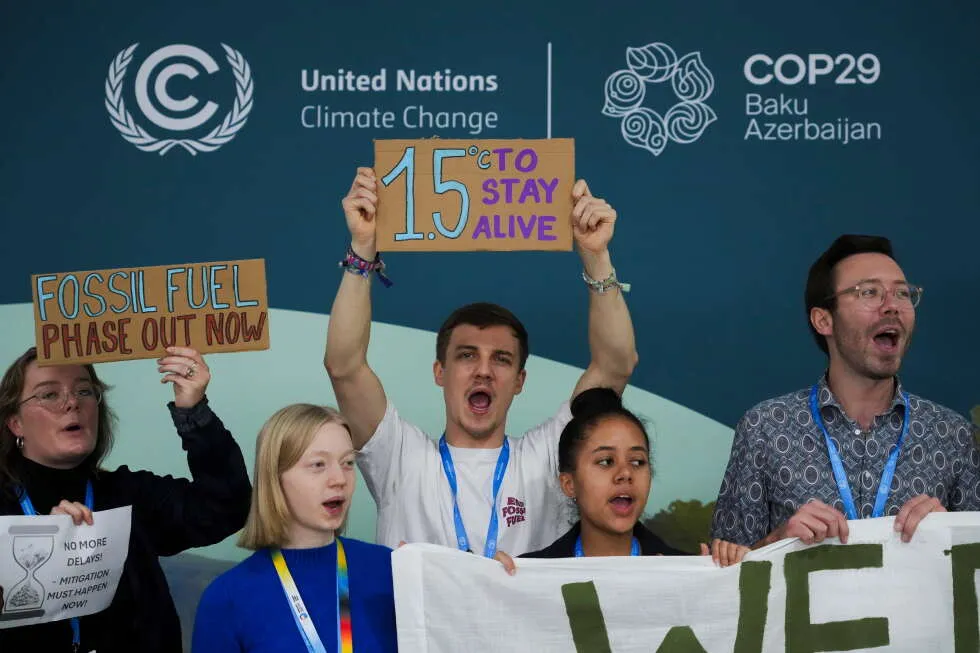
global warming will exceed limit, UN says in a report that maps path to get back below danger zone 1 of 6 | In a strategic retreat, the United Nations concedes that Earth has lost its chance to prevent some of the worst impacts of global warming. A report by the United Nations Environment Programme reveals that the planet will soon exceed the temperature threshold set by the 2015 Paris climate accord. (Production by Teresa de Miguel) 2 of 6 | Activists participate in a demonstration for phasing out fossil fuels at the UN-climate-summit" class="entity-link entity-event" data-entity-id="198363" data-entity-type="event">COP29 U.N. Climate Summit, Nov. 19, 2024, in Baku, Azerbaijan. (AP Photo/Sergei Grits, File) 3 of 6 | People salvage their belongings from a building damaged by flash flooding in Nuwakot district of Nepal, Tuesday, Sept. 1, 2026. (AP Photo/Rajesh Kumar Singh) 4 of 6 | A woman cools herself off with an ice pack during a heat wave in Banda, northern Indian state of Uttar Pradesh, June 21, 2026. (AP Photo/Rajesh Kumar Singh, File) 5 of 6 | Firefighters watch as a wildfire called the Plaskett Fire burns towards Highway 1 on Friday, Aug. 28, 2026, in Big Sur, Calif. (AP Photo/Ethan Swope) 6 of 6 | Usually submerged areas of the Danube River are exposed amid exceptionally low water levels, in Rasova, Romania, Monday, Aug. 3 2026. (AP Photo/ Vadim Ghirda) 1 of 6 In a strategic retreat, the United Nations concedes that Earth has lost its chance to prevent some of the worst impacts of global warming. A report by the United Nations Environment Programme reveals that the planet will soon exceed the temperature threshold set by the 2015 Paris climate accord. (Production by Teresa de Miguel) Add AP News on Google Add AP News as your preferred source to see more of our stories on Google. Share 2 of 6 | Activists participate in a demonstration for phasing out fossil fuels at the UN-climate-summit" class="entity-link entity-event" data-entity-id="198363" data-entity-type="event">COP29 U.N. Climate Summit, Nov. 19, 2024, in Baku, Azerbaijan. (AP Photo/Sergei Grits, File) 2 of 6 Activists participate in a demonstration for phasing out fossil fuels at the UN-climate-summit" class="entity-link entity-event" data-entity-id="198363" data-entity-type="event">COP29 U.N. Climate Summit, Nov. 19, 2024, in Baku, Azerbaijan. (AP Photo/Sergei Grits, File) Add AP News on Google Add AP News as your preferred source to see more of our stories on Google. Share 3 of 6 | People salvage their belongings from a building damaged by flash flooding in Nuwakot district of Nepal, Tuesday, Sept. 1, 2026. (AP Photo/Rajesh Kumar Singh) 3 of 6 People salvage their belongings from a building damaged by flash flooding in Nuwakot district of Nepal, Tuesday, Sept. 1, 2026. (AP Photo/Rajesh Kumar Singh) Add AP News on Google Add AP News as your preferred source to see more of our stories on Google. Share 4 of 6 | A woman cools herself off with an ice pack during a heat wave in Banda, northern Indian state of Uttar Pradesh, June 21, 2026. (AP Photo/Rajesh Kumar Singh, File) 4 of 6 A woman cools herself off with an ice pack during a heat wave in Banda, northern Indian state of Uttar Pradesh, June 21, 2026. (AP Photo/Rajesh Kumar Singh, File) Add AP News on Google Add AP News as your preferred source to see more of our stories on Google. Share 5 of 6 | Firefighters watch as a wildfire called the Plaskett Fire burns towards Highway 1 on Friday, Aug. 28, 2026, in Big Sur, Calif. (AP Photo/Ethan Swope) 5 of 6 Firefighters watch as a wildfire called the Plaskett Fire burns towards Highway 1 on Friday, Aug. 28, 2026, in Big Sur, Calif. (AP Photo/Ethan Swope) Add AP News on Google Add AP News as your preferred source to see more of our stories on Google. Share 6 of 6 | Usually submerged areas of the Danube River are exposed amid exceptionally low water levels, in Rasova, Romania, Monday, Aug. 3 2026. (AP Photo/ Vadim Ghirda) 6 of 6 Usually submerged areas of the Danube River are exposed amid exceptionally low water levels, in Rasova, Romania, Monday, Aug. 3 2026. (AP Photo/ Vadim Ghirda) Add AP News on Google Add AP News as your preferred source to see more of our stories on Google. Share Updated [hour]:[minute] [AMPM] [timezone], [monthFull] [day], [year] In a strategic retreat in the fight against climate change, the United Nations has acknowledged that Earth has lost its chance to prevent some of the worst of global warming’s harms. So now the world must figure out how to get temperatures below the danger zone and back to safety, officials say.Earth is soon going to exceed the safe temperature threshold agreed upon by the world in the 2015 Paris climate accord because of warming from the burning of coal, oil and gas, according to a bleak first-of-its-kind report issued by the United Nations Environment Programme Wednesday. Instead of giving up, scientists and U.N. officials recommend trying to limit excessive warming and then bring the temperature back down to the agreed-upon threshold. But it still will mean decades of increased weather-related disasters, rising seas, extinctions and melting ice and glaciers. “Humanity is speeding past the limit to avoid climate catastrophe,” United Nations Secretary-General António Guterres said.After a period of over-the-limit warming, the new strategy envisions getting back below the limit by ending fossil fuel use and developing some kind of way to suck industries’ carbon dioxide out of the air.“It’s a reality check. We have to live with this warmer world,” said report co-author Richard Betts, a climate scientist at the University of Exeter. “But there’s still a lot we can do to limit warming.” 4 MIN READ 2 MIN READ 4 MIN READ Passing the longtime warming thresholdAfter the Paris climate accord, the United Nations ordered its climate science arm to study different warming limits. A goal of 1.5 Celsius (2.7 Fahrenheit) above mid-19th century temperatures became generally accepted after the scientists found dramatic impacts that affect people and the planet at 2 degrees Celsius (3.8 degrees Fahrenheit) but not at 1.5 degrees. The world is now at 1.4 C (2.5 F) above pre-industrial levels, some scientists have calculated. The measure is based on a 20-year average, rather than a single year’s temperatures. Despite experts saying there’s no way to limit warming to 1.5 degrees, U.N. officials long maintained the 1.5 window was still open. Wednesday’s report finally admitted that the world will cross the 1.5 threshold “in the next few years.” The report said the most optimistic scenario has warming peaking at 1.8 C (3.2 F) around mid-century if countries pursue ambitious climate goals, but that governments’ current policies should push temperatures to 2.6 C (4.7 F) above pre-industrial levels by 2100.So instead of preventing warming of 1.5 degrees, now the U.N. said it wants policymakers to “prepare for and navigate a future’’ in which the globe crosses that limit and then corrects course and cools temperatures. The report envisions that global temperatures will pass 1.5 “within the next few years,” follow a hump-shaped path of more warming, peak, then gradually cool to below the 1.5 mark, ideally by the end of the century. The report and experts call it “overshoot.”“Let’s be very clear, 1.5 target is still the goal. But now we need to approach it differently from above,” said UNEP Executive Director Inger Andersen.The 1.5 limit is not “some magical climate cliff” where it’s just game over, said University of Victoria climate scientist Andrew Weaver, who wasn’t part of the study. “Every tenth of a degree we avoid still means less damage.” Limiting how high temperatures go past threshold is keyIt’s most important to first limit the new peak temperature and then reduce the amount of time above 1.5 degrees, Andersen said. But the world likely will be in that overshoot period for “many, many decades,” Betts said.Every five years of delay in reducing emissions adds at least a tenth of a degree to peak warming, said report co-author Joeri Rogelj, a climate scientist at Imperial College London.“If we act now we can limit overshoot,” the report said. “Not a safe world, but safer than remaining above” 1.5 degrees for the long term.“This is among the bleakest U.N. climate reports I have read. It carries the unmistakable tone of desperation, frustration and urgency — but not resignation,” Weaver said.Climate scientist Bill Hare, CEO of Climate Analytics, said that “although UNEP does a good job of describing the hole we’ve dug ourselves into, it does a poor job of showing us that there’s a way out.” Adapting to a deadlier, hungrier, thirstier worldGovernments need to increase efforts to adapt to worsening warming, which hits the poor hardest, “because some impacts simply cannot be avoided,” Andersen said. The report calls this phase “coping and containment.”During this overshoot period, more people will die or get sick because of the worsening climate change and its extreme weather, the report said. Food production will drop, people will go hungry, water shortages will worsen, economies will be hurt and species like coral will go extinct, the report said. Although the triggers behind the recent deadly Nepal flooding that came as part of a Himalayan glacier dislodging are complex, Betts said “unfortunately we do expect to see more of such things and this is exactly why we need to limit peak warming.”The report warns of “tipping points” with irreversible and cascading effects, including the loss of the West Antarctic and Greenland ice sheets, the loss of the Amazon rain forest and the shutdown of the Atlantic Ocean circulation system that keeps much of Europe warm. “Some locations might become more or less uninsurable or even uninhabitable,” the report said.The last phase in overshoot is cooling the planet by removing carbon dioxide from the air and storing it somewhere. The report said the traditional approach of this is planting more trees, but it says planting trees could, at most, shave a tenth of a degree off global temperatures. So the authors said more novel carbon removal approaches will be needed. Other scientists called that unreliable and expensive.“We were unable to stop the runaway train of global emissions to avoid 1.5 C of warming,” said Stanford University climate scientist Rob Jackson, who wasn’t part of the report. “Now overshoot scenarios require us to stop the train quickly and to back it up. Is it our best hope? Absolutely. Is it likely? Absolutely not.”___The Associated Press’ climate and environmental coverage receives financial support from multiple private foundations. AP is solely responsible for all content. Find AP’s standards for working with philanthropies, a list of supporters and funded coverage areas at AP.org. Borenstein is an Associated Press science writer, covering climate change, disasters, physics and other science topics. He is based in Washington, D.C.
SRCAssociated Press (AP)
LANGEN
LEANCenter
WORDS1 786
ENT12
WED · 2026-09-02 · 04:23 GMTBRIEF NSR-2026-0902-108350
NSR-2026-0902-108350News Report·EN·Environmental
Global warming will exceed limit, UN says in a report that maps path to get back below danger zone
A United Nations Environment Programme report acknowledges that the Earth will soon exceed the 1.5 degrees Celsius warming limit set by the 2015 Paris climate accord due to fossil fuel emissions. Instead of preventing this, the new strategy focuses on limiting the peak temperature and then working to bring global temperatures back below the threshold.
By
SETH BORENSTEINAssociated Press (AP)Filed 2026-09-02 · 04:23 GMTLean · CenterRead · 8 min
Associated Press (AP)FIG 01
Reading time
8min
Word count
1 786words
Sources cited
1cited
Entities identified
12entities
Quality score
100%
§ 01
Briefing Summary
AI-generatedNEWSAR · AI
A United Nations Environment Programme report acknowledges that the Earth will soon exceed the 1.5 degrees Celsius warming limit set by the 2015 Paris climate accord due to fossil fuel emissions. Instead of preventing this, the new strategy focuses on limiting the peak temperature and then working to bring global temperatures back below the threshold. This "overshoot" period will still result in decades of increased weather disasters, rising seas, and extinctions. The report, described as a "reality check," emphasizes the need to adapt to a warmer world while also developing methods to remove carbon dioxide from the atmosphere. Current government policies are projected to lead to 2.6 degrees Celsius warming by 2100, but ambitious goals could limit the peak to 1.8 degrees.
Confidence 0.90Sources 1Claims 4Entities 12
§ 02
Article analysis
Model · rule-basedFraming
Environmental
Public Health
Tone
Mixed Tone
AI-assessed
CalmNeutralAlarmist
Factuality
0.70 / 1.00
Factual
LowHigh
Sources cited
1
Limited
FewMany
§ 03
Key claims
4 extracted01
Activists participated in a demonstration for phasing out fossil fuels at the COP29 U.N. Climate Summit.
factual
Confidence
1.00
02
A report by the United Nations Environment Programme reveals that the planet will soon exceed the temperature threshold.
factualUnited Nations Environment Programme
Confidence
0.95
03
Global warming will exceed the temperature threshold set by the 2015 Paris climate accord.
predictionUnited Nations Environment Programme
Confidence
0.90
04
The planet has lost its chance to prevent some of the worst impacts of global warming.
factualUnited Nations
Confidence
0.80
§ 04
Full report
8 min read · 1 786 words§ 05
Entities
12 identifiedKey playerOppositionContextPositiveNeutralNegative
Organizations2
Locations7
§ 06
Keywords & salience
9 termsglobal warming
1.00
climate accord
0.90
united nations
0.80
temperature threshold
0.70
fossil fuels
0.60
climate summit
0.50
flash flooding
0.40
heat wave
0.40
wildfire
0.40
§ 07
Topic connections
Interactive graph Network visualization showing 8 related topics
View Full Graph Person Organization Location Event|Click node to navigate|Edge numbers = shared articles