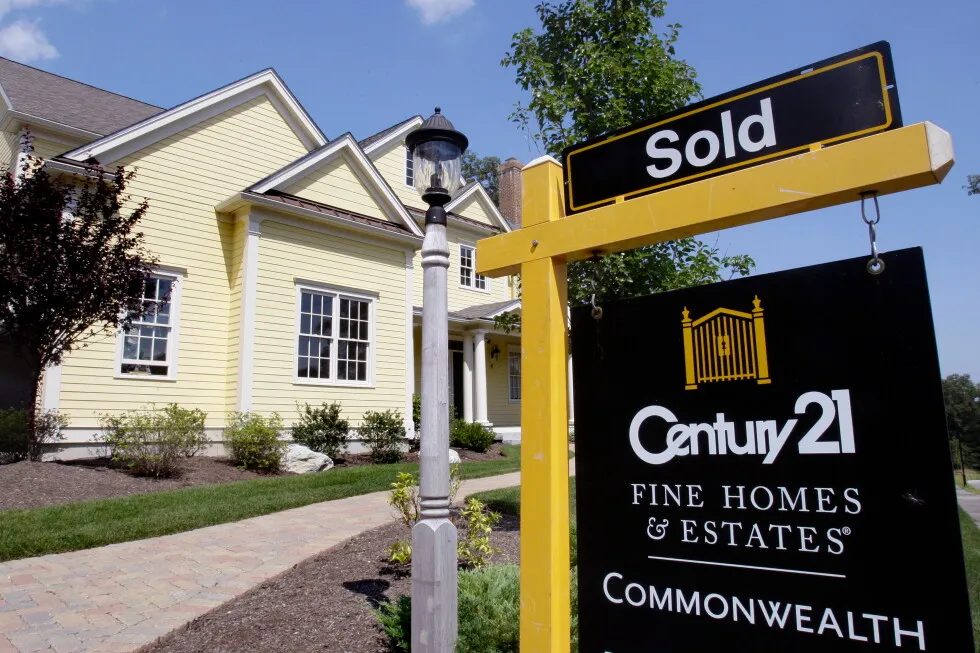
AI boom heats up Bay Area housing market as wealthy buyers drive demand for high-end homes across US 1 of 2 | A sold sign is posted outside a newly constructed luxury home in Wellesley, Mass., Aug. 25, 2009. (AP Photo/Charles Krupa, File) 2 of 2 | Luxury homes are under construction in a subdivision, May 22, 2007 in New Albany, Ohio. (AP Photo/Kiichiro Sato, File) By ALEX VEIGA Updated 2:40 PM MESZ, September 2, 2026 Add AP News on Google Add AP News as your preferred source to see more of our stories on Google. Share Share Facebook Copy Link copied Print Email X LinkedIn Bluesky Flipboard Pinterest Reddit LOS ANGELES (AP) — Here’s another place the AI frenzy is making itself felt: the market for luxury homes. High-income earners, many of them employees at AI companies, are snapping up multimillion-dollar houses in the San Francisco Bay Area, undaunted by the higher mortgage rates and rising home prices that have prevented many would-be buyers from affording a home. The Bay Area buying spree is the clearest manifestation of a nationwide trend of sales of upper-end properties largely holding up better than sales of less expensive homes. Metro areas such as San Diego, Miami, Detroit, Nashville and Tampa, Florida, are also seeing upper-market homes sell at a faster pace. The hotter market for luxury properties comes at a time when the broader housing market remains stuck in a yearslong rut. Sales of previously occupied U.S. homes were essentially flat last year, moored at a 30-year low. Most recently, they slowed again in July. Sales of newly built homes, which make up a far smaller part of the housing market, are also down this year. Underpinning the luxury market are affluent home shoppers who can afford to shrug off rising mortgage rates and often pay all cash for a home or come up with a large down payment by raising funds through sales of stocks or other investments. Stock market gains powered by the Artificial Intelligence boom have helped boost investors’ portfolios. The benchmark S&P 500 is up solidly this year and remains near its most recent all-time high. US existing homes fall 1.7% in July as record prices, high mortgage rates stifle would be-buyers 3 MIN READ Strong AI chip demand fuels Nvidia’s Q2 results well beyond Wall Street’s expectations 3 MIN READ 124 Apple’s new CEO, John Ternus, takes over from Tim Cook after 15 years 3 MIN READ 124 “These people have lots of money and they’re just not going to be very sensitive to things like mortgage rates or home prices,” said Daryl Fairweather, chief economist at Redfin. “They want the home they want and they have the money to buy it.” The trend is the housing market version of the “K-shaped” economy, where wealthier households pull ahead of middle- and lower-income ones. In this case, many would-be homebuyers remain on the sideline while affluent buyers drive sales of luxury homes. Nationally, sales of luxury homes, defined as properties in the top 5% of a metro area by price, rose 2% in the first half of this year, compared to the same period in 2025, according to data from Redfin. Sales of middle-of-the-market homes, or properties closest to an area’s median price, rose 1.9% in the same period. The dichotomy in the market can better be seen in price appreciation. The median sales price of a luxury home nationally between January and June was roughly $1.37 million, a 4.3% increase from a year earlier. For homes in the middle of the market, the median sales price rose 1.4% to $377,245. In the San Francisco metro area, sales of luxury homes soared 39.3% in the first half of this year compared to a year earlier, while middle-market home sales surged 15.1%. And across the bay in Oakland, sales of upper-market homes jumped 13.3%, while sales of middle-market properties rose 3.9%. Several other metro areas not plugged into the AI boom are also seeing sales and price growth for luxury homes. Among the most notable examples: in the Tampa metro area, luxury home sales surged 35.5% in the January-June period, while sales of middle-market homes fell 5.1%. In Nashville, sales of upper-market homes jumped 10.8%, while sales of middle-market properties rose only 1.7%. And in Detroit, sales of higher-end properties vaulted 8.7% compared to a 6% decline in sales of middle-market homes. All told, sales of luxury homes so far this year are outpacing or have declined less than those of middle-market homes in 44% of the nation’s 50 largest metro areas. In the Bay Area, tech companies bent on winning the race to develop Artificial Intelligence into a profitable business have juiced compensation to recruit talented executives and software engineers, widening the pool of high-income earners. Many of these employees have been buying homes, often outdoing rival buyers by offering well above the asking price, real estate agents say. The Bay Area housing market could get even hotter should two of the biggest names in AI follow through on their intent to become publicly traded companies. OpenAI, creator of ChatGPT, and Anthropic, home to Claude, filed preliminary paperwork in June for initial public offerings. Neither has yet decided on the timing. An analysis by Redfin that looked at how much employees at both companies stand to gain potentially from the companies going public estimated that the combined IPO earnings would be enough to buy nearly one-third of all homes in San Francisco. Just the possibility of these two blockbuster IPOs is building pressure on some home shoppers in the Bay Area to buy sooner, rather than later. They worry they’ll face a flood of newly minted millionaires ready to pounce, further ratcheting up competition in the San Francisco housing market. Julio Bermudez, an AI data infrastructure company executive in the Bay Area, had been looking to buy his first home for about a year, but his search took on new urgency. Recently, Bermudez entered into a contract to buy a five-bedroom, four-bath house in Orinda, about 17 miles northeast of San Francisco. The seller was asking $3.5 million, but agreed to sell for $3.3 million. “I felt like this was sort of an interesting time and location to try to strike before it really does get crazy,” he said.
SRCAssociated Press (AP)
LANGEN
LEANCenter
WORDS1 051
ENT12
WED · 2026-09-02 · 12:53 GMTBRIEF NSR-2026-0902-108477
NSR-2026-0902-108477News Report·EN·Economic Impact
AI boom heats up Bay Area housing market as wealthy buyers drive demand for high-end homes across US
The artificial intelligence boom is significantly impacting the U.S. luxury housing market, particularly in the San Francisco Bay Area.
Associated Press (AP)Filed 2026-09-02 · 12:53 GMTLean · CenterRead · 5 min
Associated Press (AP)FIG 01
Reading time
5min
Word count
1 051words
Sources cited
1cited
Entities identified
12entities
Quality score
100%
§ 01
Briefing Summary
AI-generatedNEWSAR · AI
The artificial intelligence boom is significantly impacting the U.S. luxury housing market, particularly in the San Francisco Bay Area. High-income earners, many employed by AI companies, are purchasing multimillion-dollar homes despite rising prices and mortgage rates, a trend observed nationwide in upper-end properties. This surge in demand for luxury homes contrasts with a stagnant broader housing market. Affluent buyers, often able to pay cash or leverage stock market gains from the AI boom, are less sensitive to market conditions. This phenomenon reflects a "K-shaped" economy, where wealthier households outpace others. In the Bay Area, the potential for upcoming AI company IPOs is further intensifying urgency among some buyers to purchase homes before prices escalate further.
Confidence 0.90Sources 1Claims 5Entities 12
§ 02
Article analysis
Model · rule-basedFraming
Economic Impact
Technology
Tone
Measured
AI-assessed
CalmNeutralAlarmist
Factuality
0.70 / 1.00
Factual
LowHigh
Sources cited
1
Limited
FewMany
§ 03
Key claims
5 extracted01
The trend reflects a 'K-shaped' economy where wealthier households are pulling ahead of middle and lower-income ones.
quoteDaryl Fairweather
Confidence
0.90
02
Affluent buyers can often pay cash or make large down payments, making them less sensitive to mortgage rates and home prices.
factual
Confidence
0.90
03
High-income earners, many employed by AI companies, are purchasing multimillion-dollar homes in the Bay Area.
factual
Confidence
0.90
04
The AI boom is contributing to a heated luxury housing market in the Bay Area and across the US.
factual
Confidence
0.90
05
Sales of upper-end properties are performing better than sales of less expensive homes nationwide.
factual
Confidence
0.80
§ 04
Full report
5 min read · 1 051 words§ 05
Entities
12 identifiedKey playerOppositionContextPositiveNeutralNegative
Locations6
§ 06
Keywords & salience
9 termsluxury homes
1.00
ai boom
1.00
housing market
0.90
bay area
0.80
wealthy buyers
0.80
high-end homes
0.70
mortgage rates
0.60
artificial intelligence
0.50
stock market
0.50
§ 07
Topic connections
Interactive graph Network visualization showing 51 related topics
View Full Graph Person Organization Location Event|Click node to navigate|Edge numbers = shared articles