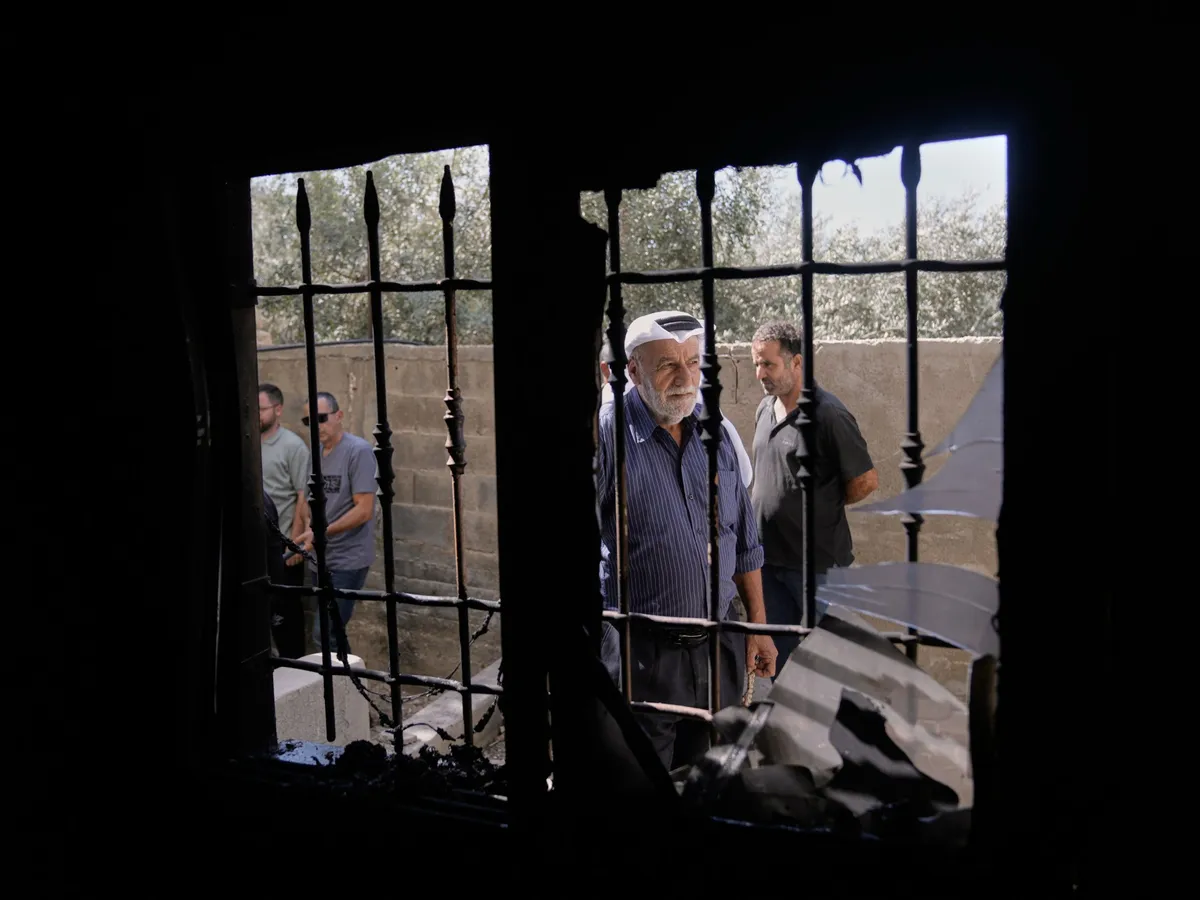
Palestinian witnesses recount the coordinated Israeli army and settler attacks on mosques in the occupied West Bank.Palestinians check damage to a mosque that, according to residents, was set alight during a pogrom by Israeli settlers, in the West Bank village of Bazariya, on Tuesday, September 1, 2026 [Majdi Mohammed/AP]Published On 2 Sep 2026Naim Ahmed Faraj, along with dozens of worshippers, was standing for the evening (Isha) prayers, when Israeli forces threw tear gas canisters inside their mosque in Madama village near Nablus. Faraj, 66, who suffers from joint and heart ailments, collapsed due to suffocation.Faraj’s son, Mohammed Naim, says his father fell semiconscious and his condition deteriorated after inhaling tear gas. The 66-year-old regained consciousness gradually after he was rushed home inside a car as there were no ambulances available, according to Naim.“The mosque is supposed to be a safe haven where people can pray without being attacked. But lately – and for a long time now – the mosque has become a source of anxiety,” Naim told Al Jazeera, adding that worshippers now fear while going to mosques for prayers amid escalating violence in the occupied West Bank.A suffocating islandThe Madama attack is part of a sharply rising wave of Israeli settler and military pogroms across the occupied territory, which Palestinian sources say are emboldened by extremist government ministers like Itamar Ben-Gvir and Bezalel Smotrich.Naim described these raids as daily occurrences, deliberately timed during prayer hours to maximise panic. He noted that soldiers and settlers regularly collaborate to “terrorise” the local population.“Our village has become like an island surrounded from all sides by settlements, the bypass road, and the army, and we do not have any outlet or area we can go to,” Naim said, pointing out the expansion of illegal settlements in the occupied West Bank and East Jerusalem, which cut through Palestinian towns and villages.More than 750,000 settlers live in illegal settlements throughout the occupied Palestinian territory, and their numbers continue to rise as top Israeli leaders, including Prime Minister Benjamin Netanyahu, publicly oppose the establishment of a sovereign Palestinian state.The anti-Palestinian rhetoric and physical attacks have particularly exploded in recent weeks as Israeli politicians campaign for next month’s general elections. Last week, far-right Israeli Knesset member Zvi Sukkot stormed Madama village and smashed a Palestinian memorial with a sledgehammer.Arson and racismHours after the attack in Madama, Israeli settlers launched a separate violent raid on the Imad al-Din Zanki mosque in the nearby town of Bazariya in the occupied West Bank.Attackers poured flammable liquids onto the ground floor of the building and ignited it.Taysir Safarini, the former head of the Bazariya village council, recounted the frantic response.“Neighbours woke up, of course, to the burning flames, and informed the civil defence crews in Anabta, and tried to extinguish the fire themselves to stop [it] from spreading,” Safarini told Al Jazeera.The settlers also sprayed Hebrew graffiti on the walls, including threats to kill Arabs and a mocking message directed at the United States ambassador to Israel reading: “Huckabee, greetings from the terrorists.”Mike Huckabee, a staunch ally of Israel who has voiced support for Israeli settlements in the occupied West Bank, recently called the settlers “terrorists“.Following the attacks, the office of Palestinian President Mahmoud Abbas warned that such violations risk triggering a catastrophic religious war.Religious targetingThe Palestinian Ministry of Religious Affairs condemned the continued pogroms, describing the targeting of mosques as a flagrant violation of international law.The ministry documented that at least 13 mosques have been vandalised or burned by Israeli settlers and forces since the start of the year.This targeting extends far beyond rural villages; in a detailed August report, the ministry recorded 26 incursions into the Al-Aqsa Mosque compound and 155 instances in which the call to prayer was banned at the Ibrahimi Mosque in Hebron.The human toll of these pogroms is high.According to the United Nations, at least 76 Palestinians, including 18 children, have been killed in the territory this year, and some 3,800 people have been displaced.The UN recorded more than 1,450 settler attacks resulting in roughly 1,040 injuries, while the Colonization and Wall Resistance Commission estimates the total number of attacks exceeds 6,000.For Palestinian residents, the relentless violence has shattered any semblance of safety, forcing families to make choices about their basic movements.“For example, I do not allow my son to go to the mosque or anywhere else out of fear for him, and I keep him at home and tell him do not go out in these times due to the daily incursions,” Naim told Al Jazeera.
SRCAl Jazeera
LANGEN
LEANCenter
WORDS753
ENT12
WED · 2026-09-02 · 14:14 GMTBRIEF NSR-2026-0902-108529
NSR-2026-0902-108529News Report·EN·Human Rights
Palestinians in fear as Israeli forces mount pogroms on West Bank mosques
Palestinian witnesses report coordinated attacks by Israeli forces and settlers on mosques in the occupied West Bank. Incidents include tear gas being thrown into a mosque during evening prayers in Madama, causing a worshipper to collapse, and settlers setting fire to a mosque in Bazariya, spraying Hebrew graffiti on its walls.
Mohammad MansourAl JazeeraFiled 2026-09-02 · 14:14 GMTLean · CenterRead · 4 min
Al JazeeraFIG 01
Reading time
4min
Word count
753words
Sources cited
3cited
Entities identified
12entities
Quality score
100%
§ 01
Briefing Summary
AI-generatedNEWSAR · AI
Palestinian witnesses report coordinated attacks by Israeli forces and settlers on mosques in the occupied West Bank. Incidents include tear gas being thrown into a mosque during evening prayers in Madama, causing a worshipper to collapse, and settlers setting fire to a mosque in Bazariya, spraying Hebrew graffiti on its walls. These attacks, described as daily occurrences, are reportedly timed to maximize panic and are seen by Palestinians as emboldened by extremist Israeli government ministers. The Palestinian Ministry of Religious Affairs has documented at least 13 mosques vandalized or burned by Israeli settlers and forces this year, alongside numerous incursions into the Al-Aqsa Mosque compound and bans on the call to prayer at the Ibrahimi Mosque. These actions have led to fear among Palestinians, impacting their ability to practice their faith safely.
Confidence 0.90Sources 3Claims 5Entities 12
§ 02
Article analysis
Model · rule-basedFraming
Human Rights
Conflict
Tone
Sensational
AI-assessed
CalmNeutralAlarmist
Factuality
0.60 / 1.00
Mixed
LowHigh
Sources cited
3
Well sourced
FewMany
§ 03
Key claims
5 extracted01
Palestinians fear going to mosques due to escalating violence and attacks by Israeli forces and settlers.
quoteNaim Ahmed Faraj
Confidence
0.95
02
Far-right Israeli Knesset member Zvi Sukkot smashed a Palestinian memorial with a sledgehammer in Madama village.
factualArticle
Confidence
0.90
03
Israeli forces threw tear gas canisters inside a mosque in Madama village near Nablus during evening prayers.
factualPalestinian witnesses
Confidence
0.90
04
Israeli settlers launched a violent raid on the Imad al-Din Zanki mosque in Bazariya and set it on fire.
factualPalestinian sources
Confidence
0.85
05
More than 750,000 settlers live in illegal settlements throughout the occupied Palestinian territory.
statisticArticle
Confidence
0.80
§ 04
Full report
4 min read · 753 words§ 05
Entities
12 identifiedKey playerOppositionContextPositiveNeutralNegative
People4
§ 06
Keywords & salience
10 termsisraeli settler attacks
1.00
west bank mosques
1.00
occupied palestinian territory
0.90
pogroms
0.90
escalating violence
0.80
illegal settlements
0.70
israeli forces
0.60
extremist government ministers
0.50
anti-palestinian rhetoric
0.50
election campaign
0.40
§ 07
Topic connections
Interactive graph Network visualization showing 51 related topics
View Full Graph Person Organization Location Event|Click node to navigate|Edge numbers = shared articles