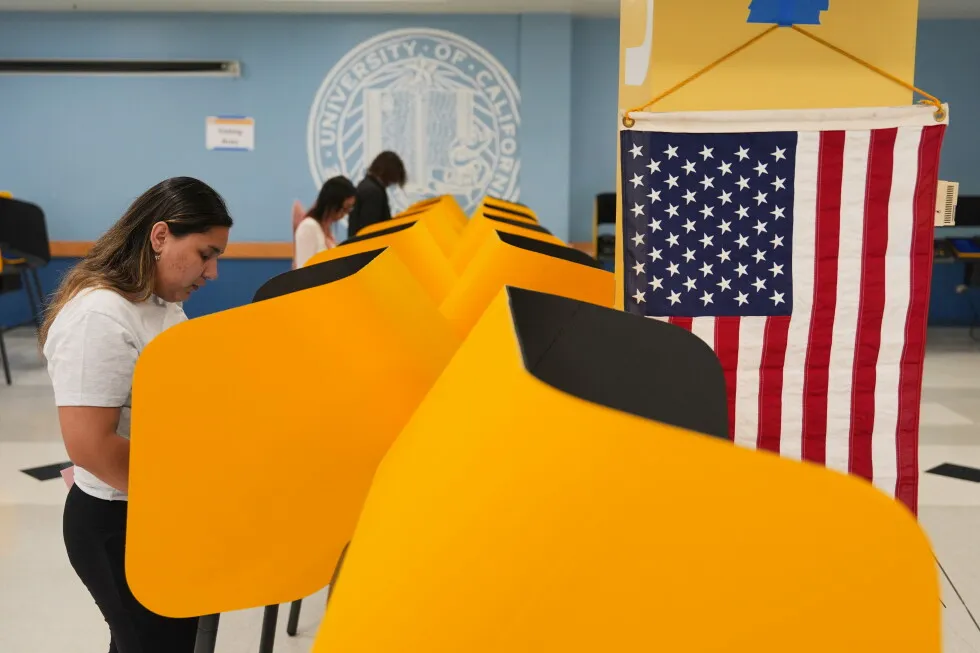
Immigrant rights group seeks to block use of federal databases it says could purge legal voters 1 of 3 | Voters cast their ballots at a voting center on the UCLA campus, June 2, 2026, in Los Angeles. (AP Photo/Jae C. Hong, File) 2 of 3 | Pranav Kadiyala votes at Ocean Plant during the California primary election Tuesday, June 2, 2026, in San Francisco. (AP Photo/Jeff Chiu,File) 3 of 3 | California gubernatorial candidate, Xavier Becerra, D-CA talks with reporters after appearing at a town hall meeting in Sacramento, Calif., Monday, May 11, 2026. (AP Photo/Rich Pedroncelli,File) By MICHAEL R. BLOOD Updated 12:17 AM MESZ, September 3, 2026 Add AP News on Google Add AP News as your preferred source to see more of our stories on Google. Share Share Facebook Copy Link copied Print Email X LinkedIn Bluesky Flipboard Pinterest Reddit Los Angeles (AP) — An immigrant rights group sued the Trump administration Wednesday to block the U.S. Department of Homeland Security from using federal databases that it alleged are being used to target naturalized citizens who are eligible to vote. The lawsuit, filed in U.S. District Court in Washington on behalf of the Coalition for Humane Immigrant Rights, alleges that DHS and the U.S. Justice Department are interfering with fair elections by using inaccurate federal databases in an attempt to buttress allegations of voter fraud. The federal government is engaging in an “attack on the freedom to vote,” Angelica Salas, the coalition’s executive director, said at a downtown Los Angeles news conference. “This is voter intimidation.” The lawsuit — filed on behalf of the coalition by the UCLA Voting Rights Project — becomes part of a swirl of legal moves that states, including California, have taken to fend off federal actions that threaten to create confusion during the midterms. “It’s not an accident the federal government is trying to interfere with the right to vote. ... They believe they can intimidate naturalized U.S. citizens,” said Xavier Becerra, the Democratic nominee for California governor who is acting as a senior adviser to the voting project. Part of a broader effort to search for noncitizens on voter rolls The lawsuit alleges that the administration might be comparing voter rolls with undisclosed government databases. Those systems can include outdated information and be riddled with errors, it said, and could produce inaccurate results that disproportionately affect naturalized voters. “Comparing government databases to try and arrive at a list of noncitizen registrants has been shown to result in erroneous data,” the lawsuit said. “Congress has never authorized such activities and in fact has ... prohibited invasion of voter privacy through government data matches in this way.” Noncitizen voting claims animate Trump’s attacks on midterms and set up potential result challenges 3 MIN READ 323 Republican nominee for Maine governor says he wants ICE agents at polling places in the state 5 MIN READ 1195 Judge again bars Trump administration from implementing order that sought to limit mail voting 5 MIN READ 1195 The Trump administration has been targeting noncitizen voting to allege it could be a source of significant fraud during the midterm elections, even though actual voting by people who are not citizens is rare. He is pushing for the U.S. Postal Service to send mail ballots only to voters verified as U.S. citizens, and his Justice Department has sued to force the release of detailed voter data in 30 states and the District of Columbia, though it has not yet succeeded in those cases. Asked to respond to the lawsuit, a DHS spokesperson said in an email: “The department accessed publicly available data from states’ voter rolls and cross referenced them with known illegal aliens in our systems. It’s not rocket science; it’s an easy step to secure our elections.” “DHS is laser focused on prosecuting and removing aliens who vote and preventing the dilution of the votes of U.S. citizens,” the statement added. Judge had previously halted use of a federal citizenship database In June, a federal judge ruled that a recently revamped version of a federal tool can no longer be used, which critics had referred to as an unlawful centralized federal database of voter information. U.S. District Court Judge Sparkle L. Sooknanan sided with advocacy groups that argued the recent upgrades to the program, called Systematic Alien Verification for Entitlements, or SAVE, aggregated Americans’ sensitive personal data in a way that could result in voters being wrongly purged from voter rolls. The lawsuit said it isn’t clear if the administration used that system to generate projections about noncitizens on voting rolls in the states or if other unknown datasets were involved. By May, the Trump administration had run millions of voter registrations through government databases to determine their eligibility, a process that critics feared could purge valid voters from the rolls before the November elections. At least 67 million registrations, primarily from Republican-controlled states, have gone through a beefed-up verification program, or SAVE, at the U.S. Department of Homeland Security, and tens of thousands of those have been flagged as potential noncitizens or people who have died. This site is protected by reCAPTCHA and the Google and Terms of Service apply. State officials push back against DHS noncitizen claims Specifically, the lawsuit by the immigrant rights group asks the court to stop the administration from pursuing a review of California’s voter list and to rescind the letter sent to the state requesting voter information. It also asks the court to declare the administration’s actions unconstitutional. Trump’s Department of Homeland Security is claiming without providing evidence that 250,000 noncitizens might be on the rolls in just four states, including 190,832 in California. California’s secretary of state, Democrat Shirley Weber, said in response, “I have serious doubts about the reliability of your data and accuracy of your claims, since my office has not shared our statewide voter registration list with DHS or any other federal agency or official.” According to the lawsuit, federal officials have not disclosed evidence supporting those figures. MICHAEL R. BLOOD Blood is a political writer for The AP. Over the years he has filed stories under datelines from Wasilla, Alaska, to Tel Aviv, but he has spent most of his career anchored in AP bureaus in Washington, D.C., New York City and - for the last two decades - Los Angeles. twitter mailto
SRCAssociated Press (AP)
LANGEN
LEANCenter
WORDS1 058
ENT12
THU · 2026-09-03 · 00:53 GMTBRIEF NSR-2026-0903-108655
NSR-2026-0903-108655News Report·EN·Social Justice
Immigrant rights group seeks to block use of federal databases it says could purge legal voters
An immigrant rights group, the Coalition for Humane Immigrant Rights, has sued the Trump administration to block the Department of Homeland Security (DHS) from using federal databases. The lawsuit, filed in U.S.
Associated Press (AP)Filed 2026-09-03 · 00:53 GMTLean · CenterRead · 5 min
Associated Press (AP)FIG 01
Reading time
5min
Word count
1 058words
Sources cited
3cited
Entities identified
12entities
Quality score
100%
§ 01
Briefing Summary
AI-generatedNEWSAR · AI
An immigrant rights group, the Coalition for Humane Immigrant Rights, has sued the Trump administration to block the Department of Homeland Security (DHS) from using federal databases. The lawsuit, filed in U.S. District Court in Washington, alleges that DHS and the Justice Department are interfering with fair elections by using inaccurate databases to target naturalized citizens and buttress claims of voter fraud. The group contends this practice constitutes voter intimidation and an attack on the freedom to vote. The lawsuit is part of broader efforts by states, including California, to counter federal actions that could confuse voters. DHS stated it cross-referenced publicly available voter rolls with known illegal aliens in their systems to secure elections. A previous ruling had halted the use of a federal citizenship database due to concerns about wrongly purging voters.
Confidence 0.90Sources 3Claims 5Entities 12
§ 02
Article analysis
Model · rule-basedFraming
Social Justice
Legal & Judicial
Tone
Mixed Tone
AI-assessed
CalmNeutralAlarmist
Factuality
0.60 / 1.00
Mixed
LowHigh
Sources cited
3
Well sourced
FewMany
§ 03
Key claims
5 extracted01
Xavier Becerra stated that the federal government is trying to interfere with the right to vote and intimidate naturalized U.S. citizens.
quoteXavier Becerra
Confidence
1.00
02
Angelica Salas stated that the federal government is engaging in an 'attack on the freedom to vote' and 'voter intimidation'.
quoteAngelica Salas
Confidence
1.00
03
An immigrant rights group sued the Trump administration to block the use of federal databases.
factualAP News
Confidence
1.00
04
The lawsuit claims that comparing government databases to find noncitizen registrants has resulted in erroneous data and could disproportionately affect naturalized voters.
factualCoalition for Humane Immigrant Rights
Confidence
0.90
05
The lawsuit alleges that DHS and DOJ are interfering with fair elections by using inaccurate federal databases to target naturalized citizens.
factualCoalition for Humane Immigrant Rights
Confidence
0.90
§ 04
Full report
5 min read · 1 058 words§ 05
Entities
12 identifiedKey playerOppositionContextPositiveNeutralNegative
Organizations5
Locations4
§ 06
Keywords & salience
10 termsvoter purge
1.00
immigrant rights
0.90
federal databases
0.80
naturalized citizens
0.70
voting rights
0.70
voter intimidation
0.60
voter fraud allegations
0.60
election interference
0.50
department of homeland security
0.50
ucla voting rights project
0.40
§ 07
Topic connections
Interactive graph No topic relationship data available yet. This graph will appear once topic relationships have been computed.