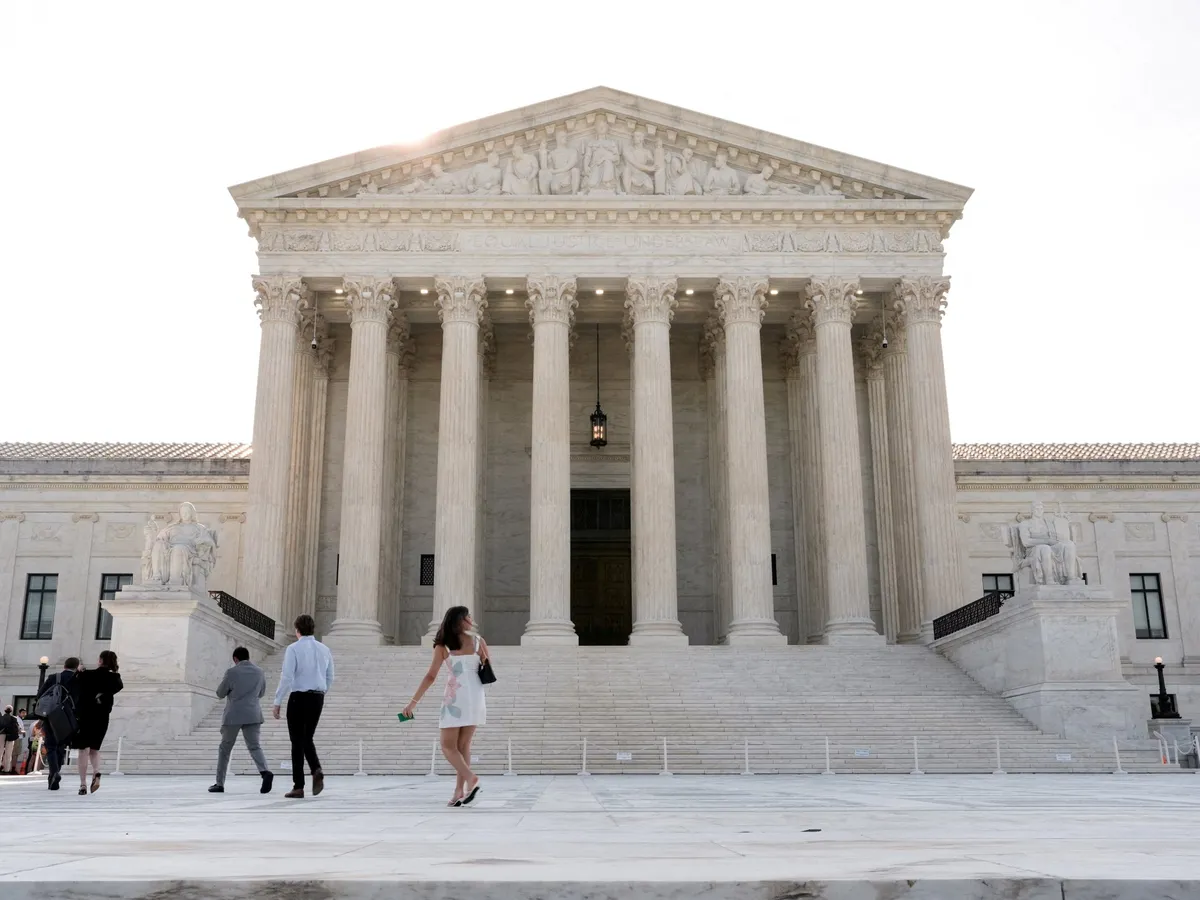
Republican Mike Johnson slams Democrats for voting against ‘defending the integrity’ of the court.The United States Supreme Court is currently composed of nine justices [File: Cheney Orr/Reuters]Published On 3 Sep 2026A proposed amendment to the United States Constitution has fallen short, after Republicans attempted to cap the number of seats on the nation’s Supreme Court.On Wednesday, the House of Representatives failed to advance a joint resolution championed by Republicans that would have permanently limited the court to its current number of justices: nine.Recommended Stories list of 3 itemslist 1 of 3US Supreme Court allows Trump’s ballroom project to continue for nowlist 2 of 3US Supreme Court sides with Trump administration on mail votinglist 3 of 3White House construction on $400m ballroom can go on, says US Supreme Courtend of listThe amendment’s final vote, which was mostly along party lines, was 212 in favour and 206 opposed.A simple majority is needed to pass most legislation in the House, but constitutional amendments require two-thirds support.Representative Don Davis of North Carolina was the only Democrat to vote in support of the amendment, while independent Representative Kevin Kiley of California, who caucuses with Republicans, voted against it.The vote comes a day after the House voted 220 to 192 in favour of adopting a resolution condemning socialism. Eight Democrats joined with Republicans to advance the measure.US House Speaker Mike Johnson on Wednesday took to social media to chide Democrats who voted against the two bills.“For members of Congress who swore an oath to support and defend the Constitution, condemning socialism and defending the integrity of the Supreme Court shouldn’t be a controversial vote,” Johnson wrote on X. “Sadly, for today’s Democrats, they are.”Both efforts effectively amount to messaging exercises by Republicans, who are attempting to put their Democratic counterparts on the record as not denouncing socialism and any Supreme Court expansion.The manoeuvres come less than two months before November’s pivotal midterm elections, which will decide which party controls the chambers of Congress.Some Democrats have called to add justices to the nation’s highest court to counter its conservative supermajority. The process, known among its opponents as “court packing”, is controversial.But support for the idea gained momentum after US President Donald Trump appointed three justices to the bench in his first term. That conservative-led court has since handed him a string of legal victories.In April 2021, four Democrats in the US Congress introduced a bill that would have created a Supreme Court with 13 justices.They claimed it “would restore balance to the nation’s highest court after four years of norm-breaking actions by Republicans”.The US Constitution establishes the Supreme Court but does not limit – or specify – its size, leaving the matter entirely to the nation’s lawmakers.In 1789, the Judiciary Act established six justices: a chief justice and five associates. The court changed in size several times over the next century. The current number of seats was set in 1869 and has been subject to debate since.The most famous attempt to change the court’s composition was under former President Franklin D Roosevelt.After winning the 1936 election, Roosevelt proposed expanding the court, which would have added one justice for each justice over the age of 70, with a maximum of six additional justices.Since then, advocacy groups, including the Brennan Center for Justice, have proposed structural changes to the court, such as term limits and ethics codes, while some Democratic lawmakers have unsuccessfully called for a Roosevelt-like expansion.The issue has reemerged in the midterm election season. In an interview with NBC News last month, Democratic Senator Jim Clyburn of South Carolina embraced the idea.“I think that we are in a position now that calls for some significant actions taken by the Congress, and we ought to expand,” Clyburn said.“Thirteen is a pretty good number. A baker’s dozen would be a good number to have on the court. I would hope that we would get people on the court who will follow the constitutional underpinnings of this great nation of ours.”Former Vice President Kamala Harris, the 2024 Democratic presidential nominee, also suggested that Democrats should have a “real conversation” about “expanding the court to 13 justices”.But Republicans, including Senator Chuck Grassley of Iowa, have remained staunchly opposed.“We must safeguard the independence of the federal judiciary to protect our constitutional freedoms and way of life for generations to come,” Grassley said in a statement in June, citing Harris’s statements.
SRCAl Jazeera
LANGEN
LEANCenter
WORDS728
ENT11
THU · 2026-09-03 · 01:06 GMTBRIEF NSR-2026-0903-108664
NSR-2026-0903-108664News Report·EN·Political Strategy
US Congress rejects constitutional amendment to restrict Supreme Court size
The U.S. House of Representatives failed to advance a Republican-led constitutional amendment that would have permanently capped the Supreme Court at nine justices.
Evan SemonesAl JazeeraFiled 2026-09-03 · 01:06 GMTLean · CenterRead · 3 min
Al JazeeraFIG 01
Reading time
3min
Word count
728words
Sources cited
2cited
Entities identified
11entities
Quality score
100%
§ 01
Briefing Summary
AI-generatedNEWSAR · AI
The U.S. House of Representatives failed to advance a Republican-led constitutional amendment that would have permanently capped the Supreme Court at nine justices. The resolution, requiring a two-thirds majority for constitutional amendments, received 212 votes in favor and 206 against, falling short of the necessary threshold. House Speaker Mike Johnson criticized Democrats for voting against the measure, which he framed as defending the court's integrity. This vote occurs as Democrats, citing the court's conservative supermajority, have proposed expanding the court's size, a concept referred to as "court packing." The Constitution does not specify the court's size, which has been set at nine since 1869.
Confidence 0.90Sources 2Claims 5Entities 11
§ 02
Article analysis
Model · rule-basedFraming
Political Strategy
Legal & Judicial
Tone
Measured
AI-assessed
CalmNeutralAlarmist
Factuality
0.70 / 1.00
Factual
LowHigh
Sources cited
2
Limited
FewMany
§ 03
Key claims
5 extracted01
The US Constitution does not specify the size of the Supreme Court, leaving it to lawmakers.
factual
Confidence
1.00
02
Some Democrats have proposed adding justices to the Supreme Court to counter its conservative majority, a move opponents call 'court packing'.
factual
Confidence
1.00
03
Speaker Mike Johnson criticized Democrats for voting against the amendment, stating it was about 'defending the integrity of the Supreme Court'.
quoteMike Johnson
Confidence
1.00
04
The amendment vote was 212 in favor and 206 opposed, falling short of the two-thirds majority required for constitutional amendments.
factual
Confidence
1.00
05
A proposed constitutional amendment to cap the Supreme Court at nine justices failed in the House of Representatives.
factual
Confidence
1.00
§ 04
Full report
3 min read · 728 words§ 05
Entities
11 identifiedKey playerOppositionContextPositiveNeutralNegative
People4
Organizations4
Locations1
§ 06
Keywords & salience
10 termssupreme court size
1.00
constitutional amendment
0.90
court packing
0.80
us congress
0.70
republican
0.60
democrat
0.60
house of representatives
0.50
mike johnson
0.50
socialism
0.40
midterm elections
0.40
§ 07
Topic connections
Interactive graph Network visualization showing 51 related topics
View Full Graph Person Organization Location Event|Click node to navigate|Edge numbers = shared articles