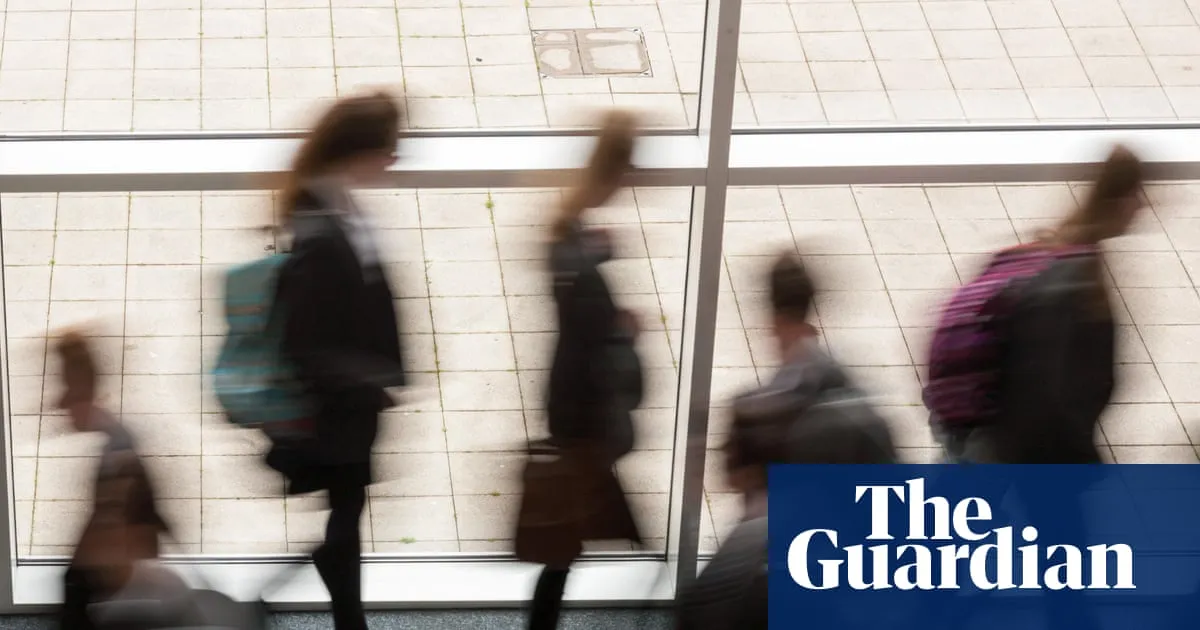
The proportion of secondary school students in England removed from class and placed in “internal exclusion” as a disciplinary measure has almost trebled in three years, according to new data.The data shows the proportion of secondary pupils removed from normal lessons went up from 5% in the 2022/2023 academic year to 13% in 2025/26 – a 160% increase.Poorer children are disproportionately affected, with more than one in five (22%) disadvantaged youngsters taken out of lessons at least once in 2025/26, up from 8% three years ago – a 175% increase, according to analysis of the data. The figure was one in ten (10%) for non-disadvantaged pupils.Children with special educational needs and disabilities (Send) are also overrepresented, with 18% of students with an education, health and care plan removed from class at least once in 2025/26.Critics say that putting pupils into internal exclusion – which varies between schools but is sometimes described as an “isolation room” – can damage mental wellbeing and result in lost learning. Others say it is an effective tool in behaviour management.The data was collected and analysed by Arbor, a management information system used by 13,000 schools across England, and shared exclusively with The Guardian.Fewer than 1% of primary pupils were internally excluded at least once in a year. In 2025/6 the number of under-11s affected was almost 5,000, though the real figure is likely to be significantly higher, as Arbor does not have data for every school.Unlike permanent exclusions and fixed term suspensions, when pupils are sent home, internal exclusions require children to remain on site and they are returned to their class at the end of the exclusion. While the government collects data on exclusions and suspensions, it does not for internal exclusions.Arbor’s CEO and co-founder, James Weatherill, said: “Schools clearly need effective ways to respond when behaviour disrupts learning, and we know from schools that internal exclusion can be an important alternative to sending a pupil home. But the scale of this increase, particularly among disadvantaged pupils, should prompt us to look more closely at what is driving it.”The rise in internal exclusions, as recorded by Arbor’s live national data, comes at a time when official figures published by the Department for Education (DfE) showed formal suspensions and exclusions fell last year.“We cannot tell from these figures whether one is replacing the other, but the divergence underlines why government needs a more complete picture of how many pupils are being removed from their normal lessons, for how long, and with what consequences,” said Weatherill.Pepe Di’Iasio, general secretary of the Association of School and College Leaders, said: “Internal exclusions are never used lightly but only after other avenues have been exhausted. They are a step short of an external exclusion and are designed to keep the student in school with appropriate learning support.”Lily Wielar, researcher at the Education Policy Institute, said: “Classroom removal has become a deeply embedded feature of behaviour management in England’s secondary schools.“We urgently need to know more about how classroom removal is being used, and to ensure that removed pupils have the same legal protections and transparency that apply elsewhere.”Tom Bennett, a leading expert in behaviour management, said: “Internal exclusions are, of course, a form of inclusion. A way to show students who disrupt the learning or safety of others that their actions have consequences, but in a way that means they aren’t simply sitting at home doing nothing, or worse, exposed to unsupportive environments.“It means that learning can be delivered on site, and in an environment where staff ratios are higher, work can be done on their social skills and behaviour, but away from the students whose learning and safety has been damaged – because they matter too.”Dame Rachel de Souza, children’s commissioner for England, said: “Excluding a child from the classroom can be necessary to protect other children, but every child should be supported to learn alongside their peers. Where that isn’t possible, children should still be receiving a high-quality education as part of internal exclusion – and I’m concerned that might not always be the case.”The DfE has been contacted for comment.
SRCThe Guardian - World News
LANGEN
LEANCenter-Left
WORDS684
ENT8
THU · 2026-09-03 · 04:00 GMTBRIEF NSR-2026-0903-108729
NSR-2026-0903-108729News Report·EN·Social Justice
‘Internal exclusion’ of England secondary school students almost triples in three years
New data reveals that the use of "internal exclusion" in English secondary schools has nearly tripled between the 2022/23 and 2025/26 academic years, with the proportion of students removed from class rising from 5% to 13%. This disciplinary measure, where students remain on school grounds but are separated from regular lessons, disproportionately affects disadvantaged pupils and those with special educational needs and disabilities (Send).
Sally Weale Education correspondentThe Guardian - World NewsFiled 2026-09-03 · 04:00 GMTLean · Center-LeftRead · 3 min
The Guardian - World NewsFIG 01
Reading time
3min
Word count
684words
Sources cited
3cited
Entities identified
8entities
Quality score
100%
§ 01
Briefing Summary
AI-generatedNEWSAR · AI
New data reveals that the use of "internal exclusion" in English secondary schools has nearly tripled between the 2022/23 and 2025/26 academic years, with the proportion of students removed from class rising from 5% to 13%. This disciplinary measure, where students remain on school grounds but are separated from regular lessons, disproportionately affects disadvantaged pupils and those with special educational needs and disabilities (Send). Over one in five disadvantaged students were internally excluded in 2025/26, a significant increase from three years prior. While some view internal exclusion as an effective behavior management tool, critics express concerns about its impact on student wellbeing and learning. The data was collected and analyzed by Arbor, a school management information system, and highlights a divergence from official figures showing a decrease in formal suspensions and exclusions.
Confidence 0.90Sources 3Claims 5Entities 8
§ 02
Article analysis
Model · rule-basedFraming
Social Justice
Human Interest
Tone
Mixed Tone
AI-assessed
CalmNeutralAlarmist
Factuality
0.80 / 1.00
Factual
LowHigh
Sources cited
3
Well sourced
FewMany
§ 03
Key claims
5 extracted01
The government does not collect data on internal exclusions, unlike permanent exclusions and fixed term suspensions.
factualArticle
Confidence
1.00
02
Children with special educational needs and disabilities (Send) are also overrepresented, with 18% removed from class at least once in 2025/26.
statisticArbor
Confidence
1.00
03
Disadvantaged pupils are disproportionately affected by internal exclusions, with 22% affected in 2025/26, up from 8% three years prior.
statisticArbor
Confidence
1.00
04
The proportion of secondary school students in England removed from class for internal exclusion has almost trebled in three years.
statisticArbor
Confidence
1.00
05
Internal exclusions vary between schools but are sometimes described as an 'isolation room' and can damage mental wellbeing and result in lost learning.
quoteCritics
Confidence
0.90
§ 04
Full report
3 min read · 684 words§ 05
Entities
8 identifiedKey playerOppositionContextPositiveNeutralNegative
Organizations3
Locations1
§ 06
Keywords & salience
10 termsinternal exclusion
1.00
secondary school students
0.90
disadvantaged pupils
0.80
behaviour management
0.70
special educational needs
0.60
mental wellbeing
0.50
lost learning
0.50
arbor
0.40
england
0.40
school data
0.40
§ 07
Topic connections
Interactive graph Network visualization showing 51 related topics
View Full Graph Person Organization Location Event|Click node to navigate|Edge numbers = shared articles