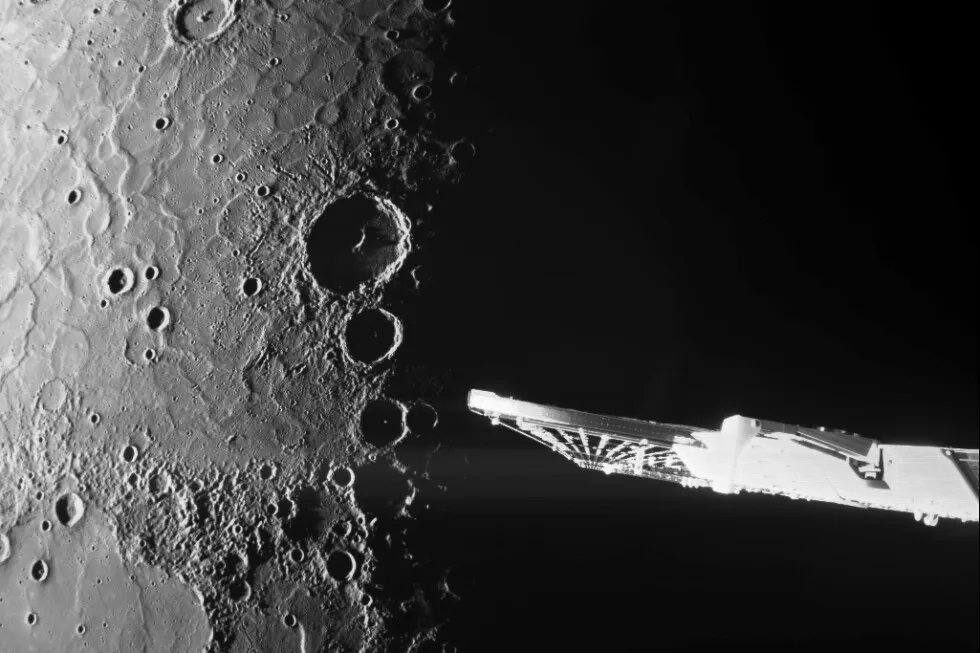
A pair of spacecraft draw closer to Mercury after nearly decade-long voyage 1 of 2 | This undated image provided by the European Space Agency shows close-up photos of Mercury’s north pole captured by the European-Japanese spacecraft BepiColombo. (ESA via AP, File) 2 of 2 | This composite image provided by NASA/Johns Hopkins University Applied Physics Laboratory/Carnegie Institution of Washington on Oct. 22, 2013, shows Mercury as it appeared to the Messenger spacecraft following a flyby of the planet. (NASA/Johns Hopkins University Applied Physics Laboratory/Carnegie Institution of Washington via AP) 1 of 2 | This undated image provided by the European Space Agency shows close-up photos of Mercury’s north pole captured by the European-Japanese spacecraft BepiColombo. (ESA via AP, File) 1 of 2 This undated image provided by the European Space Agency shows close-up photos of Mercury’s north pole captured by the European-Japanese spacecraft BepiColombo. (ESA via AP, File) Add AP News on Google Add AP News as your preferred source to see more of our stories on Google. Share 2 of 2 | This composite image provided by NASA/Johns Hopkins University Applied Physics Laboratory/Carnegie Institution of Washington on Oct. 22, 2013, shows Mercury as it appeared to the Messenger spacecraft following a flyby of the planet. (NASA/Johns Hopkins University Applied Physics Laboratory/Carnegie Institution of Washington via AP) 2 of 2 This composite image provided by NASA/Johns Hopkins University Applied Physics Laboratory/Carnegie Institution of Washington on Oct. 22, 2013, shows Mercury as it appeared to the Messenger spacecraft following a flyby of the planet. (NASA/Johns Hopkins University Applied Physics Laboratory/Carnegie Institution of Washington via AP) Add AP News on Google Add AP News as your preferred source to see more of our stories on Google. Share Updated [hour]:[minute] [AMPM] [timezone], [monthFull] [day], [year] Cape Canaveral, Fla. (AP) — Two Mercury-bound spacecraft left their mother ship behind on Thursday and headed down the home stretch of their nearly decade-long voyage to the solar system’s smallest and closest-to-the-sun planet.The linked European and Japanese spacecraft separated as planned from their cruiser, but controllers had to wait two anxious hours to receive confirmation via radio signals. The crucial operation was broadcast from the European Space Agency’s control center in Germany, more than 124 million miles (200 million kilometers) away.“It’s a brilliant moment,” said lead project scientist Geraint Jones.If all goes well, the conjoined spacecraft known as BepiColombo will enter orbit around Mercury in November and split from each other in December to map and study the entire planet from different altitudes. As of Thursday, the spacecraft still had 2 million miles (3.3 million kilometers) to go before reaching its destination. Launched in 2018, the BepiColombo mission is named for the Italian mathematician who took part in NASA’s Mariner 10 mission to Mercury in the 1970s. Only one other spacecraft, NASA’s Messenger, has explored the puzzling, scorching planet that is just a little bigger than our moon.“How tiny Mercury is and still it holds some of the biggest mysteries of our solar system,” mission manager Santa Martinez said earlier this week. 2 MIN READ 4 MIN READ 5 MIN READ Added Jones: “There’s a huge amount still left to be learned.” BepiColombo already has traveled more than 6 billion miles (10 billion kilometers) on its roundabout route, according to Martinez. It needed nine planetary flybys to reduce its energy enough to be caught in Mercury’s orbit. The last flyby, in January 2025, yielded stunning photos of Mercury’s impact craters and volcanic plains.Beginning next spring, a slew of science instruments on the European and Japanese spacecraft will study the magnetic field that envelops Mercury, the planet’s dense interior, and the geologic processes at the surface, including the hollows, or depressions, that scientists believe are being eaten away by minerals vaporizing from rocks.It’s a strange world of contrasts. On a planet where the temperature can top 800 degrees Fahrenheit (427 degrees Celsius), the poles are frigid with deep, permanently shadowed craters packed with ice. Given Mercury’s proximity to the sun, engineers had to design the spacecraft to withstand “extremely punishing” conditions, said the European Space Agency’s Ignacio Tanco, a mission operations chief. “It’s essentially equivalent to operating with a very hot pizza oven running right on your back,” he said.Science observations should begin next spring, with the European Space Agency covering most of the mission’s $2 billion (1.7 billion euros) cost.___The Associated Press’ health and science coverage receives financial support from the AP Fund for Journalism and private foundations. AP is solely responsible for all content. Find AP’s standards for working with philanthropies, a list of supporters and funded coverage areas at AP.org.
SRCAssociated Press (AP)
LANGEN
LEANCenter
WORDS766
ENT10
THU · 2026-09-03 · 14:53 GMTBRIEF NSR-2026-0903-108906
NSR-2026-0903-108906News Report·EN·Technology
A pair of spacecraft draw closer to Mercury after nearly decade-long voyage
The European-Japanese spacecraft BepiColombo has separated from its cruiser, marking the final approach to Mercury after a nearly decade-long journey. Launched in 2018, the mission is nearing its destination, with only 2 million miles remaining.
By
MARCIA DUNNAssociated Press (AP)Filed 2026-09-03 · 14:53 GMTLean · CenterRead · 4 min
Associated Press (AP)FIG 01
Reading time
4min
Word count
766words
Sources cited
1cited
Entities identified
10entities
Quality score
100%
§ 01
Briefing Summary
AI-generatedNEWSAR · AI
The European-Japanese spacecraft BepiColombo has separated from its cruiser, marking the final approach to Mercury after a nearly decade-long journey. Launched in 2018, the mission is nearing its destination, with only 2 million miles remaining. BepiColombo is scheduled to enter orbit around Mercury in November and then split into two modules in December to study the planet from different altitudes. This mission aims to uncover more about Mercury's mysteries, including its magnetic field, dense interior, and surface geology, despite the extreme conditions caused by its proximity to the sun. Science observations are expected to commence next spring.
Confidence 0.90Sources 1Claims 5Entities 10
§ 02
Article analysis
Model · rule-basedFraming
Technology
Human Interest
Tone
Measured
AI-assessed
CalmNeutralAlarmist
Factuality
0.90 / 1.00
Factual
LowHigh
Sources cited
1
Limited
FewMany
§ 03
Key claims
5 extracted01
The mission is named for the Italian mathematician Bepi Colombo.
factual
Confidence
1.00
02
As of Thursday, the spacecraft still had 2 million miles (3.3 million kilometers) to go before reaching its destination.
factual
Confidence
1.00
03
BepiColombo was launched in 2018.
factual
Confidence
1.00
04
Two Mercury-bound spacecraft separated from their mother ship on Thursday, continuing their nearly decade-long voyage.
factual
Confidence
1.00
05
The European-Japanese spacecraft BepiColombo is expected to enter orbit around Mercury in November.
prediction
Confidence
0.90
§ 04
Full report
4 min read · 766 words§ 05
Entities
10 identifiedKey playerOppositionContextPositiveNeutralNegative
Organizations7
§ 06
Keywords & salience
10 termsspacecraft
1.00
mercury
1.00
bepicolombo
0.90
voyage
0.80
european space agency
0.70
space exploration
0.60
solar system
0.60
messenger spacecraft
0.50
north pole
0.40
radio signals
0.40
§ 07
Topic connections
Interactive graph Network visualization showing 7 related topics
View Full Graph Person Organization Location Event|Click node to navigate|Edge numbers = shared articles