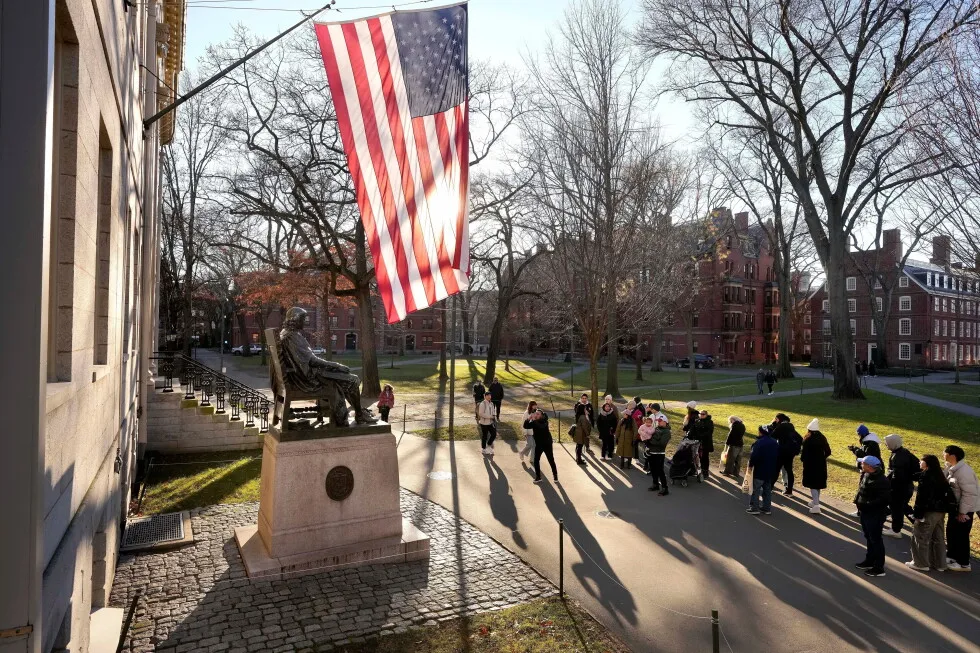
People take photos near a John Harvard statue, left, on the Harvard University campus, Jan. 2, 2024, in Cambridge, Mass. (AP Photo/Steven Senne, File) Updated [hour]:[minute] [AMPM] [timezone], [monthFull] [day], [year] WASHINGTON (AP) — The Trump administration is proposing a new rule that would strip private schools and colleges of their tax-exempt status if they provide targeted help to students based on their race, a significant escalation in the White House’s campaign to eradicate diversity programs directed at Black, Hispanic and other minority students.The Treasury Department proposed the change Thursday in a new regulation that, if made final, would kick in after May 2027. The rule is broadly aimed at ending any policies or programs that help students because of their race, and it specifically says such benefits in admissions, scholarships and facilities “would be incompatible” with the rule.It’s the latest attempt by the Trump administration to pressure schools and colleges to weed out diversity, equity and inclusion policies that had become common before President Donald Trump returned to the White House with a promise to end them. Trump officials have used Civil Rights-era laws to unwind the policies, saying they discriminate against white and Asian American students.Higher education leaders criticized the proposal. “The administration’s latest rules changes are its most blatant attack to keep working class Americans and people of color from accessing higher education and a better life,” Mike Gavin, Alliance for Higher Education president and CEO, said in a statement. “By claiming that efforts to increase fair opportunity for all students are discriminatory, the administration is trying to gaslight the American people into believing that up is down and black is white.” Thousands of colleges could be affected Scores of universities have shut down or rebranded their DEI offices and ended scholarships and clubs designed for minority students under pressure from the White House. In a statement announcing the proposal, Treasury Secretary Scott Bessent suggested that even policies that are no longer under the banner of DEI could be targeted. 5 MIN READ 3 MIN READ 5 MIN READ “Schools rebranding race-based preferences as equitable, inclusive, or diversity-enhancing does not change their discriminatory nature,” Bessent said. The Treasury Department and IRS estimate that up to 18,000 private schools, colleges and other education institutions could be affected by the proposal.America’s private universities have been exempt from many taxes for more than a century because they provide a public good. The benefit saves many universities millions of dollars every year.Trump has seen the tax-exempt status as a lever to pull in his pressure campaign against colleges that he describes as hotbeds of “wokeness.” He threatened to cut the benefit for Harvard University last year during his battle with the nation’s oldest college. In a response, Harvard officials said there was no legal basis for doing so and argued it would force cuts to financial aid and crucial medical research. In the 1970s, a college lost tax-exempt status over a ban on interracial datingIt’s incredibly rare for the federal government to go after a college’s tax-exempt status, but there’s one notable precedent. Bob Jones University, a small Christian school in South Carolina, lost the benefit in the 1970s over a ban on interracial dating and marriage on campus. The Supreme Court upheld the IRS’s decision to deny the school its exemption. The school has since ended the ban and regained tax-exempt status in 2017. Laws forbid the IRS from targeting individuals and organizations for ideological reasons, and federal officials are not allowed to direct IRS investigations.To maintain nonprofit status, which allows donations to be tax-deductible, organizations must follow IRS rules on lobbying, political campaign activity and annual reporting requirements, as well as other obligations.The Trump administration describes the new proposal as a move toward restoring merit in the nation’s education systems.Marjorie Hass, president of the Council of Independent Colleges, said the change would most likely impact donations, which are often earmarked for scholarships. The uncertainty around the proposal also will create challenges for schools, said Tim Powers, a vice president of the National Association of Independent Colleges and Universities. “Our institutions are committed to complying with applicable civil rights laws and maintaining safe and supportive campuses free from discrimination,” Powers said. “However, the proposed rule may create new compliance burdens and legal uncertainties for institutions of higher education that are already operating in line with existing nondiscrimination rules.” The Justice Department has separately opened investigations into several medical schools that it accuses of favoring Black and Hispanic students in admissions. Trump officials say any such favoritism violates Title IV of the Civil Rights Act of 1964, a federal law that forbids discrimination in education and was created to fight segregation and its impact.A statement from IRS Chief Executive Officer Frank J. Bisignano said private schools that promote discriminatory practices will no longer be exempt from taxes. “Today’s proposed regulations put institutions on notice and schools that continue to engage in racial discrimination should expect to lose that status,” he said.___Associated Press Education Writers Annie Ma and Heather Hollingsworth contributed to this report.___The Associated Press’ education coverage receives financial support from multiple private foundations. AP is solely responsible for all content. Find AP’s standards for working with philanthropies, a list of supporters and funded coverage areas at AP.org. Binkley covers the White House and education policy for The Associated Press. He is based in Washington and joined the AP in 2015.
SRCAssociated Press (AP)
LANGEN
LEANCenter
WORDS900
ENT12
THU · 2026-09-03 · 16:23 GMTBRIEF NSR-2026-0903-108931
NSR-2026-0903-108931News Report·EN·Political Strategy
Trump administration pushes to remove tax exemption for private colleges with DEI policies
The Trump administration is proposing a new rule to revoke the tax-exempt status of private schools and colleges that offer targeted assistance to students based on race. The Treasury Department announced this change, which would take effect after May 2027, aiming to eliminate diversity, equity, and inclusion (DEI) programs.
By
COLLIN BINKLEYAssociated Press (AP)Filed 2026-09-03 · 16:23 GMTLean · CenterRead · 4 min
Associated Press (AP)FIG 01
Reading time
4min
Word count
900words
Sources cited
2cited
Entities identified
12entities
Quality score
100%
§ 01
Briefing Summary
AI-generatedNEWSAR · AI
The Trump administration is proposing a new rule to revoke the tax-exempt status of private schools and colleges that offer targeted assistance to students based on race. The Treasury Department announced this change, which would take effect after May 2027, aiming to eliminate diversity, equity, and inclusion (DEI) programs. Officials argue these policies discriminate against white and Asian American students, citing Civil Rights-era laws. This proposal could impact up to 18,000 educational institutions. The administration views this as a step to restore merit in education. Critics argue the move will hinder access to higher education for working-class individuals and people of color.
Confidence 0.90Sources 2Claims 5Entities 12
§ 02
Article analysis
Model · rule-basedFraming
Political Strategy
Social Justice
Tone
Mixed Tone
AI-assessed
CalmNeutralAlarmist
Factuality
0.70 / 1.00
Factual
LowHigh
Sources cited
2
Limited
FewMany
§ 03
Key claims
5 extracted01
Higher education leaders criticize the proposal as an attack to keep working class Americans and people of color from accessing higher education.
quoteMike Gavin, Alliance for Higher Education president and CEO
Confidence
1.00
02
The proposed rule would affect policies and programs in admissions, scholarships, and facilities that benefit students based on race.
factualTreasury Department
Confidence
1.00
03
The Trump administration is proposing a new rule to strip private schools of tax-exempt status if they provide targeted help based on race.
factualTreasury Department
Confidence
1.00
04
Up to 18,000 private schools, colleges, and education institutions could be affected by the proposal.
statisticTreasury Department and IRS
Confidence
0.90
05
Scores of universities have shut down or rebranded DEI offices and ended minority scholarships under White House pressure.
factualnull
Confidence
0.80
§ 04
Full report
4 min read · 900 words§ 05
Entities
12 identifiedKey playerOppositionContextPositiveNeutralNegative
People3
Organizations5
§ 06
Keywords & salience
10 termstax exemption
1.00
dei policies
1.00
private colleges
0.90
trump administration
0.80
diversity programs
0.80
higher education
0.70
race-based preferences
0.60
treasury department
0.60
civil rights-era laws
0.50
discriminatory nature
0.40
§ 07
Topic connections
Interactive graph Network visualization showing 4 related topics
View Full Graph Person Organization Location Event|Click node to navigate|Edge numbers = shared articles