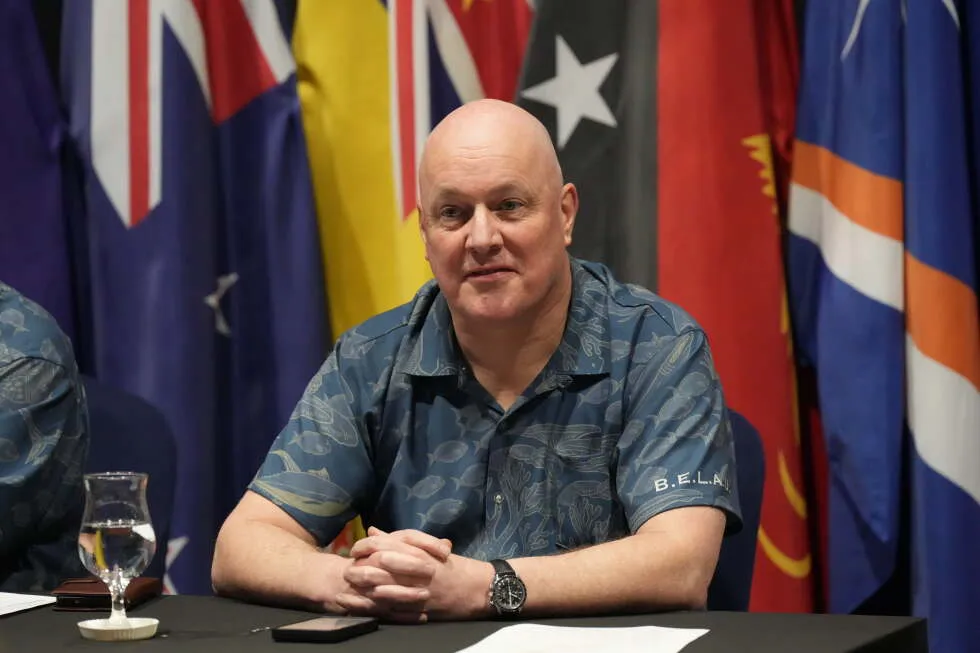
Pacific leaders at summit fail to reach unanimous condemnation of China’s ballistic missile launch 1 of 5 | New Zealand Prime Minister Christopher Luxon attends a news conference at the Pacific Islands Forum Leaders Meeting in Koror, Palau, Thursday, Sept. 3, 2026. (AP Photo/Charlotte Graham-McLay) 2 of 5 | Solomon Islands Foreign Minister Rick Houenipwela reacts during a news conference at the Pacific Islands Forum Leaders Meeting in Koror, Palau, Thursday, Sept. 3, 2026. (AP Photo/Charlotte Graham-McLay) 3 of 5 | From left, Pacific Islands Forum Secretary-General Baron Waqa, Palau President Surangel Whipps Jr., Solomon Islands Foreign Minister Rick Houenipwela and New Zealand Prime Minister Christopher Luxon speak during a news conference at the Pacific Islands Forum Leaders Meeting in Koror, Palau, Thursday, Sept. 3, 2026. (AP Photo/Charlotte Graham-McLay) 4 of 5 | President of the Federated States of Micronesia Wesley Simina, right, reacts ahead of a closing ceremony at the Pacific Islands Forum Leaders Meeting in Koror, Palau, Thursday, Sept. 3, 2026. (AP Photo/Charlotte Graham-McLay) 5 of 5 | Flags of Pacific Island nations are displayed ahead of a news conference by leaders at the Pacific Islands Forum Leaders Meeting in Koror, Palau, Thursday, Sept. 3, 2026. (AP Photo/Charlotte Graham-McLay) 1 of 5 | New Zealand Prime Minister Christopher Luxon attends a news conference at the Pacific Islands Forum Leaders Meeting in Koror, Palau, Thursday, Sept. 3, 2026. (AP Photo/Charlotte Graham-McLay) 1 of 5 New Zealand Prime Minister Christopher Luxon attends a news conference at the Pacific Islands Forum Leaders Meeting in Koror, Palau, Thursday, Sept. 3, 2026. (AP Photo/Charlotte Graham-McLay) Add AP News on Google Add AP News as your preferred source to see more of our stories on Google. Share 2 of 5 | Solomon Islands Foreign Minister Rick Houenipwela reacts during a news conference at the Pacific Islands Forum Leaders Meeting in Koror, Palau, Thursday, Sept. 3, 2026. (AP Photo/Charlotte Graham-McLay) 2 of 5 Solomon Islands Foreign Minister Rick Houenipwela reacts during a news conference at the Pacific Islands Forum Leaders Meeting in Koror, Palau, Thursday, Sept. 3, 2026. (AP Photo/Charlotte Graham-McLay) Add AP News on Google Add AP News as your preferred source to see more of our stories on Google. Share 3 of 5 | From left, Pacific Islands Forum Secretary-General Baron Waqa, Palau President Surangel Whipps Jr., Solomon Islands Foreign Minister Rick Houenipwela and New Zealand Prime Minister Christopher Luxon speak during a news conference at the Pacific Islands Forum Leaders Meeting in Koror, Palau, Thursday, Sept. 3, 2026. (AP Photo/Charlotte Graham-McLay) 3 of 5 From left, Pacific Islands Forum Secretary-General Baron Waqa, Palau President Surangel Whipps Jr., Solomon Islands Foreign Minister Rick Houenipwela and New Zealand Prime Minister Christopher Luxon speak during a news conference at the Pacific Islands Forum Leaders Meeting in Koror, Palau, Thursday, Sept. 3, 2026. (AP Photo/Charlotte Graham-McLay) Add AP News on Google Add AP News as your preferred source to see more of our stories on Google. Share 4 of 5 | President of the Federated States of Micronesia Wesley Simina, right, reacts ahead of a closing ceremony at the Pacific Islands Forum Leaders Meeting in Koror, Palau, Thursday, Sept. 3, 2026. (AP Photo/Charlotte Graham-McLay) 4 of 5 President of the Federated States of Micronesia Wesley Simina, right, reacts ahead of a closing ceremony at the Pacific Islands Forum Leaders Meeting in Koror, Palau, Thursday, Sept. 3, 2026. (AP Photo/Charlotte Graham-McLay) Add AP News on Google Add AP News as your preferred source to see more of our stories on Google. Share 5 of 5 | Flags of Pacific Island nations are displayed ahead of a news conference by leaders at the Pacific Islands Forum Leaders Meeting in Koror, Palau, Thursday, Sept. 3, 2026. (AP Photo/Charlotte Graham-McLay) 5 of 5 Flags of Pacific Island nations are displayed ahead of a news conference by leaders at the Pacific Islands Forum Leaders Meeting in Koror, Palau, Thursday, Sept. 3, 2026. (AP Photo/Charlotte Graham-McLay) Add AP News on Google Add AP News as your preferred source to see more of our stories on Google. Share Updated [hour]:[minute] [AMPM] [timezone], [monthFull] [day], [year] KOROR, Palau (AP) — Leaders of Pacific nations agreed at their annual regional summit to register collective “concern” about China’s launch of a ballistic missile into their waters, they said Thursday, but failed to reach unanimous agreement on the statement and stopped short of a sterner rebuke of Beijing’s actions. The willingness of the Pacific Island Forum’s member countries and territories to agree during this event to a joint reproach of China for the missile launch in July was seen by some as a litmus test for how much the geopolitical jostling in the region among major powers had destabilized relations between the group of mainly small island states. Leaders announcing decisions the group made during a private retreat day at their annual summit, held this year in Palau, said the island nation of Nauru — which has had warmer ties to China in recent years — dissented from the statement of concern. Further the country of Kiribati, whose leader was absent from this week’s event and sent the country’s recent former ambassador to China in his place, had no representative at all in the daylong retreat, according to New Zealand’s Prime Minister Christopher Luxon. Luxon, however, downplayed the significance of Kiribati’s non-attendance and of Nauru’s rare dissent to the clause in the Pacific leaders’ end of summit communiqué. The document is normally decided by unanimous consensus, an important political process in the region, among the leaders during the retreat day with only a handful officials in the room.“I think we’ve got to a very good place,” Luxon told reporters after returning from the retreat. “Yes, Nauru has dissociated itself from that statement, but that shouldn’t be a reason for why we shouldn’t be able to express a PIF position or a consensus position.” Navigating major power ties in Pacific will not be simpleIt wasn’t immediately clear why Kiribati was absent or what that meant for its position on the leaders’ joint statement. But it signaled that the region’s future in navigating ties to major powers would not be simple. The vast Pacific Ocean, with its remote and often sparsely populated island states, has ballooned in geopolitical importance over the past decade. Major powers have rushed to shore up access to the countries and relationships with Pacific leaders in return for various sweeteners, creating a web of sometimes conflicting alliances that have reshaped the region. In 2024, Nauru severed its diplomatic ties with Taiwan, which Beijing sees as part of China, to align itself with Beijing. Palau, the host of this year’s leaders’ summit, is one of a handful of countries worldwide still to recognize Taiwan, prompting suggestions that the absence of some leaders from this week’s event could be explained by Beijing’s displeasure about Palau’s leanings. 2 MIN READ 4 MIN READ 6 MIN READ There was no public evidence of that, and those present attributed several of the absences, who were all replaced by senior officials from their countries, to ill-health or politics at home. But the inability of the forum to form an agreed position on the missile episode hinted at deeper divisions than before. A joint statement of concern about the missile launch was largely symbolic; many countries in the region had criticized Beijing’s move at the time. However, the Forum members’ inability to reach consensus on it drew interest when a meeting in Suva weeks ago of the foreign ministers of member states ended without such a statement being produced — reportedly because Nauru and Kiribati wouldn’t agree to one. Graham-McLay is an Associated Press reporter covering regional and national stories about New Zealand, Australia and the Pacific Islands by putting them in a global context. She is based in Wellington.
SRCAssociated Press (AP)
LANGEN
LEANCenter
WORDS1 298
ENT12
THU · 2026-09-03 · 20:23 GMTBRIEF NSR-2026-0903-108993
NSR-2026-0903-108993News Report·EN·Diplomatic
Pacific leaders at summit fail to reach unanimous condemnation of China’s ballistic missile launch
Pacific leaders at their annual summit in Palau agreed to express collective "concern" regarding China's ballistic missile launch into their waters. However, they did not reach unanimous agreement on a stronger condemnation, with Nauru dissenting from the statement of concern.
By
CHARLOTTE GRAHAM-MCLAYAssociated Press (AP)Filed 2026-09-03 · 20:23 GMTLean · CenterRead · 6 min
Associated Press (AP)FIG 01
Reading time
6min
Word count
1 298words
Sources cited
0cited
Entities identified
12entities
Quality score
100%
§ 01
Briefing Summary
AI-generatedNEWSAR · AI
Pacific leaders at their annual summit in Palau agreed to express collective "concern" regarding China's ballistic missile launch into their waters. However, they did not reach unanimous agreement on a stronger condemnation, with Nauru dissenting from the statement of concern. Kiribati's leader was absent, and the country had no representative at the retreat where the decision was made. New Zealand's Prime Minister Christopher Luxon downplayed the significance of Nauru's dissent and Kiribati's non-attendance, stating the group still reached a consensus position. The event highlighted the region's challenges in navigating geopolitical pressures from major powers.
Confidence 0.90Claims 5Entities 12
§ 02
Article analysis
Model · rule-basedFraming
Diplomatic
Political Strategy
Tone
Measured
AI-assessed
CalmNeutralAlarmist
Factuality
0.80 / 1.00
Factual
LowHigh
Sources cited
0
No named sources
FewMany
§ 03
Key claims
5 extracted01
Pacific Islands Forum Secretary-General Baron Waqa and Palau President Surangel Whipps Jr. also spoke at a news conference.
factual
Confidence
1.00
02
Solomon Islands Foreign Minister Rick Houenipwela was present at a news conference.
factual
Confidence
1.00
03
New Zealand Prime Minister Christopher Luxon attended a news conference at the meeting.
factual
Confidence
1.00
04
The Pacific Islands Forum Leaders Meeting took place in Koror, Palau.
factual
Confidence
1.00
05
Pacific leaders at a summit failed to reach a unanimous condemnation of China’s ballistic missile launch.
factual
Confidence
1.00
§ 04
Full report
6 min read · 1 298 words§ 05
Entities
12 identifiedKey playerOppositionContextPositiveNeutralNegative
People5
Locations5
§ 06
Keywords & salience
8 termsballistic missile launch
1.00
pacific islands forum
0.90
china
0.80
pacific leaders
0.70
unanimous condemnation
0.60
geopolitical tensions
0.50
regional security
0.40
diplomacy
0.40
§ 07
Topic connections
Interactive graph Network visualization showing 51 related topics
View Full Graph Person Organization Location Event|Click node to navigate|Edge numbers = shared articles