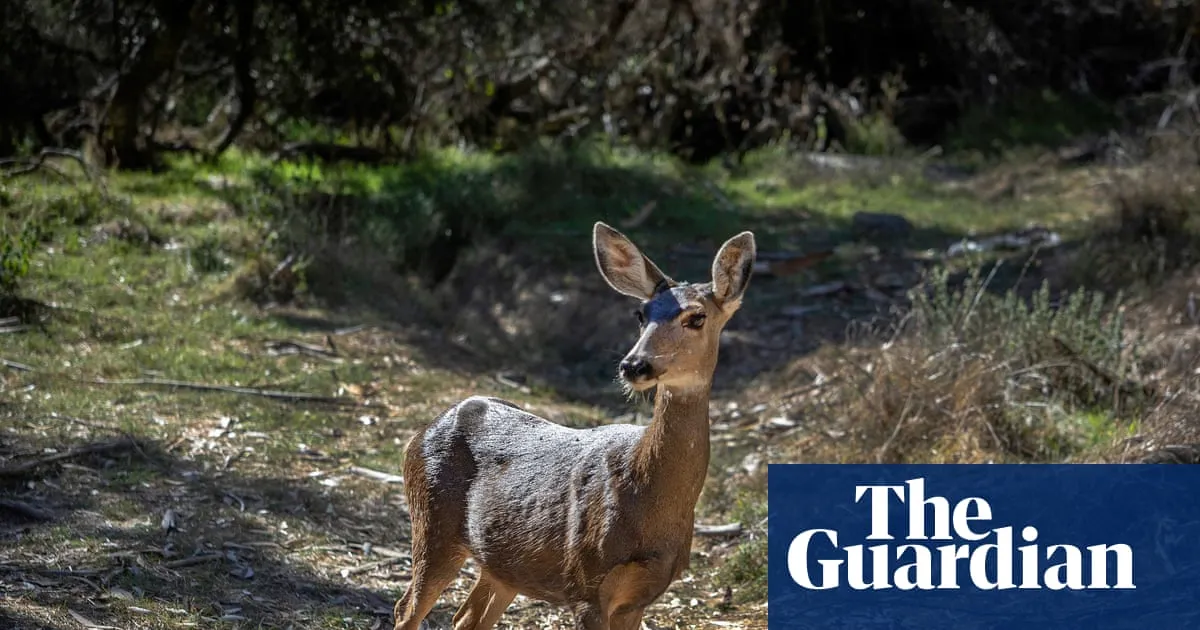
Locals and tourists have long fawned over Catalina Island’s mule deer population. For nearly a century, the ungulates have roamed the land’s waterfronts and woodlands, so comfortable around humans that it is not uncommon to spot deer roaming downtown Avalon.But that sight will soon disappear, after a judge this week paved the way for the island’s conservancy to kill nearly all the island’s 2,000 deer.A non-profit controlling 88% of the island off the southern California coast has been trying for years to eliminate a non-native deer population. Experts statewide have expressed support for the Catalina Island Conservancy proposal, saying the deer’s consumption of a native shrub plant has led to a growth of an invasive grass species that ignites faster and spreads fire more easily.The prospect of killing so many deer has sparked fierce – and emotional – opposition from the public, creating an unlikely coalition of animal activists and hunters that has tried to prevent the culling in court. An online petition against the move has garnered more than 32,000 signatures.Los Angeles County supervisor Janice Hahn, an outspoken critic of the deer’s killing, asked California’s governor, Gavin Newsom, to intervene earlier this week. But the plea was to no avail, and on Thursday a county judge issued a final ruling denying a preliminary injunction filed by opponents.The conservancy said it would now move forward with a five-year plan to eliminate the island’s deer population, according to its director of communications, Pepe Barton, with an estimated 200 to be hunted with rifles over the next two months. Formally known as Santa Catalina Island, it is the last leg of the Channel Islands to remove non-native deer species.Barton said the conservancy’s decision was “never our first choice”.“We understand the gravity of the situation and the responsibility, and it’s a noble sacrifice on the part of the deer that didn’t ask for this,” Barton said. “But this is a necessary step to protect the island, the native plants and animals that are only found here, as well as the residents and livelihoods that depend on Catalina.”Hunters first introduced mule deer to Catalina for sport about a century ago. What began as a population of a few quickly grew to a few thousand, and save for minor dips in drought seasons, the island’s deer population has not dwindled.The animals developed an appetite for shrubs native to the island. That presented a unique ecological problem, according to Anna L Jacobsen, a professor and plant biologist at California State University, Bakersfield, who studied the island deer’s relationship with its vegetation after its last major fires in 2006 and 2007.Jacobsen said when non-native deer eat shrubs already threatened by climate change, the native plants cannot regenerate or recover fast enough, and can become locally extinct. They are subsequently replaced by invasive grasses that ignite and spread fire faster than native species.In southern California, which has seen increasingly dangerous wildfire seasons in recent years, prevention “has shifted away from, say, fuel reduction to focusing on ignitions”, according to Max Moritz, a wildfire specialist who provides scientific advisory to California state and local governments.Seeing that loss, and increasingly concerned as wildfires become more frequent across California, scientists sought deer population control measures.The conservancy examined contraception and sterilization for the deer, which Barton said was infeasible for such a large population. They considered fencing the animals, but it “just isn’t a thing that would be approved”, he said. Four decades of regular hunting seasons have not been enough to reduce populations. And introducing new predators would create new risks to native animals and local people, Barton said.That leaves total extermination. The conservancy filed for a restoration management permit with the California department of fish and wildlife, which in January approved the plan.Only a small population of deer will be sterilized – those living near the town of Avalon – and all others will be killed. Island residents will be allowed one last hunting season from late October to mid-December of this year.The meat from the deer killing will go to the California condor recovery program or local tribal groups, and Barton said deer carcasses near trails or roads will be removed; only those in steep, dangerous terrain will be allowed to decompose naturally. People traveling or hiking the island will not regularly see deer carcasses, Barton said.Still, the question over what to do about Catalina’s deer has created a complex situation where “people feel some strong attachment to the deer” and it becomes difficult to see the science behind decisions, Moritz said. “But the fact is, you can’t realistically constrain the deer to graze only targeted areas ... From a scientific, ecological, and fire perspective, removal is the best way.”
SRCThe Guardian - World News
LANGEN
LEANCenter-Left
WORDS781
ENT9
THU · 2026-09-03 · 23:19 GMTBRIEF NSR-2026-0904-109019
NSR-2026-0904-109019News Report·EN·Environmental
Judge rules 2,000 Catalina Island deer can be killed to save native plant species
A judge has ruled that the Catalina Island Conservancy can proceed with a plan to kill nearly all of the island's 2,000 non-native mule deer. This decision comes after years of efforts by the conservancy to address ecological damage caused by the deer.
Sophie Sullivan in Los AngelesThe Guardian - World NewsFiled 2026-09-03 · 23:19 GMTLean · Center-LeftRead · 4 min
The Guardian - World NewsFIG 01
Reading time
4min
Word count
781words
Sources cited
3cited
Entities identified
9entities
Quality score
100%
§ 01
Briefing Summary
AI-generatedNEWSAR · AI
A judge has ruled that the Catalina Island Conservancy can proceed with a plan to kill nearly all of the island's 2,000 non-native mule deer. This decision comes after years of efforts by the conservancy to address ecological damage caused by the deer. Experts support the cull, stating that the deer's consumption of native shrubs has led to the spread of invasive, fast-igniting grasses, increasing wildfire risk. Despite opposition from animal activists and hunters, a court denied an injunction, allowing the conservancy to implement a five-year plan for deer population elimination. The conservancy stated this is a necessary sacrifice to protect native plants, animals, and the island's residents.
Confidence 0.90Sources 3Claims 5Entities 9
§ 02
Article analysis
Model · rule-basedFraming
Environmental
Human Interest
Tone
Mixed Tone
AI-assessed
CalmNeutralAlarmist
Factuality
0.80 / 1.00
Factual
LowHigh
Sources cited
3
Well sourced
FewMany
§ 03
Key claims
5 extracted01
Mule deer were introduced to Catalina Island for sport about a century ago.
factualArticle
Confidence
1.00
02
An online petition against the deer culling has garnered over 32,000 signatures.
statisticArticle
Confidence
1.00
03
The Catalina Island Conservancy plans to eliminate the island's deer population over five years.
factualCatalina Island Conservancy
Confidence
1.00
04
A judge ruled that 2,000 Catalina Island deer can be killed to protect native plant species.
factualJudge
Confidence
1.00
05
Experts believe the deer's consumption of native shrubs has led to the growth of invasive grass species that spread fire more easily.
factualExperts statewide
Confidence
0.90
§ 04
Full report
4 min read · 781 words§ 05
Entities
9 identifiedKey playerOppositionContextPositiveNeutralNegative
Organizations1
Locations4
§ 06
Keywords & salience
8 termscatalina island deer
1.00
native plant species
0.90
deer culling
0.80
invasive grass species
0.70
ecological problem
0.60
wildlife management
0.50
animal activists
0.40
court ruling
0.40
§ 07
Topic connections
Interactive graph No topic relationship data available yet. This graph will appear once topic relationships have been computed.