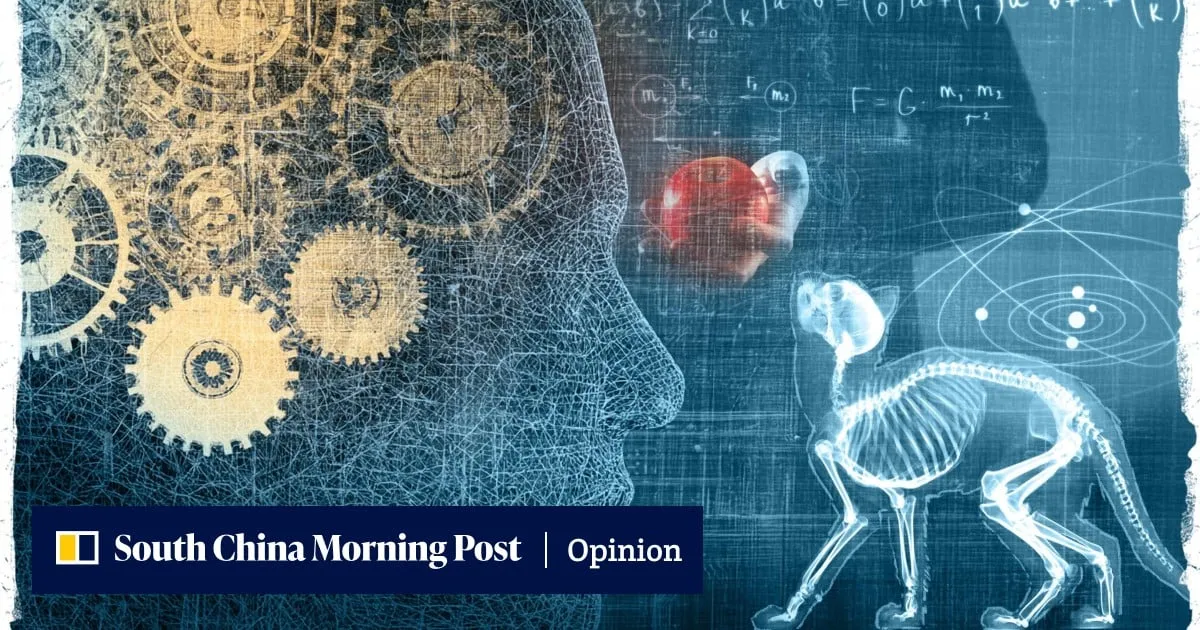
Frank Anthony Wilczek, an American theoretical physicist and mathematician, was awarded the Nobel Prize in Physics in 2004 for his discovery of asymptotic freedom in the theory of the strong interaction.Cats are wonderful gymnasts. Their ability to land on their feet – even when dropped upside-down – caught the attention of two of the nineteenth century’s greatest mathematical physicists, Sir George Gabriel Stokes and James Clerk Maxwell.The remarkable feats of cats inspired these theorists to perform, in the 1850s, legendary experiments in “cat-turning”, as Maxwell later described:“There is a tradition in Trinity that when I was here I discovered a method of throwing a cat so as not to light on its feet, and that I used to throw cats out of windows,” he wrote.
SRCSouth China Morning Post
LANGEN
LEANCenter-Right
WORDS125
ENT9
FRI · 2026-09-04 · 01:00 GMTBRIEF NSR-2026-0904-109053
NSR-2026-0904-109053News Report·EN·Human Interest
Cats and mind-full mechanics: what happens when quantum physics meets the brain
Nineteenth-century physicists Sir George Gabriel Stokes and James Clerk Maxwell were inspired by cats' gymnastic abilities, particularly their capacity to land on their feet. This fascination led them to conduct experiments in "cat-turning" in the 1850s.
Frank WilczekSouth China Morning PostFiled 2026-09-04 · 01:00 GMTLean · Center-RightRead · 1 min
South China Morning PostFIG 01
Reading time
1min
Word count
125words
Sources cited
2cited
Entities identified
9entities
Quality score
100%
§ 01
Briefing Summary
AI-generatedNEWSAR · AI
Nineteenth-century physicists Sir George Gabriel Stokes and James Clerk Maxwell were inspired by cats' gymnastic abilities, particularly their capacity to land on their feet. This fascination led them to conduct experiments in "cat-turning" in the 1850s. Maxwell humorously recounted a tradition that he had discovered a method of throwing cats so they would not land on their feet, even suggesting he used to throw cats out of windows. The article also mentions Nobel laureate Frank Anthony Wilczek, who received the prize in 2004 for his work on asymptotic freedom in strong interaction theory, though his connection to the cat experiments is not detailed.
Confidence 0.85Sources 2Claims 3Entities 9
§ 02
Article analysis
Model · rule-basedFraming
Human Interest
Technology
Tone
Measured
AI-assessed
CalmNeutralAlarmist
Factuality
0.60 / 1.00
Mixed
LowHigh
Sources cited
2
Limited
FewMany
§ 03
Key claims
3 extracted01
Frank Anthony Wilczek was awarded the Nobel Prize in Physics in 2004 for his discovery of asymptotic freedom in the theory of the strong interaction.
factualFrank Anthony Wilczek
Confidence
1.00
02
Cats' ability to land on their feet inspired physicists Sir George Gabriel Stokes and James Clerk Maxwell in the 1850s.
factualSir George Gabriel Stokes and James Clerk Maxwell
Confidence
0.90
03
Maxwell described experiments in 'cat-turning' where he would throw cats out of windows.
quoteJames Clerk Maxwell
Confidence
0.80
§ 04
Full report
1 min read · 125 words§ 05
Entities
9 identifiedKey playerOppositionContextPositiveNeutralNegative
People3
Organizations1
§ 06
Keywords & salience
10 termsquantum physics
0.90
brain
0.80
cats
0.70
cat-turning
0.60
sir george gabriel stokes
0.50
theoretical physicist
0.50
james clerk maxwell
0.50
asymptotic freedom
0.40
strong interaction
0.40
nobel prize in physics
0.40
§ 07
Topic connections
Interactive graph No topic relationship data available yet. This graph will appear once topic relationships have been computed.