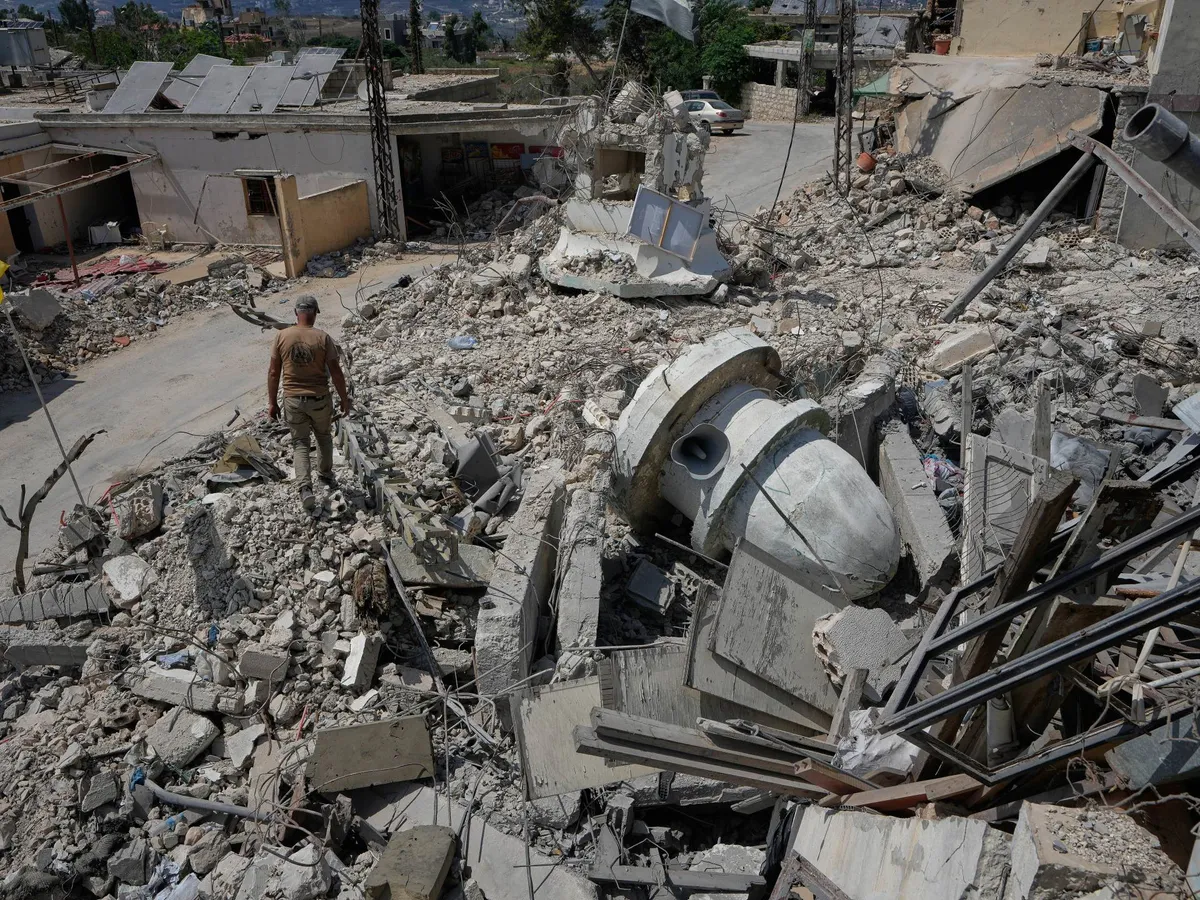
Explosions shake the ground in Froun as Israeli operations persist, disrupting daily life in southern Lebanon.A Lebanese man walks on the rubble of a mosque that was destroyed in an Israeli attack in Froun village in southern Lebanon on July 16, 2026 [Mohammed Zaatari/AP]Published On 4 Sep 2026Froun, Lebanon – Hasan Saeid Ramadan, 56, was at home in this southern Lebanese municipality when he heard the explosions.“It shook the ground like an earthquake, and the mountain collapsed,” he said, pointing at the nearby Qantara mountains.Recommended Stories list of 3 itemslist 1 of 3Who are the ‘Hilltop Girls’ behind Israel’s ‘soft settlement’ strategy?list 2 of 3Israel releases Lebanese civilian, says five prisoners will be freedlist 3 of 3‘An impasse’: EU ministers fail to break deadlock over Israel and Ukraineend of listIsraeli forces are present just south of Froun and occupy large areas of southern Lebanon, where they conduct operations, including regular detonations, that they say target the Lebanese group Hezbollah.The ones conducted by Israel along the Qantara mountain range this week led to a visible collapse in at least two places in the mountains. Locals and officials in villages along the edge of Israeli-controlled Lebanese territory, such as Froun, Ghandouriyeh, Qalaway" class="entity-link entity-location" data-entity-id="200052" data-entity-type="location">Bourj Qalaway and Qalaway, told Al Jazeera that the sounds of war – warplanes, drones but, most of all, Israeli demolitions – are constant and often keep them up at night.While Ramadan was speaking, an explosion echoed in the distance – another apparent Israeli detonation of a home. “Day and night,” he said. “We even see them.”He added: “It’s become routine.”Pilot zonesIn March, Israel invaded Lebanon for the second time in less than two years. The first invasion in October 2024 was followed by a near-full Israeli withdrawal with soldiers remaining in five locations in southern Lebanon. After the second invasion, however, Israeli officials have said their troops will stay on in southern Lebanon despite promises from United States officials that the Israelis do not have territorial ambitions in Lebanon.While US President Donald Trump announced a ceasefire in April, Israel’s military has continued to attack what it says are Hezbollah targets and infrastructure around southern Lebanon.Meanwhile, the Lebanese state has been locked in US-brokered direct discussions with Israel despite objections from Hezbollah and its allies, who favour indirect discussions with the Israelis to try to end the war and the Israeli presence in southern Lebanon.Israel and Lebanon agreed a “framework agreement” in June, which launched a “pilot zone” plan. The pilot zones are to act as a test area for the Lebanese army to disarm Hezbollah and for the Israelis to withdraw. The first pilot zones were the villages of Froun, Srifa and Zawtar al-Gharbiyeh. But locals disputed the inclusion of Froun and Srifa, saying they were never occupied by Israel in the first place.“[The Israelis] didn’t take a single step here,” Ramadan said.For its part, Israel is also reportedly critical of the pilot zone scheme, and analysts doubt their willingness to allow it to progress.“The pilot zones can only really work if you have goodwill of various parties,” Nicholas Blanford, a nonresident senior fellow at the Atlantic Council and author of a book on Hezbollah, told Al Jazeera. “The trouble is the Israelis have said they are not going to stage any more withdrawals, so it brings the process to a halt.”And regardless of the efforts from the Lebanese state and the Lebanese army, both Hezbollah and Israel have played a role in undermining the process.“Hezbollah opposes the scheme outright and argues that Lebanon should rely on Iran to pressure the US into demanding an Israeli withdrawal,” David Wood, the International Crisis Group’s senior analyst for Lebanon, told Al Jazeera. “Israel has paid lip service to the pilot zones scheme but has recently expanded – rather than reduced – its occupation of Lebanese territory.”Demolitions and destructionIn the villages near the areas Israel controls, many of the homes and local infrastructure lie destroyed. Piles of concrete rubble and dust line many of the roads to the villages. Explosions were heard throughout the day on Thursday, and locals said they are often worse at night and disrupt their sleep.During the harshest days of the war, these villages were ghost towns. Residents fled north to Sidon or Beirut, where they stayed with family, in displacement centres, or slept rough on the streets, locals said.Residents began to return to these villages after the announcement of the framework agreement. But what they returned to was not what they had left behind.Mohammad Ali Nader, the head of the municipality of Ghandouriyeh, said his area was mostly agricultural and farmers grew olives, wheat, chickpeas, corn and tobacco, among many other crops. But now, the area lies overwhelmingly in ruins. Most residents don’t have access to water or electricity.The clanking sound of cranes and other construction equipment moving rubble or smashing concrete echoed out into the rolling hills behind Nader. He stood on the ruins of a home that had been destroyed by two Israeli rockets.“Much like all the other houses that were destroyed, this house is no longer habitable,” he said, saying it had once boasted two storeys and a large garden. He added that the electric and water infrastructure in the area was also mostly destroyed. “We used to grow carob here, but where is there carob now?” he asked rhetorically. “Not a carob is left nor olives, tobacco or wheat.”Nasser Mokdad, an official in the municipality of Froun, said the area was currently not receiving state-provided electricity but added that the Lebanese government was working on returning services, setting September 15 as a target date.No water, no electricity, no returnResidents in the affected villages said the current period reminds them of the days of the Israeli occupation of southern Lebanon from 1982 to 2000. Hasan Bazzi, the head of the municipality of Froun, said the only difference is that during the previous occupation, southerners remained in their Israeli-occupied villages.This time around, the Israeli demolitions are ensuring that those whose homes are in Israeli-occupied areas will have difficulty returning, even if the troops eventually withdraw.When the war restarted this year, Ramadan fled his home of 30 years and took refuge in an area near Tyre, a coastal city in southern Lebanon, and then moved farther north to Sidon, about an hour south of Beirut.When he returned after the truce in the area, his house had been badly damaged. Still, it fared better than the neighbouring houses, which he said belonged to his cousins. He’s now sleeping in his garage with his wife. Their house, like the surrounding area, has no access to water or electricity.He said the heat at night bothers him and he’s developed a bad heat rash. During the day, he slowly works on fixing the shrapnel-pocketed walls of his home.Dripping with sweat under the midday sun, he smiled. “My conscience is at ease because I’m by my home,” he said.
SRCAl Jazeera
LANGEN
LEANCenter
WORDS1 147
ENT12
FRI · 2026-09-04 · 06:24 GMTBRIEF NSR-2026-0904-109116
NSR-2026-0904-109116News Report·EN·Conflict
In southern Lebanon, Israeli demolitions continue ‘day and night’
Israeli forces continue operations in southern Lebanon, including frequent demolitions and detonations, disrupting daily life for residents in villages like Froun. These actions, which locals describe as occurring "day and night," are part of Israeli efforts to target Hezbollah.
Justin SalhaniAl JazeeraFiled 2026-09-04 · 06:24 GMTLean · CenterRead · 5 min
Al JazeeraFIG 01
Reading time
5min
Word count
1 147words
Sources cited
3cited
Entities identified
12entities
Quality score
100%
§ 01
Briefing Summary
AI-generatedNEWSAR · AI
Israeli forces continue operations in southern Lebanon, including frequent demolitions and detonations, disrupting daily life for residents in villages like Froun. These actions, which locals describe as occurring "day and night," are part of Israeli efforts to target Hezbollah. Despite a US-brokered ceasefire and a framework agreement for "pilot zones" intended for Lebanese army disarmament of Hezbollah and Israeli withdrawal, Israeli military operations persist. The pilot zone plan, which includes Froun, has faced disputes from locals and skepticism from analysts regarding its effectiveness due to a lack of genuine withdrawal from Israeli forces and opposition from Hezbollah. The ongoing conflict has resulted in widespread destruction of homes and infrastructure in affected Lebanese villages.
Confidence 0.90Sources 3Claims 5Entities 12
§ 02
Article analysis
Model · rule-basedFraming
Conflict
Human Interest
Tone
Mixed Tone
AI-assessed
CalmNeutralAlarmist
Factuality
0.60 / 1.00
Mixed
LowHigh
Sources cited
3
Well sourced
FewMany
§ 03
Key claims
5 extracted01
Israel invaded Lebanon for the second time in March, with troops remaining in southern Lebanon.
factualAl Jazeera
Confidence
0.90
02
Israeli forces are present south of Froun and occupy large areas of southern Lebanon, conducting operations including regular detonations.
factualAl Jazeera
Confidence
0.90
03
Explosions are shaking the ground in Froun, Lebanon, due to ongoing Israeli operations.
factualAl Jazeera
Confidence
0.90
04
Locals disputed the inclusion of Froun and Srifa in pilot zones, stating they were never occupied by Israel.
factualAl Jazeera
Confidence
0.80
05
Israel and Lebanon agreed a 'framework agreement' in June, launching a 'pilot zone' plan for disarming Hezbollah and Israeli withdrawal.
factualAl Jazeera
Confidence
0.80
§ 04
Full report
5 min read · 1 147 words§ 05
Entities
12 identifiedKey playerOppositionContextPositiveNeutralNegative
Organizations1
Locations8
§ 06
Keywords & salience
8 termssouthern lebanon
1.00
israeli demolitions
1.00
hezbollah
0.90
israeli operations
0.80
lebanese civilian
0.70
israeli invasion
0.60
ceasefire
0.50
direct discussions
0.40
§ 07
Topic connections
Interactive graph Network visualization showing 51 related topics
View Full Graph Person Organization Location Event|Click node to navigate|Edge numbers = shared articles