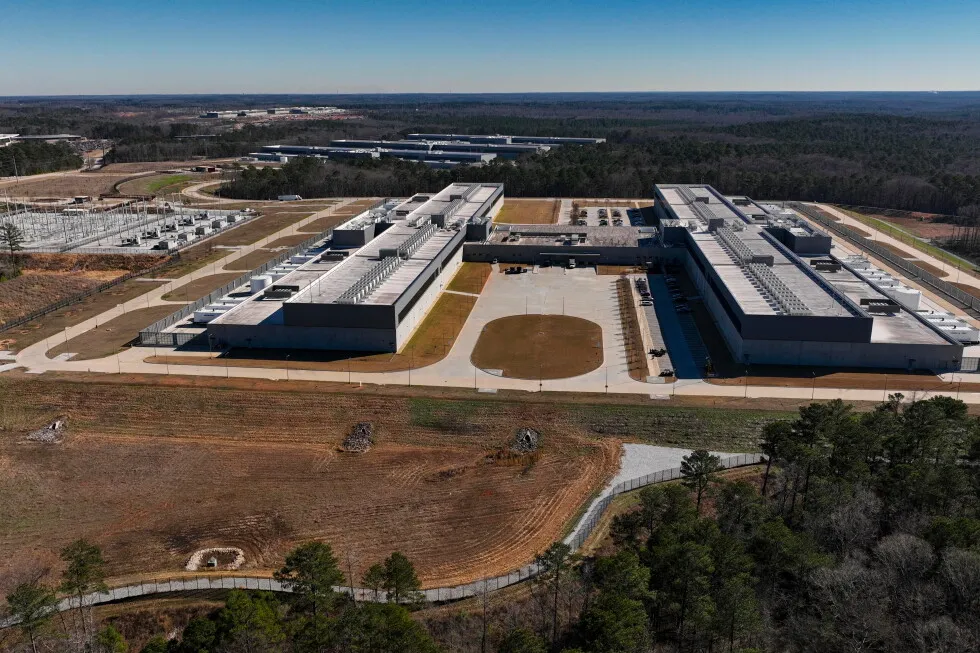
Meta’s Stanton Springs Data Center is visible Jan. 13, 2026, in Newton County, Ga. (AP Photo/Mike Stewart, File) By MOGOMOTSI MAGOME and MICHELLE GUMEDE Updated 1:06 PM MESZ, September 4, 2026 Add AP News on Google Add AP News as your preferred source to see more of our stories on Google. Share Share Facebook Copy Link copied Print Email X LinkedIn Bluesky Flipboard Pinterest Reddit JOHANNESBURG (AP) — South African civil rights groups are calling for a halt to the construction of additional Data Centers in the country until the use of scarce water, land and Electricity resources has been investigated. With South Africa positioning itself as Africa’s main data hub and U.S. technology companies like Amazon, Microsoft and Equinix increasingly setting up digital infrastructure in the country, civil society organizations have raised the alarm about the lack of transparency around the projects. The country’s rights watchdog, the South African Human Rights Commission, told The Associated Press that it has received over 250 submissions from interested groups after it called for input in May this year. According to South African President Cyril Ramaphosa, the country hosts 70% of Africa’s data center capacity, and the government has identified this as an opportunity in the global digital economy, inviting more tech companies to build digital infrastructure in the country. However, as in other parts of the world, such as the U.S., where Data Centers have been increasing rapidly, their long-term environmental and societal impacts are coming under greater scrutiny. The commission noted that the country had experienced “significant growth” in the establishment of Data Centers, cloud infrastructure and related digital systems. More than 178,000 immigrants have suddenly fled or been deported from South Africa. Here’s why 1 MIN READ Africa wants more homegrown solar to boost self-reliance, but China’s shadow remains 3 MIN READ Chinese automaker Chery buys Nissan plant in Africa as EV production shifts to new markets 3 MIN READ “A key issue emerging from the process is precisely the availability, consistency and transparency of information relating to matters such as Electricity and water demand, land use, infrastructure requirements, environmental impacts and impacts on surrounding communities,” said Dr. Eileen Carter, who leads the commission preliminary process. One of the latest municipal approvals for a data center that has irked various quarters is an Equinix hyperscale facility to be built in Cape Town, a city that avoided a so-called “Day Zero” in 2018, when its taps were predicted to run dry due to Water Scarcity. The country’s recent memory of widespread power cuts, known as “ loadshedding, ” has also raised concerns about the 160 megawatts of Electricity estimated to be required to run the facility. South Africa has seemingly overcome its Electricity crisis, with the country’s power utility, Eskom, reporting a power surplus during the winter peak-demand season, but civil society groups are wary of the surplus power being sold to Data Centers. Some experts say the call for a temporary halt to more approvals should not be taken as a rejection of potential foreign investment in the country, but rather as a mechanism to establish clear rules, especially around transparency. “Serious investors are not deterred by clear rules. They price uncertainty, and an unregulated boom is the most uncertain environment of all,” said Pitso Tsibolane, a senior lecturer in Information Systems at the University of Cape Town. He said one of the major problems was that operators were not required to disclose how much water, Electricity and land they would use or commit to in binding terms, so every proposal was weighed without the numbers. Operators have cautioned against comparing Data Centers being built in South Africa to large-scale Data Centers in the U.S. as the water, land and power needs there are much higher. They point out that Eskom currently has a power surplus and that most Data Centers increasingly rely on renewable energy for Electricity. “It should be clear that the growth in energy demand due to Data Centers is not contributing to Electricity scarcity in South Africa and that this increasing demand is not a cause of rising Electricity tariffs,” said Internet Service Providers Association chairperson Sasha Booth-Beharilal. “Local Data Centers apply new technologies to minimize their water usage, which is substantially lower than the global average.” The organization represents tech companies operating in the sector and operating Data Centers in the country. MOGOMOTSI MAGOME Magome is an Associated Press reporter based in Johannesburg, South Africa. He covers a range of topics including general news, politics, and enterprise stories from across the Southern Africa region. mailto MICHELLE GUMEDE Gumede is a Johannesburg-based text news reporter for The Associated Press. She covers a wide range of news topics, including health, climate change, and politics in South Africa. mailto
SRCAssociated Press (AP)
LANGEN
LEANCenter
WORDS791
ENT12
FRI · 2026-09-04 · 13:23 GMTBRIEF NSR-2026-0904-109222
NSR-2026-0904-109222News Report·EN·Environmental
Civil rights groups urge a halt to South Africa data centers boom amid water and power fears
Civil rights groups in South Africa are urging a halt to new data center construction until resource usage, particularly water and electricity, is thoroughly investigated. These organizations, including the South African Human Rights Commission, are concerned about the lack of transparency surrounding projects by major tech companies like Amazon, Microsoft, and Equinix, which are establishing South Africa as a major data hub.
Associated Press (AP)Filed 2026-09-04 · 13:23 GMTLean · CenterRead · 4 min
Associated Press (AP)FIG 01
Reading time
4min
Word count
791words
Sources cited
3cited
Entities identified
12entities
Quality score
100%
§ 01
Briefing Summary
AI-generatedNEWSAR · AI
Civil rights groups in South Africa are urging a halt to new data center construction until resource usage, particularly water and electricity, is thoroughly investigated. These organizations, including the South African Human Rights Commission, are concerned about the lack of transparency surrounding projects by major tech companies like Amazon, Microsoft, and Equinix, which are establishing South Africa as a major data hub. Concerns are heightened due to the country's history of water scarcity and power outages, despite current power surpluses. Experts suggest this call is not a rejection of investment but a push for clear regulations, as operators are not currently required to disclose their resource commitments. While industry representatives argue that South African data centers use less water and renewable energy, civil society groups remain wary.
Confidence 0.90Sources 3Claims 5Entities 12
§ 02
Article analysis
Model · rule-basedFraming
Environmental
Social Justice
Tone
Measured
AI-assessed
CalmNeutralAlarmist
Factuality
0.70 / 1.00
Factual
LowHigh
Sources cited
3
Well sourced
FewMany
§ 03
Key claims
5 extracted01
South Africa hosts 70% of Africa's data center capacity, with major tech companies like Amazon, Microsoft, and Equinix investing in the country.
statisticSouth African President Cyril Ramaphosa
Confidence
0.95
02
A key issue is the lack of transparency regarding electricity and water demand, land use, and environmental impacts of data centers.
quoteDr. Eileen Carter
Confidence
0.90
03
The South African Human Rights Commission has received over 250 submissions regarding data center projects after seeking public input.
statisticSouth African Human Rights Commission
Confidence
0.90
04
Civil rights groups are calling for a halt to new data center construction in South Africa due to concerns about water, land, and electricity resources.
factualCivil rights groups
Confidence
0.90
05
An Equinix hyperscale facility in Cape Town requires an estimated 160 megawatts of electricity, raising concerns given the city's past water scarcity issues.
factualArticle
Confidence
0.85
§ 04
Full report
4 min read · 791 words§ 05
Entities
12 identifiedKey playerOppositionContextPositiveNeutralNegative
Organizations5
§ 06
Keywords & salience
10 termssouth africa
1.00
data centers
1.00
water resources
0.90
power fears
0.90
civil rights groups
0.80
digital infrastructure
0.70
environmental impacts
0.60
transparency
0.50
amazon
0.40
equinix
0.40
§ 07
Topic connections
Interactive graph No topic relationship data available yet. This graph will appear once topic relationships have been computed.