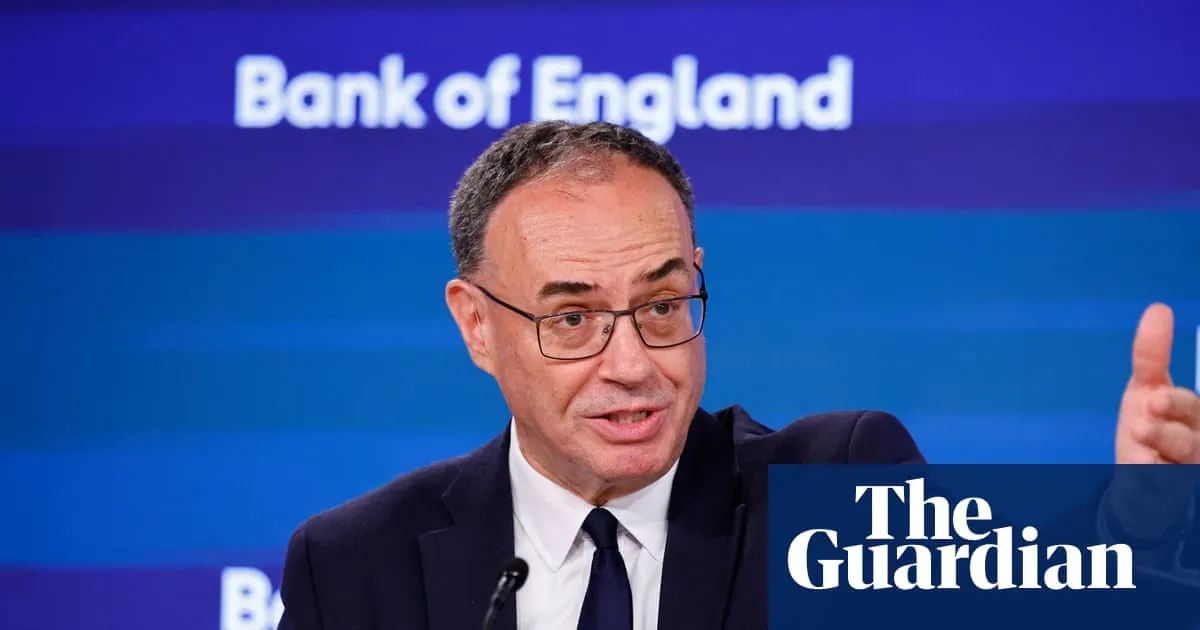
The governor of the Bank of England has said the rise of populist politicians presents a serious challenge to independent central banks.As Nigel Farage’s Reform UK gathered for its annual conference in Birmingham, Andrew Bailey said central bankers must be prepared to explain their decisions to the public or risk being attacked as an “unrepresentative elite”.Bailey was speaking at a conference at the London School of Economics. In an address peppered with historical references, from Alexander Hamilton to Thomas Hobbes, he said central banks must not take their “legitimacy for granted”.Bailey said populist parties’ pitch for power “often rests on the claim that a particular political movement alone represents the authentic will of the people. Any institution seen to get in the way becomes an unrepresentative elite standing between the people and their will, and thus an obstacle to popular sovereignty.”He added: “This is a serious challenge. We have developed systems of government (in the broadest sense of this term) in which legitimacy rests in the plurality of society, not in the preferences of any single group within it.”Populist parties, especially of the right, have been riding high on both sides of the Atlantic in recent years. Attacking traditional institutions – including central banks – often forms part of their platform.Farage has previously suggested he would like to replace Bailey if Reform comes to power. In the US, Donald Trump repeatedly launched tirades against the former Federal Reserve chair Jerome Powell over the central bank’s failure to cut interest rates.Nigel Farage has previously suggested he would like to replace Andrew Bailey if Reform came to power Photograph: Thomas Krych/APBailey was among the international central bankers who signed a joint statement defending Powell against Trump’s criticism and stressing the importance of independence.The Bank of England was made independent by the Labour government in 1997, handing decisions on interest rates from the chancellor to a nine-member monetary policy committee (MPC) chaired by the governor.After the 2008 global financial crisis, which led to a significant proportion of the UK banking sector being nationalised at taxpayer expense, the Bank of England was given additional responsibilities for financial stability.Bailey said on Friday that insulating the Bank from politics had made it better able to fulfil its role of maintaining “the monetary and financial conditions that make sustained prosperity possible”.He said: “Institutions that exercise significant authority should expect scrutiny. Such scrutiny is a sign of democratic health. But we should also recognise what is at stake.”skip past newsletter promotionafter newsletter promotionThe MPC is split over how to respond to rising inflation as a result of the Iran war. Bailey has stressed that in a weak jobs market, he does not yet see signs of the “second-round effects” that can embed inflation throughout the economy as workers bid up their wages to keep pace.The MPC voted to keep interest rates on hold at 3.75% at its last meeting in July. But three members voted for a rate rise, including the Bank’s hawkish chief economist, Huw Pill, who used a speech on Thursday to reiterate that in the face of rising inflation, Threadneedle Street should act “clearly, promptly and decisively”.At its next policy meeting on 17 September, the Bank is also expected to announce whether it will press ahead with its controversial policy of quantitative tightening. The Bank has been progressively selling off the bonds it acquired though the emergency policy of quantitative easing – creating money to help stave off recession.Critics, from Reform to leftwing thinktanks, have argued that these sales tend to drive up the yield, or interest rate, on government bonds, which move in the opposite direction to prices. That makes it more expensive for the government to borrow, a pressing issue at a time of febrile bond markets.Bailey will appear before MPs on the cross-party Treasury select committee next week to explain his thinking.
SRCThe Guardian - World News
LANGEN
LEANCenter-Left
WORDS640
ENT12
FRI · 2026-09-04 · 13:44 GMTBRIEF NSR-2026-0904-109242
NSR-2026-0904-109242News Report·EN·Political Strategy
Populism poses serious challenge to independent central banks, Bailey says
Bank of England Governor Andrew Bailey stated that the rise of populist politicians poses a significant challenge to the independence of central banks. Speaking at a London School of Economics conference, Bailey emphasized that central bankers must clearly explain their decisions to the public to avoid being perceived as an "unrepresentative elite." He argued that populist movements often claim to embody the "authentic will of the people," positioning institutions that oppose them as obstacles to popular sovereignty.
Heather StewartThe Guardian - World NewsFiled 2026-09-04 · 13:44 GMTLean · Center-LeftRead · 3 min
The Guardian - World NewsFIG 01
Reading time
3min
Word count
640words
Sources cited
3cited
Entities identified
12entities
Quality score
100%
§ 01
Briefing Summary
AI-generatedNEWSAR · AI
Bank of England Governor Andrew Bailey stated that the rise of populist politicians poses a significant challenge to the independence of central banks. Speaking at a London School of Economics conference, Bailey emphasized that central bankers must clearly explain their decisions to the public to avoid being perceived as an "unrepresentative elite." He argued that populist movements often claim to embody the "authentic will of the people," positioning institutions that oppose them as obstacles to popular sovereignty. Bailey highlighted that this scrutiny is a sign of democratic health but stressed the importance of maintaining central bank independence, which he noted was established in the UK in 1997. The article also touches on the Bank of England's current monetary policy debates regarding inflation and quantitative tightening.
Confidence 0.90Sources 3Claims 5Entities 12
§ 02
Article analysis
Model · rule-basedFraming
Political Strategy
Economic Impact
Tone
Measured
AI-assessed
CalmNeutralAlarmist
Factuality
0.70 / 1.00
Factual
LowHigh
Sources cited
3
Well sourced
FewMany
§ 03
Key claims
5 extracted01
The Bank of England was made independent by the Labour government in 1997.
factual
Confidence
1.00
02
Populist parties' pitch for power often rests on the claim that a particular political movement alone represents the authentic will of the people.
quoteAndrew Bailey
Confidence
1.00
03
Central bankers must be prepared to explain their decisions to the public or risk being attacked as an 'unrepresentative elite'.
quoteAndrew Bailey
Confidence
1.00
04
The rise of populist politicians presents a serious challenge to independent central banks.
quoteAndrew Bailey
Confidence
1.00
05
Attacking traditional institutions, including central banks, often forms part of the platform of populist parties, especially of the right.
factual
Confidence
0.90
§ 04
Full report
3 min read · 640 words§ 05
Entities
12 identifiedKey playerOppositionContextPositiveNeutralNegative
People6
Organizations5
Topics1
§ 06
Keywords & salience
10 termsindependent central banks
1.00
populism
0.90
central bank independence
0.80
public trust
0.70
monetary policy
0.60
political pressure
0.60
andrew bailey
0.50
bank of england
0.50
popular sovereignty
0.40
financial stability
0.40
§ 07
Topic connections
Interactive graph Network visualization showing 51 related topics
View Full Graph Person Organization Location Event|Click node to navigate|Edge numbers = shared articles