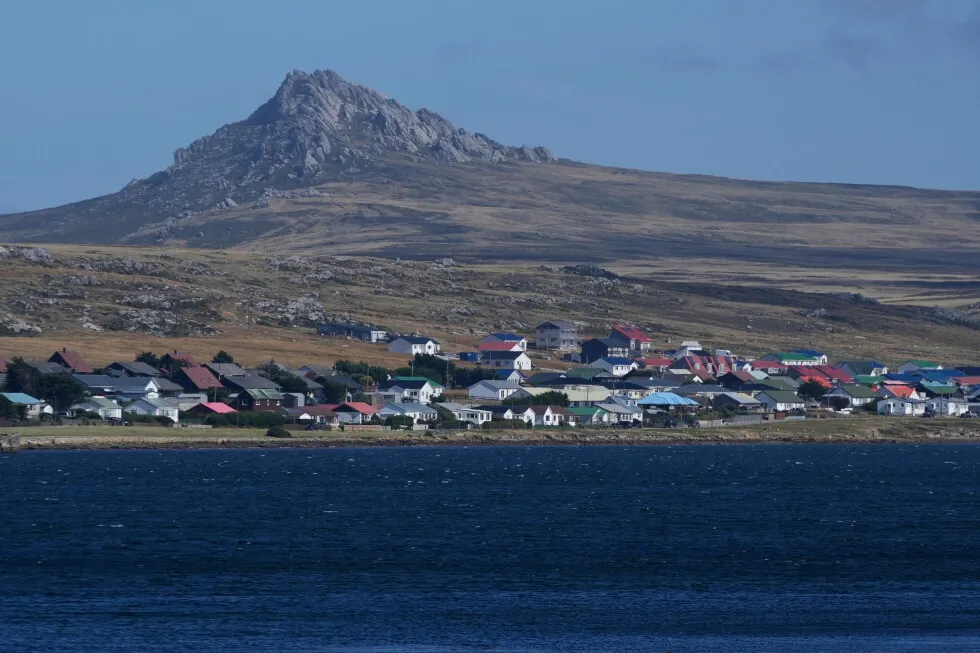
What to know about UK-controlled Falkland Islands after Argentina’s president stakes claim 1 of 3 | Mount Tumbledown stands tall behind Stanley on the Falkland Islands, also known as Malvinas" class="entity-link entity-location" data-entity-id="165916" data-entity-type="location">Islas Malvinas, March 16, 2026. (AP Photo/Ricardo Mazalan, File) 2 of 3 | Argentina’s President Javier Milei arrives to speak at the Madrid Forum in Santiago, Chile, Thursday, Sept. 3, 2026. (AP Photo/Esteban Felix) 3 of 3 | Argentina’s Giovani Lo Celso holds a banner with the words “The Malvinas are Argentine”, referring to the Falkland Islands, while teammate Argentina’s Nicolas Otamendi gestures to him, at the end of the World Cup semifinal soccer match between England and Argentina in Atlanta, on July 15, 2026. (AP Photo/Rebecca Blackwell, File) By PAN PYLAS Updated 5:00 PM MESZ, September 4, 2026 Add AP News on Google Add AP News as your preferred source to see more of our stories on Google. Share Share Facebook Copy Link copied Print Email X LinkedIn Bluesky Flipboard Pinterest Reddit LONDON (AP) — In a primetime rallying call to the nation, Argentine President Javier Milei has resurrected Argentina’s long-standing claim to the nearby U.K.-held Falkland Islands and in the process conjured up memories of the bitter war the two countries fought 44 years ago. With an election in Argentina due in October 2027, Milei did what many Argentine leaders have done over the years — bang the drum in support of his country’s claim to what Argentines call the Malvinas. In his speech Thursday, Milei welcomed a seeming change of tone from the U.S. and vowed to introduce measures to block plans to drill for oil near the small British overseas territory of about 3,500 people, which lies around 300 miles (480 kilometers) east of the southeast coast of Argentina. Without threatening a military incursion, he insisted the “winds of change” were with Argentina. Here’s what to know about the islands — a British overseas territory since 1833 — and how they impact relations between Argentina and the U.K. Argentina’s sovereignty claim is enshrined in Argentina’s constitution and is frequently invoked as an expression of national identity, from banknotes to World Cup soccer chants. Milei, surrounded by his Cabinet, told the nation that the islands are “our future” and that Argentina needs to “recover” them as a matter of national importance. Argentina’s Milei escalates Falklands dispute, seizing on Trump comments and oil tensions 5 MIN READ 80 Brazil cuts diplomatic presence in Argentina after Milei insults Lula 5 MIN READ Argentines pray that Pope Leo’s visit alleviates their economic stress 5 MIN READ Milei, a right-wing libertarian who has applied shock therapy to Argentina’s economy since taking office in late 2023, has come under increasing pressure from the opposition, which has accused him of neglecting Argentina’s sovereignty claim. He has grown more vocal on the Falklands as plans for large-scale oil production around the islands raise the economic stakes of the dispute. He said he would sign decrees to introduce sanctions against any companies working on oil production around the islands, declaring that the Sea Lion oil field, a joint U.K.-Israel operation, is a “clear and present danger” to the country’s claims. Production at the field about 220 kilometers (140 miles) north of the islands is expected to begin in 2028. Argentina considers the project an illegal exploitation of resources in waters it claims as its own. “Argentina will not stand idly by,” Milei said. “Any further advance on the Malvinas Islands will be considered a violation of our national security.” Milei’s address to the nation came amid increasing signs that the U.S. was preparing to change its long-held position on the future of the Falklands. For decades, successive U.S. administrations have remained neutral on the competing claims while recognizing Britain’s de facto administration of the islands. Any departure from that position would be a major diplomatic affront and inflame already high trans-Atlantic tensions. On Thursday, in an interview with GB News, U.S. President Donald Trump suggested he would not back the U.K. in a fight over the Falklands and pointed to its lack of support for his war in Iran at its launch on Feb. 28. “The United States is considering this change in position because it knows that Argentina has a reliable partner, aligned with Western values, in a strategically important position that can be a valuable ally in the decades to come,” said Milei, arguably Trump’s closest ally in South America. Residents of the Falkland Islands have indicated they prefer to remain a part of the U.K., and British Foreign Secretary Ed Miliband said the country will “resolutely uphold” their right to decide their future. “The U.K.’s position on the Falkland Islands is unwavering,” he said on X. “The Islands are British and will remain so because that is the overwhelming position of the Islanders.” In a 2013 referendum, the islanders voted overwhelmingly to remain a British overseas territory, with 99.8% voting in favor and just three votes against. Milei dismissed that viewpoint, saying the inhabitants of the islands do “not have a legitimate right to self-determination.” The worst-case scenario is that the dispute will once again lead to war. In 1982, Argentina’s then-military dictatorship invaded the Falklands. The U.K., led then by Prime Minister Margaret Thatcher, sent a task force all the way down the Atlantic and retook the islands after 73 days of Argentine control. The war killed 649 Argentine and 255 British troops. The humiliation of that ill-fated invasion soon led to the downfall of the junta, which had invaded in a desperate bid for popularity. The backdrop now is very different. In the early 1980s, the Falkland Islands had a minimal British military presence. Now, there is a proper deterrent — more than a thousand troops, state-of-the-art jets and Royal Navy patrols nearby. The future status of the islands has hobbled relations between the two countries, even though they share deep cultural and economic ties. Though Argentina was never a British colony, British influence and money played a crucial role in the growth of the Argentine state in the decades after its establishment in 1816. Most visibly, British influence is evident in the sporting arena, notably soccer, which was brought over by British immigrants. But the Falkland Islands have undermined what should be a close relationship based on common interests. In the recent World Cup, Argentina beat archrival England 2-1 in the semifinals. Some of the Argentine players unfurled a banner after their win proclaiming the disputed Falkland Islands as their own: “Las Malvinas son argentinas.”
SRCAssociated Press (AP)
LANGEN
LEANCenter
WORDS1 085
ENT11
FRI · 2026-09-04 · 15:23 GMTBRIEF NSR-2026-0904-109255
NSR-2026-0904-109255News Report·EN·Political Strategy
What to know about UK-controlled Falkland Islands after Argentina’s president stakes claim
Argentine President Javier Milei has reignited Argentina's claim to the UK-controlled Falkland Islands, also known as Islas Malvinas. This move comes ahead of Argentina's 2027 election and amidst plans for oil drilling near the islands.
Associated Press (AP)Filed 2026-09-04 · 15:23 GMTLean · CenterRead · 5 min
Associated Press (AP)FIG 01
Reading time
5min
Word count
1 085words
Sources cited
0cited
Entities identified
11entities
Quality score
100%
§ 01
Briefing Summary
AI-generatedNEWSAR · AI
Argentine President Javier Milei has reignited Argentina's claim to the UK-controlled Falkland Islands, also known as Islas Malvinas. This move comes ahead of Argentina's 2027 election and amidst plans for oil drilling near the islands. Milei vowed to block oil production, citing it as a threat to Argentina's claims, and welcomed a perceived shift in U.S. policy, referencing comments from Donald Trump suggesting a potential change in U.S. neutrality on the dispute. The Falkland Islanders overwhelmingly voted in a 2013 referendum to remain a British territory, a stance the UK government supports. The dispute has historically led to conflict, including a war in 1982, but the islands now have a significant British military presence.
Confidence 0.90Claims 5Entities 11
§ 02
Article analysis
Model · rule-basedFraming
Political Strategy
Diplomatic
Tone
Mixed Tone
AI-assessed
CalmNeutralAlarmist
Factuality
0.70 / 1.00
Factual
LowHigh
Sources cited
0
No named sources
FewMany
§ 03
Key claims
5 extracted01
The Falkland Islands have been a British overseas territory since 1833.
factualAP News
Confidence
1.00
02
Argentina’s sovereignty claim to the islands is enshrined in its constitution.
factualAP News
Confidence
0.95
03
Argentine President Javier Milei has resurrected Argentina’s long-standing claim to the Falkland Islands.
factualAP News
Confidence
0.90
04
Milei has come under pressure from the opposition for neglecting Argentina’s sovereignty claim.
factualAP News
Confidence
0.85
05
Milei vowed to introduce measures to block plans to drill for oil near the Falkland Islands.
quoteJavier Milei
Confidence
0.80
§ 04
Full report
5 min read · 1 085 words§ 05
Entities
11 identifiedKey playerOppositionContextPositiveNeutralNegative
§ 06
Keywords & salience
9 termsargentina sovereignty claim
1.00
falkland islands
1.00
javier milei
0.90
malvinas
0.90
uk overseas territory
0.80
national identity
0.70
oil drilling
0.60
diplomatic relations
0.50
1982 falklands war
0.40
§ 07
Topic connections
Interactive graph Network visualization showing 51 related topics
View Full Graph Person Organization Location Event|Click node to navigate|Edge numbers = shared articles