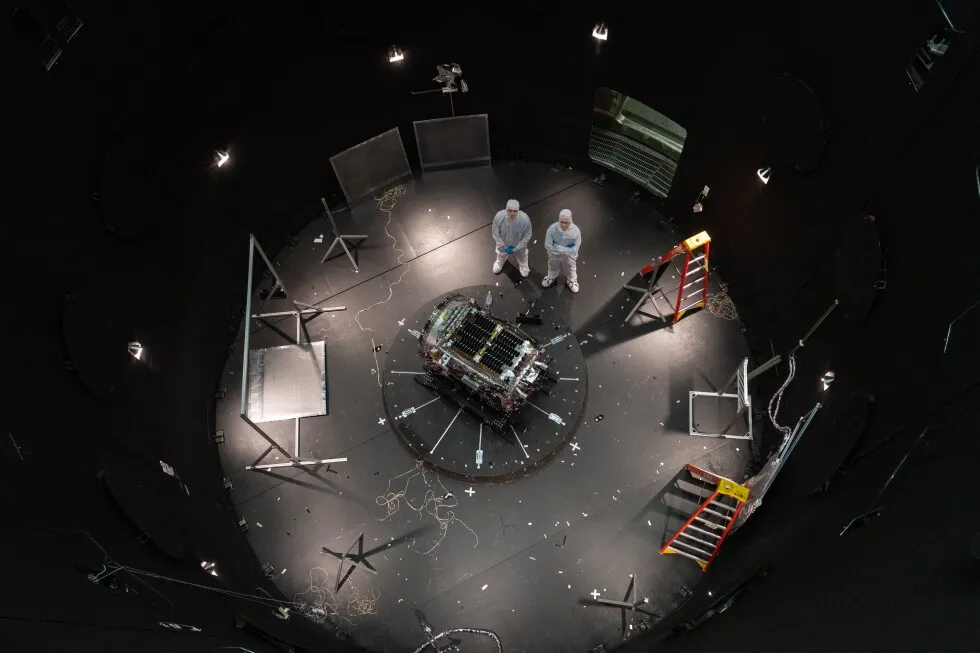
This photo provided by NASA shows Kieran Wilson, LINK’s principal investigator, and Hunter Robertson, a space systems engineer, both at Katalyst Space, standing next to their spacecraft inside the SES (Space Environment Simulator) at NASA’s Goddard Space Flight Center in Greenbelt, Md., April 17, 2026, ahead of thermal vacuum testing. (Sophia Roberts/NASA via AP, File) Updated [hour]:[minute] [AMPM] [timezone], [monthFull] [day], [year] CAPE CANAVERAL, Fla. (AP) — A private spacecraft that was supposed to supply a lifeline to NASA’s Swift Observatory managed to get close to the sinking telescope and even snap photos more than a week after the rescue was abandoned.But the three-armed robotic salvager had to turn away because of low fuel, according to Katalyst-space-technologies" class="entity-link entity-organization" data-entity-id="154235" data-entity-type="organization">Katalyst Space Technologies, which attempted the daring operation.“We got so close, but so far,” Katalyst CEO Ghonhee Lee told The Associated Press this week. Katalyst’s Link spacecraft got within 15 kilometers (nine miles) of Swift last weekend, using its own sensors to gather data on the doomed telescope for NASA. The rescue effort had already been called off in August because of Link’s own troubles in orbit, but the company wanted the practice for future satellite service calls.Link went into an uncontrollable spin soon after rocketing to Swift’s rescue in July. Flight controllers managed to reduce the tumble and stabilize the spacecraft, using up precious fuel. In the end, there wasn’t enough fuel remaining to boost the aging Swift to a higher, longer-lasting orbit so it could continue observing the cosmos. Lee blamed Link’s problems on the rush to get it flying. The mission was thrown together in just nine months, and engineers often had to grab whatever was available instead of waiting for the preferred parts, he said.NASA paid the company $30 million to carry out the attempt, which was always going to be rushed. Both sides viewed it as an experiment with little to lose, although no one wanted a wreck that would unleash clouds of space debris. 2 MIN READ 2 MIN READ 1 MIN READ “Unfortunately, it wasn’t the outcome that we were expecting,” NASA Administrator Jared Isaacman said following Sunday’s launch of the Roman Space Telescope. “But that’s exactly the type of missions that we should be flying at NASA. We will learn from that.” Isaacman said it makes sense to extend the life of a valuable spacecraft, especially if the cost to salvage it is less than to replace it. That’s why the Roman telescope was designed to be refuelable even though it’s headed toward an observation point 1 million miles (1.6 million kilometers) away.It’s unlikely that Link has enough fuel left to attempt another close approach to Swift, according to Lee. But it can keep exercising its 3-foot (1-meter) arms and provide important data before it reenters and burns up in the atmosphere sometime in the next month, he said. Launched in 2004, Swift has a little more time remaining in orbit, depending on how active the sun is. Intense solar storms of recent years are responsible for bringing the telescope down much sooner than expected. NASA anticipates Swift will plunge through the atmosphere sometime between October and year’s end. The space agency resumed observations with the telescope last week after halting them early this year to save precious power. Like Swift, the Hubble Space Telescope’s orbit also has been shortened by solar activity. Katalyst is developing a next-generation spacecraft that could boost the 36-year-old Hubble to a longer-lasting orbit.“Hubble does still have a few years of life yet, right? So the good news is this isn’t imminent,” Lee said.
SRCAssociated Press (AP)
LANGEN
LEANCenter
WORDS593
ENT11
FRI · 2026-09-04 · 15:23 GMTBRIEF NSR-2026-0904-109261
NSR-2026-0904-109261News Report·EN·Technology
Rescue satellite gets close to NASA’s doomed telescope, even if it can’t save it
Katalyst Space Technologies' Link spacecraft attempted to reach NASA's Swift Observatory to extend its life, but the mission was abandoned due to Link's low fuel. The Link spacecraft got within 15 kilometers of Swift, collecting data for NASA, after its own orbital stabilization issues in July consumed precious fuel.
By
MARCIA DUNNAssociated Press (AP)Filed 2026-09-04 · 15:23 GMTLean · CenterRead · 3 min
Associated Press (AP)FIG 01
Reading time
3min
Word count
593words
Sources cited
3cited
Entities identified
11entities
Quality score
100%
§ 01
Briefing Summary
AI-generatedNEWSAR · AI
Katalyst Space Technologies' Link spacecraft attempted to reach NASA's Swift Observatory to extend its life, but the mission was abandoned due to Link's low fuel. The Link spacecraft got within 15 kilometers of Swift, collecting data for NASA, after its own orbital stabilization issues in July consumed precious fuel. These issues stemmed from a rushed development process for the Link mission. Although the rescue was unsuccessful, Katalyst aims to use the experience for future satellite servicing. NASA anticipates Swift will reenter Earth's atmosphere by year's end due to solar storm activity. Katalyst is also developing technology for servicing the Hubble Space Telescope.
Confidence 0.90Sources 3Claims 5Entities 11
§ 02
Article analysis
Model · rule-basedFraming
Technology
Human Interest
Tone
Measured
AI-assessed
CalmNeutralAlarmist
Factuality
0.80 / 1.00
Factual
LowHigh
Sources cited
3
Well sourced
FewMany
§ 03
Key claims
5 extracted01
NASA Administrator Jared Isaacman stated that such missions, even if unsuccessful, are valuable for learning and advancing technology like refuelable telescopes.
quoteJared Isaacman
Confidence
1.00
02
The rescue attempt was abandoned in August because Link experienced an uncontrollable spin after launch, depleting its fuel.
factualKatalyst Space Technologies
Confidence
0.90
03
A private spacecraft, Link, got within 15 kilometers of NASA's Swift Observatory but could not complete the rescue due to low fuel.
factualKatalyst Space Technologies
Confidence
0.90
04
NASA paid Katalyst Space Technologies $30 million for the rescue attempt, viewing it as an experiment with little to lose.
factualAssociated Press
Confidence
0.80
05
The Link spacecraft will continue to provide data before reentering the atmosphere within the next month.
predictionGhonhee Lee
Confidence
0.70
§ 04
Full report
3 min read · 593 words§ 05
Entities
11 identifiedKey playerOppositionContextPositiveNeutralNegative
People4
Organizations3
§ 06
Keywords & salience
9 termsnasa's swift observatory
1.00
rescue satellite
1.00
satellite servicing
0.90
katalyst space technologies
0.80
spacecraft
0.70
low fuel
0.60
space debris
0.50
thermal vacuum testing
0.40
roman space telescope
0.40
§ 07
Topic connections
Interactive graph Network visualization showing 37 related topics
View Full Graph Person Organization Location Event|Click node to navigate|Edge numbers = shared articles