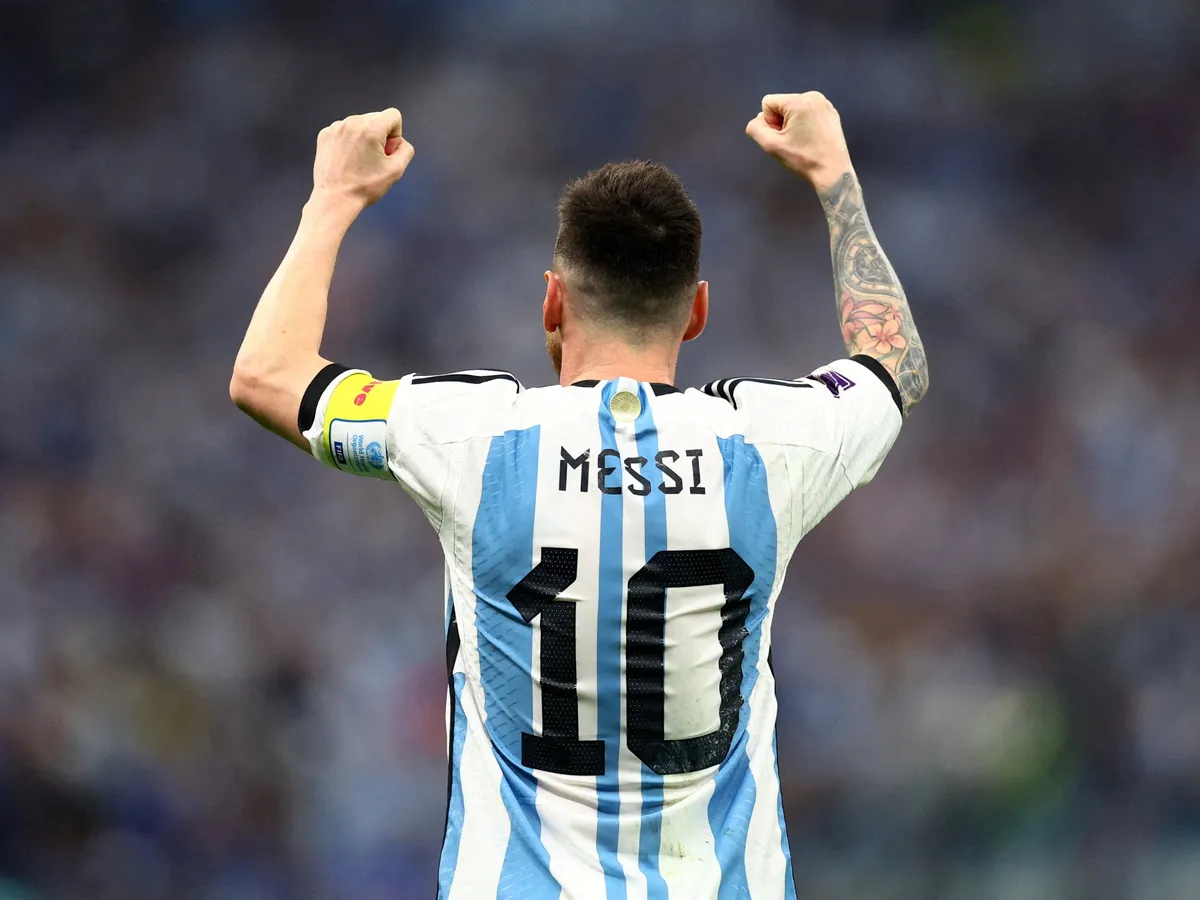
Maradona and Messi made the shirt their own in very different ways. The next great Argentinian player should have the chance to do the same.Argentine sports journalist, author and columnist.Published On 4 Sep 2026Argentina's Lionel Messi celebrates scoring their first goal against Croatia at the Fifa World Cup Qatar Semi Final on December 13, 2022 [Carl Recine/Reuters]When Lionel Messi announced his retirement from the Argentina national team last Monday, the reaction bordered on national mourning. Children cried in schools, journalists shed tears on television, newspapers filled their pages with emotional tributes and a telephone line was even opened for fans to express their gratitude to their idol. All weekend matches in Argentina were briefly stopped in the tenth minute as a tribute to the idol.“I emptied myself. I have nothing more to give,” Messi wrote in his farewell.It was an extraordinary end to an extraordinary relationship. For more than two decades, Messi had carried the expectations of a country that could never quite decide what it wanted him to be. He was compared endlessly with Diego Maradona, criticised for not displaying the same kind of passion and, for years, accused of somehow being less Argentinian because he had left for Barcelona as a child.Yet by the time he walked away, the relationship between Messi and Argentina had been transformed. The player once treated as an outsider had become a national symbol in his own right.“And we are full,” Jorge Valdano, a World Cup winner with Argentina in 1986, replied to Messi’s farewell. Messi may have emptied himself, but Argentina was full of everything he had given it.Messi played 207 official matches over 21 years with his national team, an entire lifetime. He scored 125 goals and provided 68 assists. With him on the pitch, Argentina began every match with almost a goal guaranteed. He played in six World Cups, won one in Qatar in 2022, and reached two other finals. The last came less than two months ago in the United States, where, at 39 years old, he had his most productive World Cup, scoring eight goals and providing four assists.His last great display came in the semifinal against England in Atlanta. Argentina trailed until the final minutes before staging a spectacular comeback to win 2-1, one of the most celebrated victories in the history of the national team.For Argentina, beating England has never been just about football. The rivalry is inseparable from the dispute over the Malvinas Islands and the 1982 war. After the semifinal, the players unfurled a defiant anti-colonialist banner asserting Argentina’s claim. Beating England means beating the old Empire. And for Argentinian football, it inevitably evokes another number 10: Maradona, whose defining 1986 World Cup included that other historic victory over England.Messi’s own victory over England would prove to be his last great display. Four days later, there was little left. Exhausted, he was barely involved as Spain dominated the final but needed extra time to win 1-0. “My legs gave out on me,” he later wrote in a public letter to his father, who died 20 days after the match.Much of the international press accused Messi and Argentina of “not knowing how to lose”. As Spain received the World Cup a few metres (feet) away, the Argentinian players remained on the pitch with their backs turned towards the ceremony, after a few of them had been involved in a brief but ugly confrontation following the match.The scene was not pleasant. But look at it through Messi’s eyes, and it becomes something else. He stood still, tears in his eyes, looking towards the supporters who loved him. What others saw as gracelessness in defeat was also a farewell. Messi already knew that this was goodbye. And, for the first time, his dying father could not be there with him.Messi had once been criticised relentlessly in Argentina because, for all his success elsewhere, he spent more than a decade failing to win a major title with the national team. He even walked away from it once, in 2016, before coming back. Today, he leaves as a symbol of persistence, a rarity in times when everything is fleeting.His departure has also prompted calls for Argentina to retire the number 10 shirt in his honour.The Argentine Football Association (AFA), which published an emotional farewell video, will not do so. In official competitions, FIFA’s squad-numbering rules make that impossible. Argentina has been here before.When Diego Maradona died in 2020, during the social isolation of the COVID-19 pandemic, the grief was overwhelming. “I would steal Maradona’s coffin and carry it through every neighbourhood of poor kids … until the sun, the rain, the earth and the wind turned it into ashes that would fly across the entire territory of the homeland,” the poet Liliana Campazzo wrote at the time.There were calls then, too, to retire the number 10. But doing so would have taken the shirt away from Messi, who had worn it for Argentina since 2009 and was still writing his own history in it.That matters because in Argentinian football, the number 10 has never been just a squad number. Traditionally worn by the great creative player, it became a distinction reserved for the true genius of the team. Maradona gave it eternal significance after Mexico 1986. Messi then made it his own.Pele had already made the number 10 synonymous with footballing genius on the world stage, and generations of great players followed. But nowhere has the shirt carried quite the same weight as in Argentina, where it passed from Maradona to Messi.Maradona and Messi played in 10 of the last 12 World Cups in which Argentina competed. Each won one: Maradona in 1986 and Messi in 2022. Between them came three more appearances in World Cup finals: Italy 1990 for Diego, Brazil 2014 and the United States in 2026 for Leo. Together, they scored 29 World Cup goals.The numbers tell us how much Argentina owed them on the pitch. They do not explain what each came to mean beyond it. And the two men could hardly have been more different.Diego was all excess, generosity and caprice. Millions of Argentinians became his “emotional slaves”, as the Spanish journalist Ramon Besa once wrote. Leo, by contrast, has always been far more reserved, perhaps because he witnessed Diego’s decline at close quarters and saw the price of fame.Messi did not inherit Maradona’s number by becoming another Maradona. He carried the same enormous expectation in an entirely different way and, eventually, made the number his own. Whoever comes next will have to do the same.These are days of mourning and orphanhood for the national team. Argentina has lost Maradona, and now, from the pitch at least, it has lost Messi. But Argentina has always been a factory of great players, and football lives on the hope that there can always be another.In Spanish, we say “no hay dos sin tres”: “There is no two without three”. There is no third yet. Perhaps there never will be another Maradona or another Messi. But retiring the number 10 would mean giving up on the possibility.Argentina is not ready to do that.The views expressed in this article are the author’s own and do not necessarily reflect Al Jazeera’s editorial stance.
SRCAl Jazeera
LANGEN
LEANCenter
WORDS1 204
ENT11
FRI · 2026-09-04 · 16:31 GMTBRIEF NSR-2026-0904-109271
NSR-2026-0904-109271Opinion·EN·Human Interest
The number 10 shirt must not retire with Messi
Lionel Messi has retired from the Argentina national team after a 21-year career, during which he became a national symbol and led the team to a World Cup victory in 2022. His departure, marked by widespread national emotion, has sparked debate about retiring the iconic number 10 shirt.
Ezequiel Fernández MooresAl JazeeraFiled 2026-09-04 · 16:31 GMTLean · CenterRead · 5 min
Al JazeeraFIG 01
Reading time
5min
Word count
1 204words
Sources cited
1cited
Entities identified
11entities
Quality score
100%
§ 01
Briefing Summary
AI-generatedNEWSAR · AI
Lionel Messi has retired from the Argentina national team after a 21-year career, during which he became a national symbol and led the team to a World Cup victory in 2022. His departure, marked by widespread national emotion, has sparked debate about retiring the iconic number 10 shirt. However, the Argentine Football Association will not retire the number, citing FIFA rules and the precedent set when Diego Maradona passed away and the shirt remained available for Messi. The article highlights how both Maradona and Messi made the number 10 their own, suggesting the next great Argentinian player should have the same opportunity.
Confidence 0.90Sources 1Claims 5Entities 11
§ 02
Article analysis
Model · rule-basedFraming
Human Interest
Conflict
Tone
Mixed Tone
AI-assessed
CalmNeutralAlarmist
Factuality
0.40 / 1.00
Mixed
LowHigh
Sources cited
1
Limited
FewMany
§ 03
Key claims
5 extracted01
The number 10 shirt should not retire with Messi and should be available for the next great Argentinian player.
factual
Confidence
1.00
02
Messi won the World Cup in Qatar in 2022.
factual
Confidence
1.00
03
Messi played 207 official matches over 21 years with his national team, scoring 125 goals and providing 68 assists.
statistic
Confidence
1.00
04
Lionel Messi announced his retirement from the Argentina national team.
factual
Confidence
1.00
05
Argentina's victory over England in the 2022 World Cup semifinal was linked to the Malvinas Islands dispute and the 1982 war.
factual
Confidence
0.80
§ 04
Full report
5 min read · 1 204 words§ 05
Entities
11 identifiedKey playerOppositionContextPositiveNeutralNegative
People3
Organizations2
Locations5
§ 06
Keywords & salience
8 termsmessi retirement
1.00
argentina national team
0.90
number 10 shirt
0.80
diego maradona
0.70
world cup qatar 2022
0.60
football legacy
0.50
national symbol
0.50
malvinas rivalry
0.40
§ 07
Topic connections
Interactive graph Network visualization showing 51 related topics
View Full Graph Person Organization Location Event|Click node to navigate|Edge numbers = shared articles