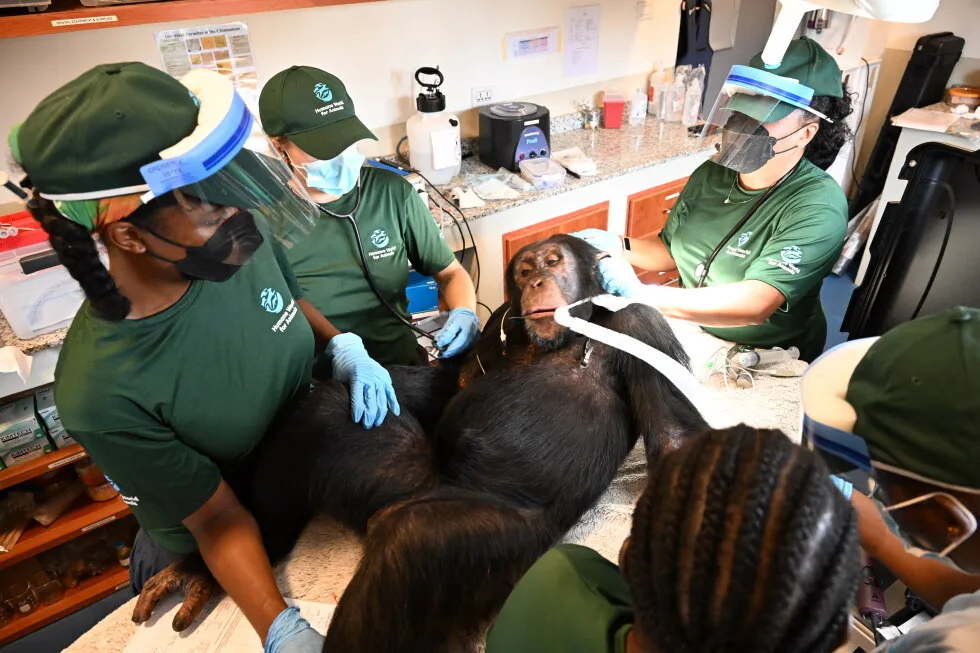
Chimpanzees once used for vaccine research get health checks as part of long-term care 1 of 4 | In this handout photo released by Humane World for Animals, a chimpanzee formerly used in research receives a comprehensive health check at a retirement sanctuary for Chimpanzees, in Bapakwali, Liberia, on Aug. 25, 2026. (Humane World for Animals via AP) 2 of 4 | In this handout photo released by Humane World for Animals, a chimpanzee formerly used in research receives a comprehensive health check at a retirement sanctuary for Chimpanzees, in Bapakwali, Liberia, on Aug. 25, 2026. (Humane World for Animals via AP) 3 of 4 | In this handout photo released by Humane World for Animals, a chimpanzee formerly used in research receives a comprehensive health check at a retirement sanctuary for Chimpanzees, in Bapakwali, Liberia, on Aug. 25, 2026. (Humane World for Animals via AP) 4 of 4 | In this handout photo released by Humane World for Animals, a chimpanzee formerly used in research receives a comprehensive health check at a retirement sanctuary for Chimpanzees, in Bapakwali, Liberia, Tuesday, Aug. 25, 2026. (Humane World for Animals via AP) 1 of 4 | In this handout photo released by Humane World for Animals, a chimpanzee formerly used in research receives a comprehensive health check at a retirement sanctuary for Chimpanzees, in Bapakwali, Liberia, on Aug. 25, 2026. (Humane World for Animals via AP) 1 of 4 In this handout photo released by Humane World for Animals, a chimpanzee formerly used in research receives a comprehensive health check at a retirement sanctuary for Chimpanzees, in Bapakwali, Liberia, on Aug. 25, 2026. (Humane World for Animals via AP) Add AP News on Google Add AP News as your preferred source to see more of our stories on Google. Share 2 of 4 | In this handout photo released by Humane World for Animals, a chimpanzee formerly used in research receives a comprehensive health check at a retirement sanctuary for Chimpanzees, in Bapakwali, Liberia, on Aug. 25, 2026. (Humane World for Animals via AP) 2 of 4 In this handout photo released by Humane World for Animals, a chimpanzee formerly used in research receives a comprehensive health check at a retirement sanctuary for Chimpanzees, in Bapakwali, Liberia, on Aug. 25, 2026. (Humane World for Animals via AP) Add AP News on Google Add AP News as your preferred source to see more of our stories on Google. Share 3 of 4 | In this handout photo released by Humane World for Animals, a chimpanzee formerly used in research receives a comprehensive health check at a retirement sanctuary for Chimpanzees, in Bapakwali, Liberia, on Aug. 25, 2026. (Humane World for Animals via AP) 3 of 4 In this handout photo released by Humane World for Animals, a chimpanzee formerly used in research receives a comprehensive health check at a retirement sanctuary for Chimpanzees, in Bapakwali, Liberia, on Aug. 25, 2026. (Humane World for Animals via AP) Add AP News on Google Add AP News as your preferred source to see more of our stories on Google. Share 4 of 4 | In this handout photo released by Humane World for Animals, a chimpanzee formerly used in research receives a comprehensive health check at a retirement sanctuary for Chimpanzees, in Bapakwali, Liberia, Tuesday, Aug. 25, 2026. (Humane World for Animals via AP) 4 of 4 In this handout photo released by Humane World for Animals, a chimpanzee formerly used in research receives a comprehensive health check at a retirement sanctuary for Chimpanzees, in Bapakwali, Liberia, Tuesday, Aug. 25, 2026. (Humane World for Animals via AP) Add AP News on Google Add AP News as your preferred source to see more of our stories on Google. Share Updated [hour]:[minute] [AMPM] [timezone], [monthFull] [day], [year] ABUJA, Nigeria (AP) — A group of Chimpanzees that were once used for hepatitis B vaccine experiments in laboratories have received health checks at their new home in Liberia, in hopes of giving them a second chance at a normal life.The West African Chimpanzees received checks ranging from teeth cleaning to X-rays and pedicure at the Humane World for Animals’ Second Chance Chimpanzee Refuge in central Liberia, Liliana Pacheco Ricote, director of the sanctuary, told The Associated Press.More than 400 of the Chimpanzees had been used by American researchers in Liberia in the hepatitis B vaccine experiments from the 1970s until early 2000s, Ricote said, many of them captured in the wild as infants.Liberia has the second-highest number of Chimpanzees in West Africa, after Guinea. The West African Chimpanzees are classified as critically endangered species because of their rapidly declining numbers. “They were used in very invasive research … (and) went through a lot of experiments and pain,” Ricote said.Humane World for Animals said that in 2015, it assumed permanent responsibility for 60 of the Chimpanzees that were remaining at the end of the research program. The chimps now mostly live at the sanctuary on a series of mangrove forest-covered islands.The checks carried out under anesthetic gave the Chimpanzees head-to-toe exams to assess their long-term health, detect any early signs of disease and tailor care plans for individuals as they age, Humane World for Animals said in a statement to the AP. The tests included dental examination, the heart, lungs and nervous system as well as blood. They get booster vaccinations and fingernail trims, it said, adding that plans are in place to carry out the checks on the remaining ones. “The health checks are a vital part of caring for these Chimpanzees who have been through so much,” said Belen Perez Hernando, the sanctuary’s veterinarian.The extent of the impact of the experiments on the chimps, whose average age is 30 to 35, is unclear, as findings from the assessments are yet to be concluded. However, “for those who were under experiments, you could still feel the hurt and the pain that they went through,” Ricote said. “Seeing how much they hurt about what we’ve done, it gives me a lot of pleasure … to give them this second chance to live with dignity the life that they deserve,” she added.
SRCAssociated Press (AP)
LANGEN
LEANCenter
WORDS1 020
ENT6
SAT · 2026-09-05 · 09:53 GMTBRIEF NSR-2026-0905-109444
NSR-2026-0905-109444News Report·EN·Human Interest
Chimpanzees once used for vaccine research get health checks as part of long-term care
Chimpanzees formerly used in hepatitis B vaccine research in Liberia are now receiving comprehensive health checks at the Humane World for Animals’ Second Chance Chimpanzee Refuge. These checks, including dental care, X-rays, and blood tests, are part of a long-term care plan to assess their health and provide individualized care as they age.
By
CHINEDU ASADUAssociated Press (AP)Filed 2026-09-05 · 09:53 GMTLean · CenterRead · 5 min
Associated Press (AP)FIG 01
Reading time
5min
Word count
1 020words
Sources cited
1cited
Entities identified
6entities
Quality score
100%
§ 01
Briefing Summary
AI-generatedNEWSAR · AI
Chimpanzees formerly used in hepatitis B vaccine research in Liberia are now receiving comprehensive health checks at the Humane World for Animals’ Second Chance Chimpanzee Refuge. These checks, including dental care, X-rays, and blood tests, are part of a long-term care plan to assess their health and provide individualized care as they age. Over 400 chimpanzees were involved in American-led research from the 1970s to the early 2000s, with many captured as infants. In 2015, Humane World for Animals took responsibility for 60 of the remaining chimpanzees, aiming to give them a better quality of life. The sanctuary is providing these critically endangered animals with a safe environment and ongoing medical attention.
Confidence 0.90Sources 1Claims 5Entities 6
§ 02
Article analysis
Model · rule-basedFraming
Human Interest
Public Health
Tone
Measured
AI-assessed
CalmNeutralAlarmist
Factuality
0.80 / 1.00
Factual
LowHigh
Sources cited
1
Limited
FewMany
§ 03
Key claims
5 extracted01
Humane World for Animals provided the handout photos and information.
factualHumane World for Animals
Confidence
1.00
02
The health checks occurred on August 25, 2026.
factual
Confidence
1.00
03
The chimpanzees are housed at a retirement sanctuary in Bapakwali, Liberia.
factual
Confidence
1.00
04
The health checks are part of long-term care for these chimpanzees.
factual
Confidence
1.00
05
Chimpanzees formerly used in vaccine research are receiving health checks.
factual
Confidence
1.00
§ 04
Full report
5 min read · 1 020 words§ 05
Entities
6 identifiedKey playerOppositionContextPositiveNeutralNegative
Organizations3
§ 06
Keywords & salience
7 termschimpanzees
1.00
vaccine research
0.90
long-term care
0.80
retirement sanctuary
0.70
health checks
0.60
animal welfare
0.50
liberia
0.40
§ 07
Topic connections
Interactive graph No topic relationship data available yet. This graph will appear once topic relationships have been computed.