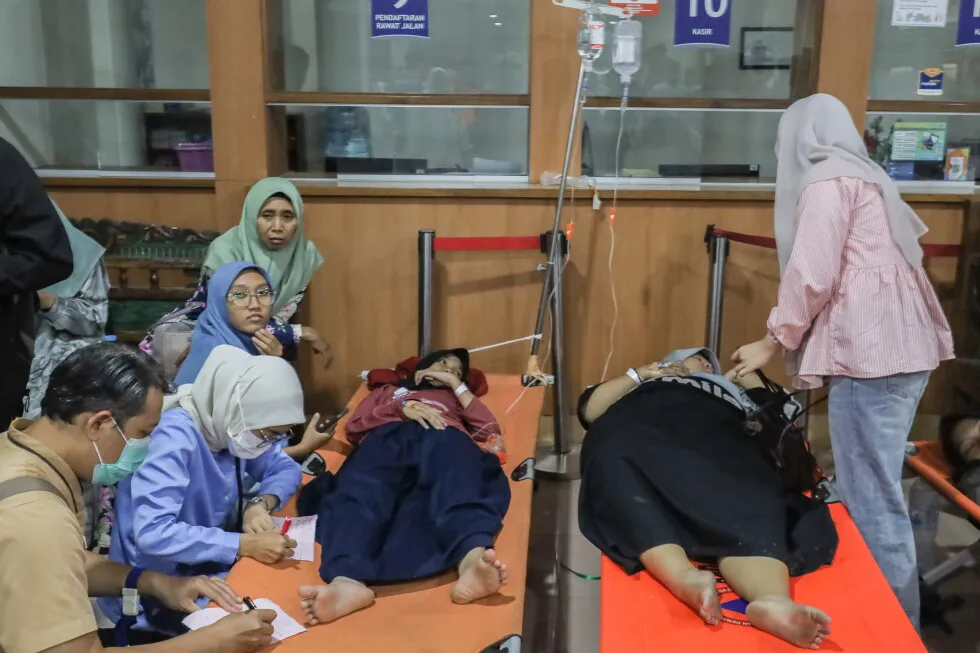
Students who fell ill allegedly due to food poisoning after consuming free meals at their school receive medical treatment at a hospital in Sidoarjo, East Java, Indonesia, Wednesday, Sept. 2, 2026. (AP Photo/Jusuf Aydin) By NINIEK KARMINI Updated 11:17 AM MESZ, September 5, 2026 Add AP News on Google Add AP News as your preferred source to see more of our stories on Google. Share Share Facebook Copy Link copied Print Email X LinkedIn Bluesky Flipboard Pinterest Reddit JAKARTA, Indonesia (AP) — Nearly 2,000 people, most of them students, fell ill in suspected food poisoning outbreaks linked to President Prabowo Subianto ’s flagship Free Nutritious Meals program this week, raising fresh concerns about food safety as the government rapidly expands the multibillion-dollar initiative nationwide, officials said Saturday. The incidents, reported between Tuesday and Thursday in East Java, Central Java, West Sumatra, Aceh and South Sulawesi, affected about 1,950 students, teachers and Islamic boarding school pupils who became sick after consuming meals distributed under the government program, known by its Indonesian acronym MBG. The outbreaks are the latest setback for Prabowo’s signature free meals program, which has been rolled out across the archipelago despite repeated food poisoning incidents and corruption allegations. The largest outbreak was reported in Central Java’s Rembang regency, where 752 students and 25 teachers at State Senior High School 1 Lasem, suffered diarrhea, nausea, vomiting and stomach pain after eating meals provided through the program, according to Rembang Health Office head Ali Syofi’i. In Sidoarjo, East Java, 730 people, most of them students at the Manbaul Hikam Islamic boarding school, were affected in another suspected food poisoning incident linked to the program. Sidoarjo health office chief Lakhsmie Herawati Yuwantina said 706 victims had been discharged and were recovering at home. Prabowo touts Indonesia’s economic growth and investment gains in State of the Nation address 1 MIN READ Indonesian police arrest 72 people suspected of starting forest fires 4 MIN READ Thousands in Indonesia await aid after quake kills 68, overshadowing Independence Day 4 MIN READ Authorities also reported 276 suspected cases involving students and teachers in Agam regency, West Sumatra, where food distribution from the local nutrition service center was suspended pending an investigation. In Aceh’s Bener Meriah regency, 15 elementary school students and a school principal were treated after experiencing dizziness, nausea and other symptoms following a school meal. Another 152 students from two junior high schools in Tana Toraja, South Sulawesi, were treated at three hospitals after developing symptoms consistent with food poisoning. Regent Zadrak Tombeq ordered hospitals and health centers to prioritize treatment for the victims. No deaths have been reported, and authorities are investigating the causes of the outbreaks. The latest incidents add to a growing number of food poisoning cases linked to the program since its launch in January 2025. According to Health Ministry surveillance data as of Sept. 2, food poisoning incidents associated with MBG have affected 50,059 people in 560 cases across 245 districts and cities in 36 provinces. In a hearing with the House’s Commission IX overseeing health issues, National Nutrition Agency chief Sudaryono said internal reviews found that roughly 80% to 90% of previous food poisoning incidents were linked to failures to follow food safety procedures, including rules governing food storage, receipt of ingredients, temperature control and consumption deadlines. “The recent incidents in Sidoarjo, Agam, Rembang and other areas have been a major blow for us,” said Sudaryono, who like many Indonesians uses a single name. He said the agency was tightening oversight of meal providers and reviewing about 27,000 meal distribution centers nationwide. Inspectors have found hundreds of allegedly fictitious facilities, while at least 833 kitchens have been shut down for failing to meet hygiene and sanitation standards. The free meals program aims to combat malnutrition and reduce childhood stunting by providing meals to nearly 90 million students, toddlers and pregnant women. The initiative, expected to cost about $28 billion through 2029, is a cornerstone of Prabowo’s administration and one of his key campaign promises.
SRCAssociated Press (AP)
LANGEN
LEANCenter
WORDS667
ENT12
SAT · 2026-09-05 · 09:23 GMTBRIEF NSR-2026-0905-109447
NSR-2026-0905-109447News Report·EN·Public Health
Nearly 2,000 fall ill in suspected food poisoning linked to Indonesia’s free school meals program
Nearly 2,000 people, primarily students, fell ill in suspected food poisoning outbreaks linked to Indonesia's Free Nutritious Meals program between Tuesday and Thursday. Incidents were reported across East Java, Central Java, West Sumatra, Aceh, and South Sulawesi, affecting approximately 1,950 individuals with symptoms like diarrhea and vomiting.
Associated Press (AP)Filed 2026-09-05 · 09:23 GMTLean · CenterRead · 3 min
Associated Press (AP)FIG 01
Reading time
3min
Word count
667words
Sources cited
4cited
Entities identified
12entities
Quality score
100%
§ 01
Briefing Summary
AI-generatedNEWSAR · AI
Nearly 2,000 people, primarily students, fell ill in suspected food poisoning outbreaks linked to Indonesia's Free Nutritious Meals program between Tuesday and Thursday. Incidents were reported across East Java, Central Java, West Sumatra, Aceh, and South Sulawesi, affecting approximately 1,950 individuals with symptoms like diarrhea and vomiting. These outbreaks represent a significant setback for President Prabowo Subianto's flagship initiative, which aims to combat malnutrition. Investigations into previous incidents revealed that 80-90% were due to failures in food safety procedures. Authorities are tightening oversight of meal providers and reviewing distribution centers, with hundreds of fictitious facilities found and many kitchens shut down for hygiene violations. The program, a cornerstone of Prabowo's administration, is intended to provide meals to nearly 90 million students, toddlers, and pregnant women.
Confidence 0.90Sources 4Claims 5Entities 12
§ 02
Article analysis
Model · rule-basedFraming
Public Health
Political Strategy
Tone
Mixed Tone
AI-assessed
CalmNeutralAlarmist
Factuality
0.80 / 1.00
Factual
LowHigh
Sources cited
4
Well sourced
FewMany
§ 03
Key claims
5 extracted01
Authorities are investigating the causes of the outbreaks.
factualarticle
Confidence
0.95
02
No deaths have been reported in connection with these outbreaks.
factualarticle
Confidence
0.95
03
The incidents occurred between Tuesday and Thursday in East Java, Central Java, West Sumatra, Aceh, and South Sulawesi.
factualarticle
Confidence
0.95
04
The largest outbreak was in Central Java's Rembang regency, affecting 752 students and 25 teachers.
statisticRembang Health Office head Ali Syofi’i
Confidence
0.90
05
Nearly 2,000 people, mostly students, fell ill in suspected food poisoning outbreaks linked to Indonesia's Free Nutritious Meals program.
statisticofficials
Confidence
0.90
§ 04
Full report
3 min read · 667 words§ 05
Entities
12 identifiedKey playerOppositionContextPositiveNeutralNegative
Locations9
§ 06
Keywords & salience
10 termsschool meals program
1.00
food poisoning
1.00
indonesia
0.90
food safety
0.80
students
0.70
outbreaks
0.60
government initiative
0.50
prabowo subianto
0.50
medical treatment
0.40
corruption allegations
0.40
§ 07
Topic connections
Interactive graph Network visualization showing 51 related topics
View Full Graph Person Organization Location Event|Click node to navigate|Edge numbers = shared articles