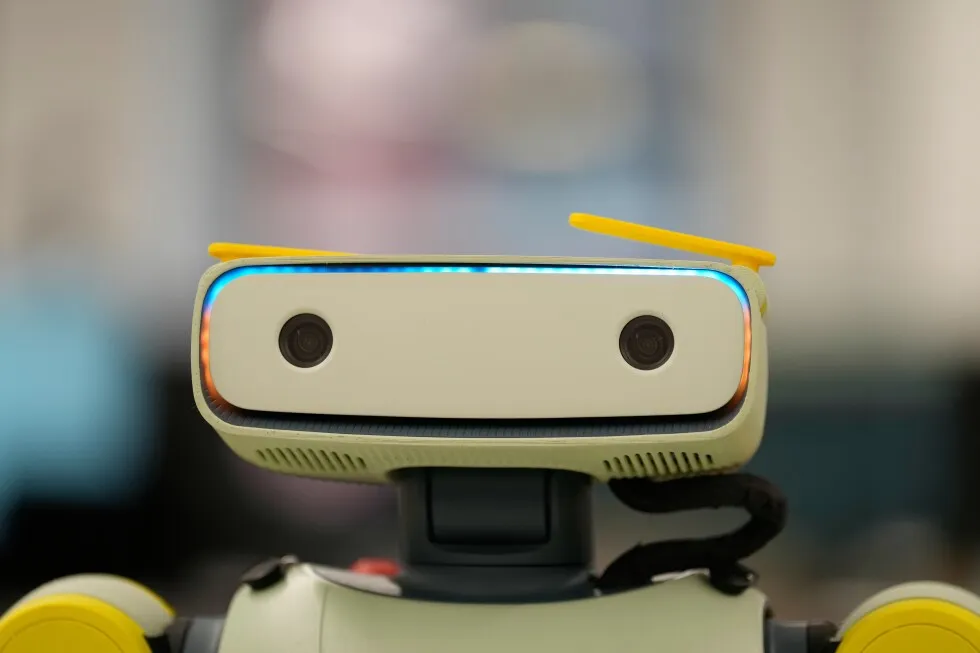
Not ready for robots in homes? The maker of a friendly new humanoid thinks it might change your mind 1 of 6 | Sprout, a 3 1/2-foot-tall humanoid from Fauna Robotics, debuts with a soft foam body, expressive moves and a friendly vibe. Built for human spaces, it’s aimed at developers and labs 2 of 6 | Fauna Robotics’ new robot, called Spout, is seen at their offices in New York, Wednesday, Jan. 14, 2026. (AP Photo/Seth Wenig) 3 of 6 | While being operated remotely, Fauna Robotics’ new robot named Sprout shows off its dexterity in New York, Wednesday, Jan. 14, 2026. (AP Photo/Seth Wenig) 4 of 6 | Fauna Robotics’ new robot, called Spout, gets up from the prone position to demonstrate its maneuverability in New York, Wednesday, Jan. 14, 2026. (AP Photo/Seth Wenig) 5 of 6 | Fauna Robotics VP of hardware Anthony Moshchella, left, and co-founders Josh Merel, center, and Rob Cochran, pose for a picture with Sprout, the company’s new robot, at their offices in New York, Wednesday, Jan. 14, 2026. (AP Photo/Seth Wenig) 6 of 6 | Fauna Robotics’ new robot, called Spout, is seen at their offices in New York, Wednesday, Jan. 14, 2026. (AP Photo/Seth Wenig) 1 of 6 Sprout, a 3 1/2-foot-tall humanoid from Fauna Robotics, debuts with a soft foam body, expressive moves and a friendly vibe. Built for human spaces, it’s aimed at developers and labs Add AP News on Google Add AP News as your preferred source to see more of our stories on Google. 2 of 6 Fauna Robotics’ new robot, called Spout, is seen at their offices in New York, Wednesday, Jan. 14, 2026. (AP Photo/Seth Wenig) Add AP News on Google Add AP News as your preferred source to see more of our stories on Google. 3 of 6 While being operated remotely, Fauna Robotics’ new robot named Sprout shows off its dexterity in New York, Wednesday, Jan. 14, 2026. (AP Photo/Seth Wenig) Add AP News on Google Add AP News as your preferred source to see more of our stories on Google. 4 of 6 Fauna Robotics’ new robot, called Spout, gets up from the prone position to demonstrate its maneuverability in New York, Wednesday, Jan. 14, 2026. (AP Photo/Seth Wenig) Add AP News on Google Add AP News as your preferred source to see more of our stories on Google. 5 of 6 Fauna Robotics VP of hardware Anthony Moshchella, left, and co-founders Josh Merel, center, and Rob Cochran, pose for a picture with Sprout, the company’s new robot, at their offices in New York, Wednesday, Jan. 14, 2026. (AP Photo/Seth Wenig) Add AP News on Google Add AP News as your preferred source to see more of our stories on Google. 6 of 6 Fauna Robotics’ new robot, called Spout, is seen at their offices in New York, Wednesday, Jan. 14, 2026. (AP Photo/Seth Wenig) Add AP News on Google Add AP News as your preferred source to see more of our stories on Google. Updated [hour]:[minute] [AMPM] [timezone], [monthFull] [day], [year] New York (AP) — As the new robot called Sprout walks around a Manhattan office, nodding its rectangular head, lifting its windshield wiper-like “eyebrows” and offering to shake your hand with its grippers, it looks nothing like the sleek and intimidating humanoids built by companies like Tesla.Sprout’s charm is the point. A 5-year-old child could comfortably talk at eye level with this humanoid, which stands 3.5 feet (1 meter) tall and wears a soft, padded exterior of sage-green foam.Forged by stealth startup Fauna Robotics over two years of secret research and development, Sprout’s public debut on Tuesday aims to jump-start a whole new industry of building “approachable” robots for homes, schools and social spaces. The robot is in many ways the first of its kind, at least in the United States, even as rapid advances in artificial intelligence and robot engineering have finally made it possible to start building such machines. If its emotive expressions and blinking lights seem vaguely familiar, it might be from generations of Star Wars droids and other endearingly clunky robotic sidekicks dreamed up in animation studios and children’s literature. “Most people in this industry take inspiration from the science fiction that we grew up with,” said Fauna Robotics co-founder and CEO Rob Cochran. “I think some do so from ‘Westworld’ and ‘Terminator.’ We do from WALL-E and Baymax and Rosie Jetson.” Making a business case for robots that won’t work in car assembly linesThe usual hypothesis for the commercialization of humanoid robots is that they will get their first jobs in warehouses or factories long before they are ready for homes. That’s the path proposed for two of today’s best-known prototypes: Tesla’s Optimus, which CEO Elon Musk sees as the carmaker’s future, and Boston Dynamics’ Atlas, which parent company Hyundai plans to deploy in car manufacturing by 2028.Fauna looks to skip that step for an entirely different clientele: other robot tinkerers. Much as early personal computers and, later, smartphones sparked a culture of developers designing new games and applications, Sprout is a software developer platform more than just a robot. It’s also a mechanically complex one that will cost buyers $50,000. That’s a price some university research labs and technology entrepreneurs are already spending on China’s Unitree, which sells a lightweight humanoid often seen at robotics conferences and competitions. Others have avoided Chinese hardware due to tariffs and broader security concerns.Cochran believes Fauna is “the first American company to be actively shipping robots as a developer platform” and has been hand-delivering the first models. Early customers include Disney and Boston Dynamics.“You take it out of the box and you can start walking it around immediately,” said Marc Theermann, chief strategy officer at Boston Dynamics, in a recent interview. “Seeing their robot for the first time really lets you see the future a little bit. And if you squint, you can see how a robot like that would be welcomed into people’s homes.” Inside the testing grounds for a ‘friendly humanoid’ robot Sprout can’t lift heavy objects, but it can dance the Twist or the Floss, grab a toy block or teddy bear, or hoist itself from a chair to take a long stroll along the wood floors of Fauna’s headquarters in New York City’s Flatiron District.Cochran and co-founder Josh Merel, the company’s chief technology officer, demonstrated the robot to The Associated Press in mid-January ahead of its public launch. Fauna employees and an AP reporter piloted the robot, using a video game controller, a phone application and a virtual-reality headset. Sprout also knows the office layout enough to be sent on a planned mission, such as to check out the inventory of the break room refrigerator.It walks slowly but steadily on uneven ground. Only once it came close to tripping, taking a sharp turn to avoid a person and instead hitting its foot on a protruding table wheel too low to the ground to be seen by Sprout’s camera eyes. But the robot, built to handle what engineers call perturbation, quickly recovered its balance and kept walking, much like a clumsy person might. “If you step in front of it, it won’t crash into you, it’ll plan a new path around you,” said Ana Pervan, a Fauna research scientist who works on the robot’s mapping and navigation. Among the first batch of Fauna’s 50 employees, and a fan of science fiction writer Isaac Asimov, she previously worked on self-driving cars but was excited about joining a startup building something that might one day serve as a robot butler.“It’s cute, and it’s not too humanoid, and I think that actually makes it a lot more fun,” Pervan said. “It’s not verging on creepy or trying to be too human. It’s like your buddy, your pal, that’s a different thing than you.” Why Fauna’s founders believe now’s the time to bet on humanoidsStarting a robot company can be unforgiving, especially one designing personal robots. One of the few successes, Roomba vacuum maker iRobot, had a decades-long run before filing for bankruptcy protection last month.Most others didn’t last that long, like Anki, maker of the playful toy robot Cozmo, or Jibo, which went out of business less than a year after its dynamic talking speaker made the cover of Time Magazine’s 2017 “best inventions” edition.“There were a lot of really brilliant attempts. I think the technology wasn’t quite there,” Cochran said. “I do think we’re right on the precipice now where you could build a companion that is present, engaging, delightful to be around, and can also move around a space in a way that nothing ever has before.”Merel, an expert in robot locomotion, previously worked for Google’s DeepMind, where he focused on teaching robots using AI learning techniques in simulated environments, a controversial approach but now increasingly how robots are built. The science journal Nature published his study on an AI-powered virtual rat, co-authored with another of Fauna’s research scientists, Diego Aldarondo.Cochran and Merel later worked together at CTRL-labs, a wearable neurotech company sold to Facebook in 2019. Cochran jokes that he then “spent a misguided four years at Goldman Sachs” before they decided to team up again.Improvements in AI, motors and batteries have accelerated humanoid development. But Fauna’s founders agreed that the dystopian aesthetic of many prototypes — what Cochran calls “industrial automotive machismo” — conveyed strength and confidence but wouldn’t work for intimate human spaces. “They were generally quite big and physically dangerous to be around,” Cochran said. “Strong, heavy. If they fell on you, it’d be a real problem.”The duo brought in Anthony Moschella, who helped design Peloton’s exercise bikes, treadmills and rowers and is an admirer of the abstract designs of Star Wars robots like R2-D2 and BB-8. “Let’s build a system that human beings actually want to be around,” said Moschella, now Fauna’s vice president of hardware. “I think it’s incredible that so many robotics companies are not versed in the cultural context of what it means to be around a robot.”Moschella said what happens next with Sprout will depend on how developers play around with it and what they learn. For Cochran, some of the most important judges have already approved. In a home video he keeps on his phone, his 2-year-old twins excitedly jump up and down as Sprout greets them. O’Brien covers the business of technology and artificial intelligence for The Associated Press.
SRCAssociated Press (AP)
LANGEN
LEANCenter
WORDS1 734
ENT4
TUE · 2026-01-27 · 13:23 GMTBRIEF NSR-2026-0127-10973
NSR-2026-0127-10973News Report·EN·Technology
Not ready for robots in homes? The maker of a friendly new humanoid thinks it might change your mind
Fauna Robotics introduced Sprout, a 3 1/2-foot-tall humanoid robot, on Wednesday, January 14, 2026, in New York. Sprout is designed with a soft foam body, expressive movements, and a friendly appearance to be suitable for human environments.
By
MATT O’BRIENAssociated Press (AP)Filed 2026-01-27 · 13:23 GMTLean · CenterRead · 7 min
Associated Press (AP)FIG 01
Reading time
7min
Word count
1 734words
Sources cited
1cited
Entities identified
4entities
Quality score
100%
§ 01
Briefing Summary
AI-generatedNEWSAR · AI
Fauna Robotics introduced Sprout, a 3 1/2-foot-tall humanoid robot, on Wednesday, January 14, 2026, in New York. Sprout is designed with a soft foam body, expressive movements, and a friendly appearance to be suitable for human environments. The company aims to make robots more appealing for use in homes. Currently, Sprout is targeted towards developers and laboratories for research and development purposes. The robot is capable of demonstrating dexterity and maneuverability, including getting up from a prone position.
Confidence 0.90Sources 1Claims 4Entities 4
§ 02
Article analysis
Model · rule-basedFraming
Technology
Human Interest
Tone
Measured
AI-assessed
CalmNeutralAlarmist
Factuality
0.70 / 1.00
Factual
LowHigh
Sources cited
1
Limited
FewMany
§ 03
Key claims
4 extracted01
While being operated remotely, Fauna Robotics’ new robot named Sprout shows off its dexterity.
factualarticle
Confidence
1.00
02
Built for human spaces, it’s aimed at developers and labs
factualarticle
Confidence
1.00
03
Fauna Robotics’ new robot, called Spout, is seen at their offices in New York, Wednesday, Jan. 14, 2026.
factualarticle
Confidence
1.00
04
Sprout, a 3 1/2-foot-tall humanoid from Fauna Robotics, debuts with a soft foam body, expressive moves and a friendly vibe.
factualarticle
Confidence
1.00
§ 04
Full report
7 min read · 1 734 words§ 05
Entities
4 identifiedKey playerOppositionContextPositiveNeutralNegative
Locations1
§ 06
Keywords & salience
8 termssprout
0.90
humanoid robot
0.90
fauna robotics
0.80
robots in homes
0.70
maneuverability
0.60
dexterity
0.60
labs
0.50
developers
0.50
§ 07
Topic connections
Interactive graph No topic relationship data available yet. This graph will appear once topic relationships have been computed.