Russia and North Korea have opened the first road bridge across their shared border, in the latest sign of the rapidly deepening ties between the two countries since the start of the Ukraine" class="entity-link entity-event" data-entity-id="142386" data-entity-type="event">war in Ukraine.The one-kilometre bridge spans the Tumen River between Khasan in Russia’s far east and Tumangang in North Korea, along a remote and sparsely populated stretch of the countries’ shared border just a few miles from the coast.Speaking by video link during the bridge’s opening ceremony on Monday, Russia’s prime minister, Mikhail Mishustin, said the new crossing would spur development in a range of areas, including tourism, while creating new jobs“I am convinced that the expansion of cross-border transport infrastructure will provide a powerful impetus for the further development of trade, economic, scientific, technological and cultural cooperation,” Mishustin said.The road bridge is named after the Soviet officer Yakov Novichenko, who is credited with saving North Korea’s founding leader, Kim Il-sung, from an assassination attempt by a pro-South Korean group.A newly built bridge connects Khasan in Russia’s far east and Tumangang in North Korea. Photograph: Ministry of Transport of the Russian FederationAfter the opening ceremony, convoys of vehicles crossed the bridge from both sides.Russia and the secretive North Korea regime are already connected by a railway bridge across the Tumen, as well as regular flights between Vladivostok and Pyongyang.Ukrainian human rights groups have warned that the bridge may be intended to provide a discreet military logistics corridor between the two countries.Truth Hounds, a Ukrainian human rights organisation, has described it as a likely future corridor for moving North Korean troops, construction brigades and military officials into Russia, while allowing Russian technology and resources to travel in the opposite direction with less risk of detection.Ties between Moscow and Pyongyang have strengthened dramatically since Russia launched its full-scale invasion of Ukraine in 2022. North Korea has sent thousands of troops to Russia’s Kursk region to help Moscow repel a Ukrainian incursion launched there in 2024.In return, Russia is believed to have provided North Korea with air-defence missiles, electronic warfare equipment, drones and spy-satellite technology, according to South Korean intelligence.Russian and North Korean officials have also touted North Korea as a new holiday destination since the country reopened to Russian tourists in 2024, with thousands of Russians visiting its newly opened beach resorts and ski slopes since then.Russia’s increasingly close embrace of totalitarian North Korea has raised eyebrows even in Moscow.During an interview with the Russian broadcaster RBC last month, a reporter asked Sergei Lavrov, Russia’s longtime foreign minister, how the country had “ended up” with just “two allies – North Korea and Iran”.Lavrov pushed back against the premise, saying there was “nothing wrong” with such company.At the same time, some of Russia’s traditional partners have shown growing frustration with Moscow’s continuing Ukraine" class="entity-link entity-event" data-entity-id="142386" data-entity-type="event">war in Ukraine and the fallout it has caused across the region.During a meeting in July, Kazakhstan’s president, Kassym-Jomart Tokayev, a longtime ally of Moscow, told the Russian president, Vladimir Putin, that he was hearing from leaders of many countries who questioned why Russia was still waging the war.“The nature of the conflict isn’t entirely clear for many, including us,” Tokayev told Putin.
SRCThe Guardian - World News
LANGEN
LEANCenter-Left
WORDS524
ENT12
MON · 2026-09-07 · 09:53 GMTBRIEF NSR-2026-0907-109873
NSR-2026-0907-109873News Report·EN·Diplomatic
Russia and North Korea open first road bridge across their shared border
Russia and North Korea have opened the first road bridge across their shared border, spanning the Tumen River between Khasan, Russia, and Tumangang, North Korea. This new one-kilometer crossing, named after Soviet officer Yakov Novichenko, is seen as a further indication of deepening ties between the two nations since the start of the war in Ukraine.
Pjotr SauerThe Guardian - World NewsFiled 2026-09-07 · 09:53 GMTLean · Center-LeftRead · 3 min
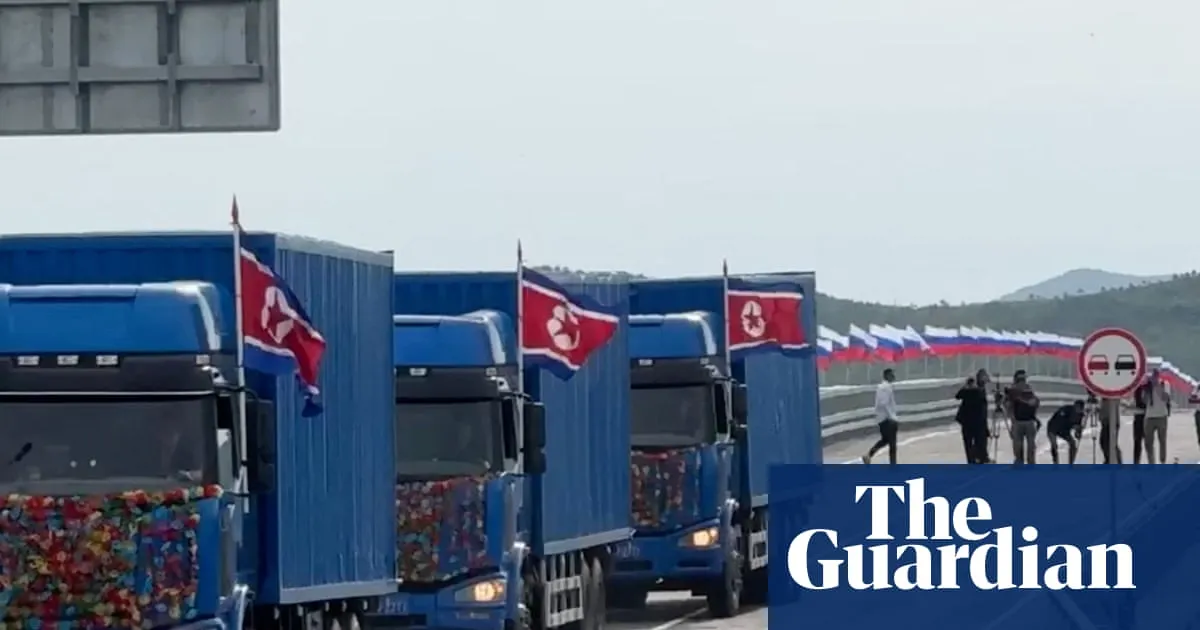
The Guardian - World NewsFIG 01
Reading time
3min
Word count
524words
Sources cited
3cited
Entities identified
12entities
Quality score
100%
§ 01
Briefing Summary
AI-generatedNEWSAR · AI
Russia and North Korea have opened the first road bridge across their shared border, spanning the Tumen River between Khasan, Russia, and Tumangang, North Korea. This new one-kilometer crossing, named after Soviet officer Yakov Novichenko, is seen as a further indication of deepening ties between the two nations since the start of the war in Ukraine. Russian Prime Minister Mikhail Mishustin stated the bridge will boost trade, tourism, and cooperation. However, Ukrainian human rights groups suggest it could also serve as a discreet military logistics corridor. Ties have strengthened significantly, with North Korea reportedly sending troops to Russia and receiving military technology in return, while also becoming a tourist destination for Russians.
Confidence 0.90Sources 3Claims 5Entities 12
§ 02
Article analysis
Model · rule-basedFraming
Diplomatic
National Security
Tone
Measured
AI-assessed
CalmNeutralAlarmist
Factuality
0.70 / 1.00
Factual
LowHigh
Sources cited
3
Well sourced
FewMany
§ 03
Key claims
5 extracted01
Russia and North Korea have opened the first road bridge across their shared border.
factual
Confidence
1.00
02
The new crossing would spur development in areas including tourism and create new jobs.
quoteMikhail Mishustin
Confidence
0.90
03
Russia is believed to have provided North Korea with air-defence missiles, electronic warfare equipment, drones and spy-satellite technology.
factualSouth Korean intelligence
Confidence
0.80
04
North Korea has sent thousands of troops to Russia’s Kursk region to help Moscow repel a Ukrainian incursion launched there in 2024.
factual
Confidence
0.80
05
The bridge may be intended to provide a discreet military logistics corridor between the two countries.
factualUkrainian human rights groups
Confidence
0.70
§ 04
Full report
3 min read · 524 words§ 05
Entities
12 identifiedKey playerOppositionContextPositiveNeutralNegative
People3
Organizations1
Locations7
§ 06
Keywords & salience
8 termsrussia north korea relations
1.00
border bridge
0.90
ukraine war
0.80
economic cooperation
0.70
military logistics
0.60
transport infrastructure
0.50
tourism development
0.40
geopolitical ties
0.40
§ 07
Topic connections
Interactive graph Network visualization showing 51 related topics
View Full Graph Person Organization Location Event|Click node to navigate|Edge numbers = shared articles