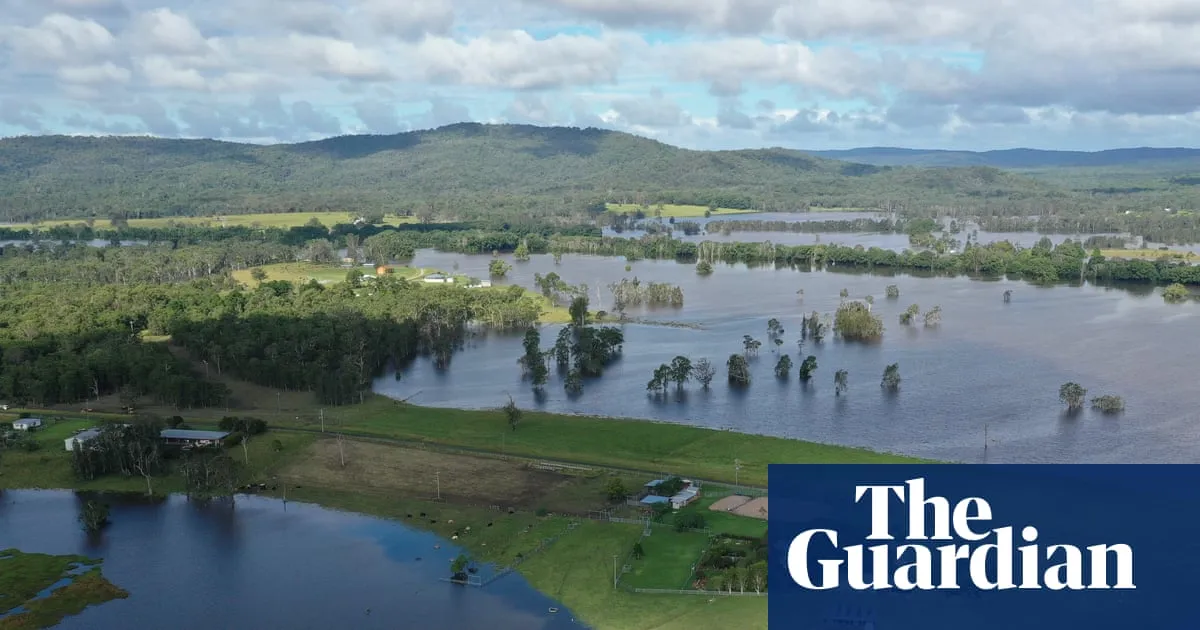
When grazier Peter Lake moved to the Clarence Valley in the New South Wales northern rivers region in 2007, he knew was “buying in flood country with … eyes open”.His cattle farm, about halfway between Yamba and Grafton, borders the Coldstream River and has flooded five times since 2009.“Out of 130 acres … in a major flood we would have maybe 15 acres that were flood-free,” he said. Lake has systems in place to prepare for such events, including moving cattle to the dry paddocks, where they would also store fodder to feed the animals.But the amount of safe ground is shrinking: in the historically big flood in 2022, “we only had just a few acres of flood-free land”. Because of both drought and frequent floods, “we just haven’t been able to successfully grow a fodder crop for some years”.“If we’re going to have more frequent and more severe major events … we need to change the way we think about how we manage,” Lake said. “If rising sea levels impact on us, it’ll just this make property less and less viable.”Grazier Peter Lake on his Clarence Valley cattle farm. Photograph: Peter LakeAgricultural damages are among $855.1bn in economic losses projected Australia-wide by the end of the century due to coastal flooding, according to a Climate Council report released on Thursday.The report forecasts that more than 267,000 coastal properties and 2m hectares (4.9m acres) of Australian land will be damaged by flooding by 2100 as sea levels rise.Queensland (93,157 properties), NSW (71,210) and Australia" class="entity-link entity-location" data-entity-id="706" data-entity-type="location">Western Australia (51,366) are the three states with the greatest number of homes at risk.The Gold Coast, Brisbane and Melbourne are the metropolitan areas expected to be worst affected.Coastal areas around Brisbane and the Gold Coast are at significant risk, the Climate Council says. Illustration: Climate CouncilThe Gold Coast, the country’s most exposed urban area, faces $84.4bn in projected economic losses, while in Melbourne, losses are concentrated in low-lying areas around Port Phillip Bay and the Yarra River.The Climate Council report is based on mapping coastal flooding by 2100, taking into account both sea level rise and storm surges under the climate scenario known as RCP4.5 – which projects a 2.7C increase in global temperature by the end of the century, similar to expected heating based on current policies worldwide.Coastal areas around Port Phillip Bay are vulnerable to rising seas. Illustration: Climate CouncilIt was co-authored by Prof Tom Kompas at the University of Melbourne, whose modelling of the economic impacts was also published in the peer-reviewed journal Scientific Reports and drew upon localised projections at 239 hotspots around Australia.skip past newsletter promotionafter newsletter promotionKompas said the costs – an estimated $274.3bn in property losses and $580.7bn in land use damages – were a conservative estimate, and did not take into account the additional impacts of coastal erosion or significant ice sheet melt.He said due to the scale of agricultural losses, there was a food security issue potentially coming as well: damage is projected to affect 619,713 hectares (1.5m acres) of farming land.A map showing coastal areas at risk in NSW and the projected economic damage. Illustration: Climate CouncilSea levels have risen, on average by more than 22cm globally since 1900, with human-caused global heating the dominant cause of the rise since 1970. An additional 14cm rise is expected in Australia by 2050, increasing the frequency of permanent inundation and tidal flooding.Kompas said that while reducing greenhouse gas emissions to limit global heating was of paramount importance, “we have to start planning and responding and adapting now”.“The nice thing about the work is it shows where the hotspots are and what … assets will be impacted. So we can start to plan for how to deal with that.“The first thing, of course, is not to build on flood plains, which is common still.”
SRCThe Guardian - World News
LANGEN
LEANCenter-Left
WORDS635
ENT12
WED · 2026-09-09 · 14:01 GMTBRIEF NSR-2026-0909-110001
NSR-2026-0909-110001News Report·EN·Economic Impact
Peter’s farm is on ‘flood country’. As Australia’s sea levels rise, safe land is vanishing and costs are huge
A Climate Council report forecasts significant economic losses and property damage in Australia due to rising sea levels and coastal flooding by 2100. Over 267,000 coastal properties and 2 million hectares of land are projected to be affected, with estimated damages totaling hundreds of billions of dollars.
Donna LuThe Guardian - World NewsFiled 2026-09-09 · 14:01 GMTLean · Center-LeftRead · 3 min
The Guardian - World NewsFIG 01
Reading time
3min
Word count
635words
Sources cited
2cited
Entities identified
12entities
Quality score
100%
§ 01
Briefing Summary
AI-generatedNEWSAR · AI
A Climate Council report forecasts significant economic losses and property damage in Australia due to rising sea levels and coastal flooding by 2100. Over 267,000 coastal properties and 2 million hectares of land are projected to be affected, with estimated damages totaling hundreds of billions of dollars. Queensland, New South Wales, and Western Australia are identified as the states with the most properties at risk. The report highlights the vulnerability of metropolitan areas like the Gold Coast, Brisbane, and Melbourne, with projected losses of $84.4 billion for the Gold Coast alone. These projections are based on a climate scenario anticipating a 2.7°C global temperature increase by the century's end. Experts emphasize the need for immediate planning and adaptation strategies, including discouraging construction on floodplains.
Confidence 0.90Sources 2Claims 5Entities 12
§ 02
Article analysis
Model · rule-basedFraming
Economic Impact
Environmental
Tone
Mixed Tone
AI-assessed
CalmNeutralAlarmist
Factuality
0.80 / 1.00
Factual
LowHigh
Sources cited
2
Limited
FewMany
§ 03
Key claims
5 extracted01
The projected economic costs of coastal flooding are a conservative estimate and do not include coastal erosion or ice sheet melt.
quoteProf Tom Kompas
Confidence
1.00
02
The Gold Coast faces $84.4 billion in projected economic losses due to coastal flooding.
statisticClimate Council report
Confidence
1.00
03
More than 267,000 coastal properties and 2 million hectares of Australian land will be damaged by flooding by 2100 as sea levels rise.
statisticClimate Council report
Confidence
1.00
04
Australia-wide economic losses projected due to coastal flooding by the end of the century are $855.1 billion.
statisticClimate Council report
Confidence
1.00
05
Peter Lake's cattle farm in Clarence Valley has experienced frequent flooding, with less flood-free land available in recent years.
quotePeter Lake
Confidence
1.00
§ 04
Full report
3 min read · 635 words§ 05
Entities
12 identifiedKey playerOppositionContextPositiveNeutralNegative
Organizations1
§ 06
Keywords & salience
10 termscoastal flooding
1.00
sea level rise
1.00
economic losses
0.90
climate change
0.80
agricultural damages
0.70
australia
0.60
property viability
0.50
clarence valley
0.50
storm surges
0.40
climate council
0.40
§ 07
Topic connections
Interactive graph No topic relationship data available yet. This graph will appear once topic relationships have been computed.