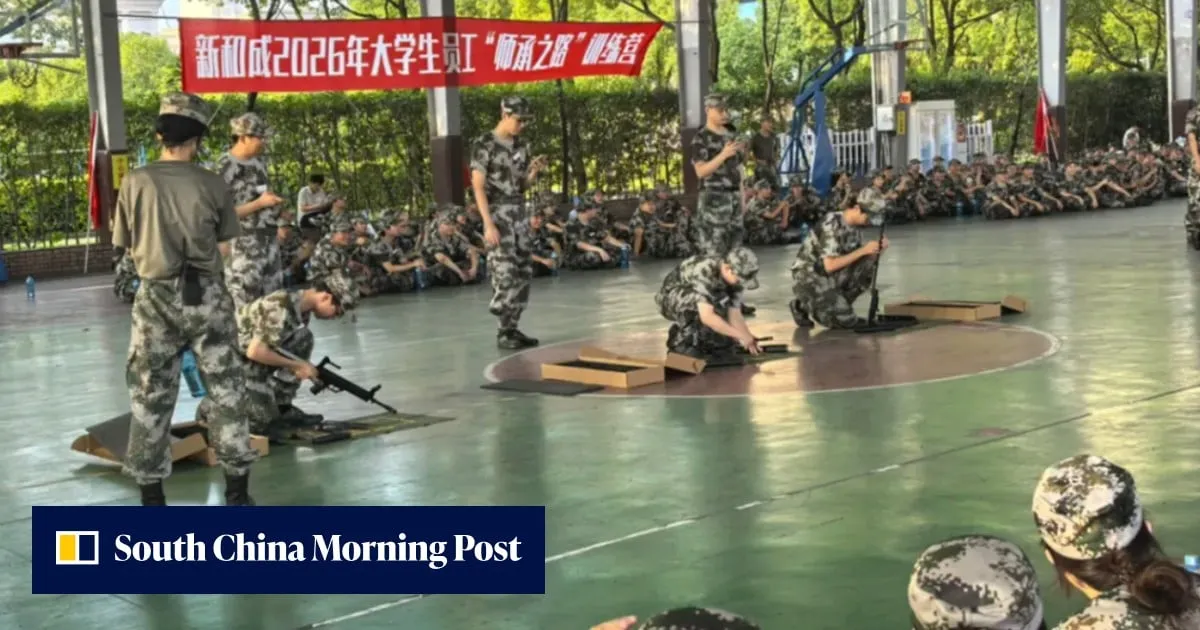
A Chinese milk tea chain has ignited a debate about workplace culture and employee autonomy after reports of its military-style onboarding training garnered public criticism.Frontline employees at Chayanyuese, also known as China-tea-shop" class="entity-link entity-organization" data-entity-id="202863" data-entity-type="organization">Modern China Tea Shop, recently voiced their concerns on mainland social media, alleging that the company’s “Cornerstone” induction programme infringes on personal boundaries.Headquartered in Hunan province, Chayanyuese is one of China’s most recognisable milk tea brands, with annual revenue reportedly around 3 billion yuan (US$447 million).A user on RedNote, with the handle @unmeaning, shared photos depicting strict dining rules at the training base, including a 30-second limit to collect meals, enforced rigid postures while eating, and a prohibition against chewing food while standing.Another employee, identified as @Xigua, claimed that recruits were required to surrender their phones, adhere to military-style dormitory rules, and fold their quilts into the precisely squared “tofu block” shape. They also alleged that during a military posture drill, a trainee collapsed and required hospitalisation, but the company refused to cover medical expenses.Moreover, several recruits interviewed by Sina Finance reported they were mandated to memorise corporate values and scripted service phrases, with failure to meet these standards potentially jeopardising their positions.High-intensity corporate boot camps, modelled after military training, have emerged as a highly debated onboarding trend among large Chinese enterprises. Photo: zgcsj.comSome online commenters defended the approach, contending that, as a customer-facing service business, milk tea chains require consistent standards for employee behaviour, appearance, and communication.Conversely, others expressed discomfort with what they described as “militarised management” extending beyond workplace training.Chayanyuese later asserted that such operational standards existed in its stores but declined to provide details about its internal training programme.He Bo, a lawyer at Sichuan Henghexin Law Firm, informed the SCMP that measures such as phone restrictions and dining protocols generally fall within employers’ management rights if employees are informed in advance and the requirements are reasonable.However, he cautioned that unsafe physical training or humiliating activities could breach legal boundaries.From traditional manufacturers to modern food and beverage brands, military-style training has increasingly emerged as a strategy for Chinese companies seeking to shape the behaviours of new employees.A strategic onboarding programme bridges the gap for new hires, transforming them from external recruits into aligned, loyal, and collaborative team members. Photo: RedNoteMary, who has worked for a home appliance manufacturer in Guangdong for a year, recounted her experience in an induction programme for fresh graduates that included a gruelling 50km hiking challenge.Further Reading“We walked through the night until morning. It was exhausting, especially in the heat. The activity also operated on a penalty system – if someone dropped out halfway, their team would lose points, making people feel they were letting everyone down,” she recalled.The programme also incorporated military-style exercises, including army songs and marching drills, alongside job-related training.Mary noted that she understood the rationale behind such programmes: helping “undisciplined” graduates shed their campus habits and adapt to professional life.“Ultimately, it could also be viewed as a test of obedience,” she reflected.Nonetheless, some corporate onboarding programmes have faced even harsher criticism.In 2024, China Philanthropist reported on an intensive induction programme organised by food company Jinmailang, where 77 employees were required to complete 80 push-ups, carry weighted equipment on a 60km hike, and participate in a “stress test” involving asking strangers for money and dining at their homes.Effective onboarding training serves as the essential bridge where new hires learn to embody corporate core values. Photo: RedNoteThe company stated that the training aimed to challenge employees’ mindsets, unlock their potential, and help them overcome psychological barriers.In July, livestock giant Muyuan Group faced backlash after reports that employees were required to read aloud and memorise a “pig worship text” praising the spirit of selfless contribution among pigs.While the company clarified that the exercise intended to promote respect for life and appreciation of the industry, critics accused it of fostering unconditional sacrifice.Lawyer He added that forcing employees to ask strangers for food could be deemed humiliating and expose companies to legal risks, including penalties or civil claims. He noted that employees are entitled to wages and rest rights during training.For many online observers, the controversy raises broader questions about how companies cultivate loyalty.“Companies invest considerable effort trying to foster employee loyalty, but for workers, the issue is straightforward – when compensation reflects the effort they put in, employees will invariably feel more motivated and loyal,” one user wrote.
SRCSouth China Morning Post
LANGEN
LEANCenter-Right
WORDS725
ENT12
FRI · 2026-09-11 · 10:00 GMTBRIEF NSR-2026-0911-110531
NSR-2026-0911-110531News Report·EN·Human Interest
Chinese milk tea chain sparks heated debate over ‘military-style’ onboarding programme
Chinese milk tea chain Chayanyuese is facing public criticism for its "Cornerstone" onboarding program, which employees describe as military-style and infringing on personal boundaries. Reports detail strict rules regarding dining, phone usage, dormitory living, and mandatory memorization of corporate values, with alleged incidents of trainees collapsing during drills and companies refusing medical expenses.
Zoey ZhangSouth China Morning PostFiled 2026-09-11 · 10:00 GMTLean · Center-RightRead · 3 min
South China Morning PostFIG 01
Reading time
3min
Word count
725words
Sources cited
3cited
Entities identified
12entities
Quality score
100%
§ 01
Briefing Summary
AI-generatedNEWSAR · AI
Chinese milk tea chain Chayanyuese is facing public criticism for its "Cornerstone" onboarding program, which employees describe as military-style and infringing on personal boundaries. Reports detail strict rules regarding dining, phone usage, dormitory living, and mandatory memorization of corporate values, with alleged incidents of trainees collapsing during drills and companies refusing medical expenses. While some defend the program for maintaining service standards, others view it as excessive "militarized management." Lawyers suggest that while some strict protocols may be within employers' rights if reasonable and disclosed, unsafe training or humiliating activities could be illegal. This controversy highlights a broader trend of Chinese companies using military-style boot camps for onboarding, sparking debate about employee autonomy and workplace culture.
Confidence 0.90Sources 3Claims 5Entities 12
§ 02
Article analysis
Model · rule-basedFraming
Human Interest
Social Justice
Tone
Mixed Tone
AI-assessed
CalmNeutralAlarmist
Factuality
0.60 / 1.00
Mixed
LowHigh
Sources cited
3
Well sourced
FewMany
§ 03
Key claims
5 extracted01
Chayanyuese confirmed operational standards exist but declined to detail its internal training program.
factualChayanyuese
Confidence
0.90
02
Legal expert He Bo stated that while some restrictions are within employer rights, unsafe training or humiliating activities could be illegal.
quoteHe Bo (lawyer)
Confidence
0.90
03
Employees reported strict dining rules, phone confiscation, and mandatory memorization of corporate values.
factualemployees (@unmeaning, @Xigua, Sina Finance interviewees)
Confidence
0.85
04
Chayanyuese's 'Cornerstone' induction programme has been criticized for being military-style and infringing on personal boundaries.
factualemployees, online commenters
Confidence
0.80
05
A trainee allegedly collapsed during a military posture drill and required hospitalization, with the company refusing to cover costs.
factualemployee (@Xigua)
Confidence
0.70
§ 04
Full report
3 min read · 725 words§ 05
Entities
12 identifiedKey playerOppositionContextPositiveNeutralNegative
Organizations5
§ 06
Keywords & salience
8 termsmilitary-style onboarding
1.00
workplace culture
1.00
employee autonomy
0.90
chayanyuese
0.80
corporate boot camps
0.70
employee rights
0.60
management rights
0.50
public criticism
0.40
§ 07
Topic connections
Interactive graph No topic relationship data available yet. This graph will appear once topic relationships have been computed.