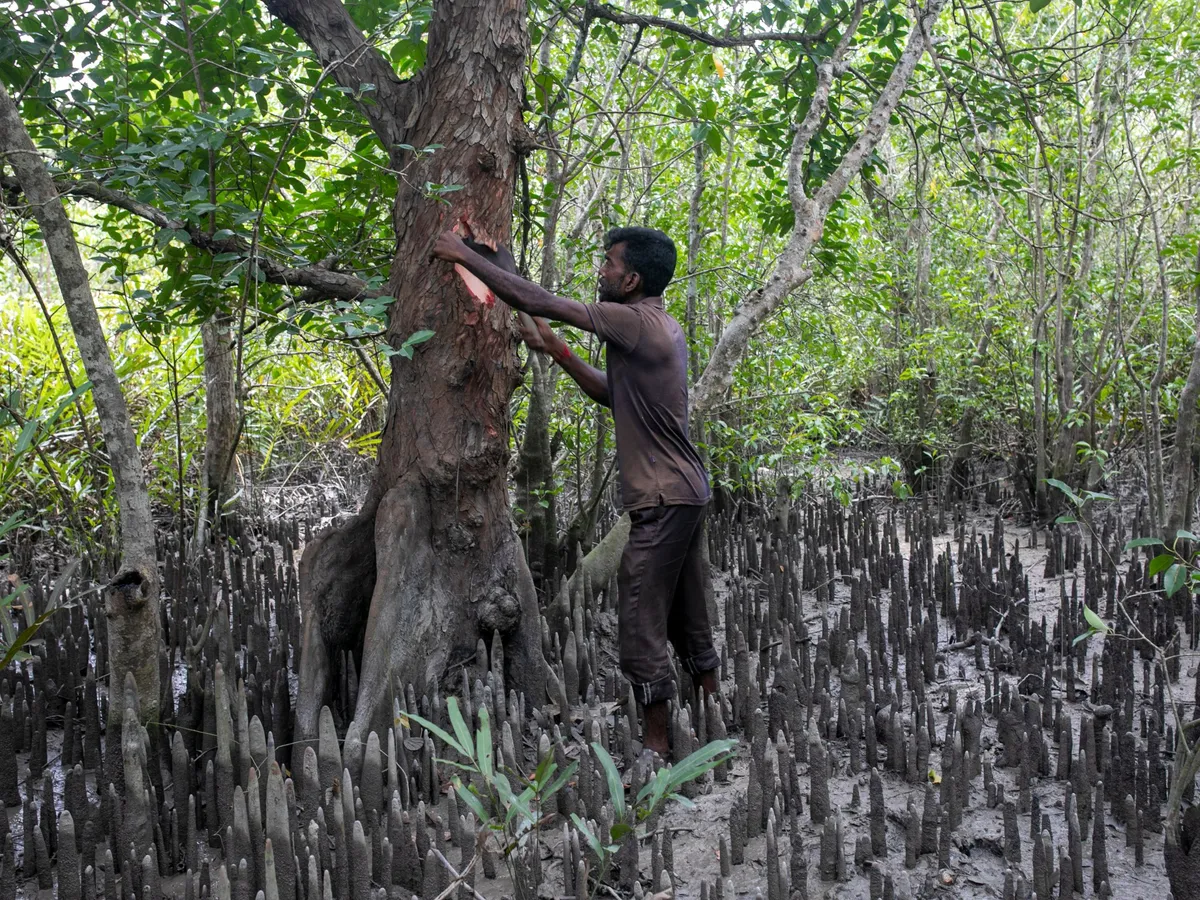
The Sundarbans stretches across 10,000 square kilometres of Bangladesh and India. Its green canopy shelters the Royal Bengal tiger, saltwater crocodiles and more than 300 plant species. Nearly 2.7 million people live in the coastal districts surrounding the forest on the Bangladesh side alone.For generations, communities here have turned to the forest for food, firewood and medicine. Kabiraj have long provided care in rural areas where formal medical services can be difficult or expensive to access.Their remedies are made from leaves, roots and bark, and their knowledge has traditionally been passed from one generation to the next. A 2011 study of medicinal plants in Barisal Division found that almost one-third of rural households in the coastal area sought help from Kabiraj or similar healers.Rising seas and repeated cyclones are pushing saltwater further into coastal ecosystems. Between 2017 and 2021, salinity in tidal water rose from 21 to 33 parts per thousand in the pre-monsoon season, while soil salinity increased by 31 percent.Mangroves are adapted to salt, but tolerance varies by species. The Sundari (Heritiera fomes) is declining. Bain (Avicennia officinalis), an important source of nectar for bees, has stopped flowering in some places. Medicinal plants that Kabiraj depend on are also becoming harder to find.For Suranjan, the evidence is in what is no longer there.A fiddler crab moves across the mud as the tide begins to return to the Sundarbans [Zakir Hossain Chowdhury/Al Jazeera]As the tide enters the forest, fiddler crabs move across the mud. He stops beside a tree and carefully cuts a section of bark with his knife.“Between the wood and the bark there is a layer. If that layer is not hurt, the bark grows back quickly. If it is damaged, the bark takes longer to grow, and sometimes it never grows again, the wound stays.”When harvesting a vine, he never pulls out the whole plant. He cuts only what he needs so it can grow again.But careful harvesting cannot protect plants from changes in the water itself.“Before, during the tide, the forest did not sink completely. The higher ground stayed dry,” he says. “But now the forest goes fully underwater, and because of the saltwater many trees are dying.”He names species that have become difficult to find: hogla, or Typha, whose fibres are traditionally applied to cuts and burns and whose roots are used in local remedies; and bain, whose bark and leaves are used in traditional medicine and whose flowers provide nectar for bees.“My father collected more than 100 medicinal plants from different parts of the country and planted them in our garden,” he says. “But because of Cyclone Aila in 2009, saltwater entered and destroyed all our plants; they all died.”Professor Md Abdur Rahim, chairman of the Department of Genetics and Plant Breeding at Sher-e-Bangla Agricultural University, describes a forest whose botanical balance is shifting.“Salt is slowly rewriting the forest. The hardy trees may survive, but the plants that heal, the ones Kabiraj rely on, are disappearing,” he says. “As salinity rises, the forest changes its face: salt-loving species spread, while the delicate, medicinal ones fade.”A season without flowersNearby, a small tea stall filled with wooden benches stands beside the Shakbaria river. Inside, a television sits silent during the day; villagers gather around it in the evening. The morning rain has left water pooled on the road and clouds hanging low over the river.Villagers gather at a tea stall beside the Shakbaria river, where honey collectors speak of a season without bain flowers [Zakir Hossain Chowdhury/Al Jazeera]Customers drink strong black tea with sugar, sometimes with biscuits.Suranjan’s uncle, Chapal Raptan, the honey collector, sits on one of the benches.Asked how much honey he gathered this season, Chapal, having overcome his cold, shakes his head.“This is the time for bain flowers,” he says. “But this year, not a single bain tree has bloomed. There is no bain honey at all.”Several men respond at once.“We have never seen this in our lifetime,” one says as the others agree. “Not a single flower on the bain tree.”For men who have spent their lives entering the forest, the missing blossom is more than a poor honey harvest. It is an unfamiliar change in a landscape they thought they knew.Suranjan names other medicinal plants he says are becoming difficult to find around Koyra: neem, ashwagandha and haritaki.Then he looks down at his hands.“It is becoming difficult to collect medicinal plants. Since I don’t have all the necessary medicines in my collection, I cannot give patients what they need on time when they come.”
SRCAl Jazeera
LANGEN
LEANCenter
WORDS753
ENT12
FRI · 2026-09-11 · 13:29 GMTBRIEF NSR-2026-0911-110539
NSR-2026-0911-110539News Report·EN·Environmental
The vanishing pharmacy of the Sundarbans
Rising sea levels and increased salinity are threatening the Sundarbans, a vast mangrove forest spanning Bangladesh and India. This ecological shift is causing the decline of numerous plant species, including those traditionally used by local communities for medicine.
Zakir Hossain ChowdhuryAl JazeeraFiled 2026-09-11 · 13:29 GMTLean · CenterRead · 4 min
Al JazeeraFIG 01
Reading time
4min
Word count
753words
Sources cited
2cited
Entities identified
12entities
Quality score
100%
§ 01
Briefing Summary
AI-generatedNEWSAR · AI
Rising sea levels and increased salinity are threatening the Sundarbans, a vast mangrove forest spanning Bangladesh and India. This ecological shift is causing the decline of numerous plant species, including those traditionally used by local communities for medicine. For generations, healers known as kabiraj have relied on these plants, passed down through oral tradition, to treat ailments in areas with limited access to formal healthcare. However, increased saltwater intrusion, exacerbated by cyclones, is killing off sensitive plant species like the Sundari and bain, making it harder for kabiraj to find essential medicinal ingredients. This loss impacts not only traditional healing practices but also the local ecosystem, as seen with the absence of bain flowers affecting honey production.
Confidence 0.90Sources 2Claims 5Entities 12
§ 02
Article analysis
Model · rule-basedFraming
Environmental
Human Interest
Tone
Measured
AI-assessed
CalmNeutralAlarmist
Factuality
0.70 / 1.00
Factual
LowHigh
Sources cited
2
Limited
FewMany
§ 03
Key claims
5 extracted01
The botanical balance of the Sundarbans forest is shifting due to increased salinity.
quoteProfessor Md Abdur Rahim
Confidence
0.95
02
Salinity in tidal water rose from 21 to 33 parts per thousand between 2017 and 2021 in the pre-monsoon season.
statistic
Confidence
0.95
03
Cyclone Aila in 2009 destroyed traditional medicinal plants due to saltwater intrusion.
quoteSuranjan
Confidence
0.90
04
Medicinal plants that kabiraj depend on are becoming harder to find due to environmental changes.
factual
Confidence
0.90
05
Rising seas and repeated cyclones are pushing saltwater further into coastal ecosystems in the Sundarbans.
factual
Confidence
0.90
§ 04
Full report
4 min read · 753 words§ 05
Entities
12 identifiedKey playerOppositionContextPositiveNeutralNegative
Organizations1
Locations4
§ 06
Keywords & salience
10 termstraditional medicine
1.00
sundarbans
1.00
salinity
0.90
climate change
0.80
medicinal plants
0.80
coastal ecosystems
0.70
mangroves
0.60
rising seas
0.50
cyclones
0.50
biodiversity
0.40
§ 07
Topic connections
Interactive graph Network visualization showing 3 related topics
View Full Graph Person Organization Location Event|Click node to navigate|Edge numbers = shared articles