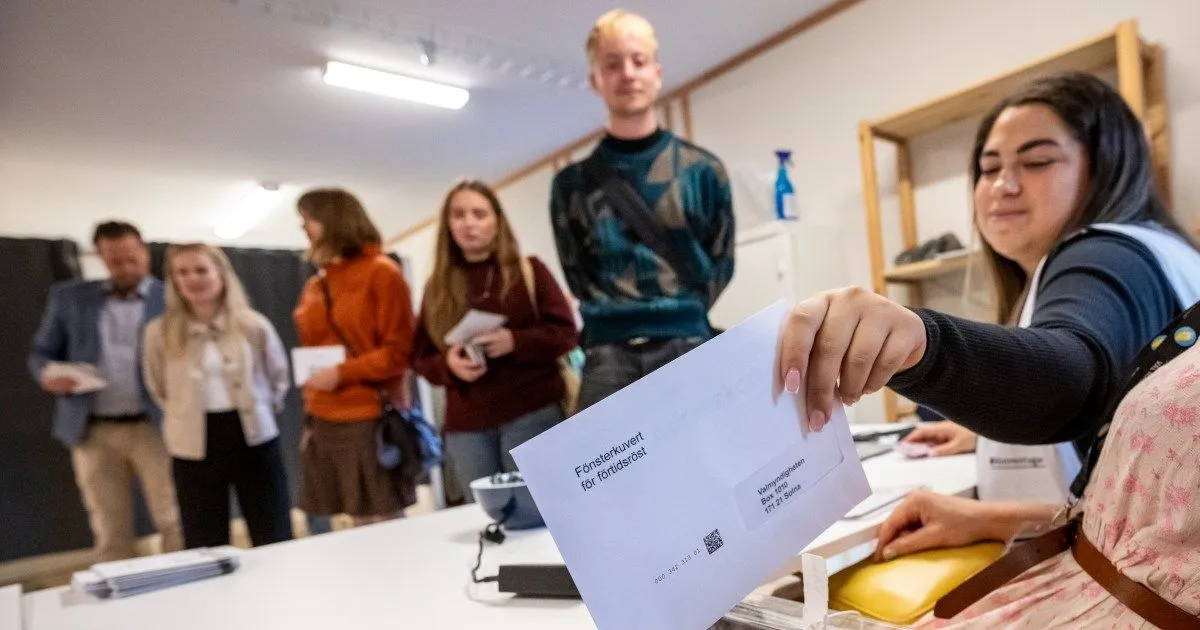
EXPLAINERSweden votes on Sunday as voters weigh migration, crime, the economy and whether the far right will enter government.Envelopes containing votes are placed into a ballot box during early voting for Sweden's 2026 general election at Malmo Central Station in Malmo, Sweden [Johan Nilsson/EPA]Published On 12 Sep 2026Stockholm, Sweden – On Sunday, Swedes will vote in a knife-edge general election that could see it either usher in a left-wing coalition or take a step even further to the right and welcome the Sweden-democrats" class="entity-link entity-organization" data-entity-id="9626" data-entity-type="organization">Sweden Democrats, a party with neo-Nazi roots, into government for the first time.Once a political pariah, the party has become the greatest force on the right and has already helped shape government policy from beyond the cabinet. Now, Moderate Party leader and Prime Minister Ulf Kristersson wants to bring it formally into power.Recommended Stories list of 3 itemslist 1 of 3As Sweden heads to polls, Israel and Palestine policies are on the ballotlist 2 of 3UK, France among 12 states backing sanctions on illegal Israeli settlementslist 3 of 3Germany’s AfD wins in key state: Is far-right on cusp of national rule?end of listOpposing them is a centre-left bloc led by Social Democrats leader Magdalena Andersson, which has been leading in the polls, although the gap has been narrowing in recent weeks.Sweden’s four left-bloc parties now have support of between 49.3 and 50.8 percent, according to the surveys conducted by the Ipsos, Demoskop and Indikator Opinion polling firms, while support for the coalition government and the Sweden-democrats" class="entity-link entity-organization" data-entity-id="9626" data-entity-type="organization">Sweden Democrats stands at 47.6 to 49 percent, according to polls released by Swedish Radio and dailies Aftonbladet and DN.Here is what you need to know:How the election process worksAdvance voting has been running since August 26.Sunday, however, is the official election day when polling stations will open at 8am (06:00 GMT) and close at 8pm (18:00 GMT).Swedes are voting in three elections on the same day: one for members of the national parliament, one for the regional council and one for the municipal council.How are Sweden’s political parties distributed?Sweden’s politics run in two blocs.On the right are the governing Moderates, the Christian Democrats and the Liberals, as well as the Sweden-democrats" class="entity-link entity-organization" data-entity-id="9626" data-entity-type="organization">Sweden Democrats, who have propped up the government from outside since all four parties signed an agreement in 2022.On the left are the Social Democrats, the Left Party and the Greens, with the Centre Party a possible fourth.Swedish politics has traditionally been built around coalition-building, compromise and minority governments rather than one party winning outright.Governments do not need a majority of seats to take office, but they won’t survive in parliament unless smaller parties form agreements within blocs.Sweden’s prime ministerial candidates Magdalena Andersson, left, of the Social Democrats, and Ulf Kristersson, right, of the Moderates, in Gavle, Sweden [File: Anders Wiklund/EPA]What are the key issues for this election?A number of issues are on voters’ minds ahead of this election.ImmigrationImmigration remains one of the defining issues in Swedish politics, and a major reason the Sweden-democrats" class="entity-link entity-organization" data-entity-id="9626" data-entity-type="organization">Sweden Democrats have gone from political pariah to kingmakers.Analysts say the 2015 refugee crisis, when an estimated 1.3 million asylum seekers arrived in Europe, handed the party a major opportunity.In Sweden alone, 163,000 arrived – the highest annual figure in the country’s history and the largest per capita intake in the European Union.According to Sweden’s annual SOM (society, opinion and media) survey, immigration became the single most important issue for 53 percent of Swedish voters almost overnight that year.As a result, Sweden has dramatically tightened its migration policy since the crisis, with asylum numbers now far below their peak.The government has introduced tougher residency and citizenship rules and, this year, began offering migrants with residency permits about $36,000 as an incentive to leave.The Sweden-democrats" class="entity-link entity-organization" data-entity-id="9626" data-entity-type="organization">Sweden Democrats want to go further, while the centre left has also moved towards a more restrictive position than it once held.The argument is now less about whether migration should be reduced and more about what integration should look like.However, some of the most hardline new migration policies introduced have gone “too far” even for right-wing voters, Zina al-Dewany, a political commentator and editorial writer for the Swedish newspaper Aftonbladet, told Al Jazeera.The government’s focus on repatriation and hubris, driven by the upswell of support for tougher measures in the country, led to overreach and a spate of scandals that dominated Swedish headlines this year, she said.This largely centred around a wave of deportation orders issued to teenagers who had grown up in Sweden and were being told to leave on turning 18 while their parents stayed – a practice the government ultimately suspended in March and moved to reform in June.Foreign policyRussia’s invasion of Ukraine has transformed Sweden’s security policy, helping drive its historic decision to join NATO in 2024.Sweden has provided about $16.4bn in military and civilian support to Ukraine since 2022.There is unusually broad agreement across the political spectrum that Sweden should continue backing Ukraine, with debate focused less on whether to support Ukraine than on how much Sweden should spend and how far Europe should go in strengthening its own defence.On Palestine, the debate is very different.The current right-wing government does not regard Israel’s conduct in Gaza as genocide and has not joined South Africa’s genocide case against Israel at the International Court of Justice (ICJ).However, it has pushed for EU sanctions against “extremist” settlers and ministers, and in April proposed extra tariffs and export certificates on settlement products.If the Sweden-democrats" class="entity-link entity-organization" data-entity-id="9626" data-entity-type="organization">Sweden Democrats were to get into government, it would represent the most pro-Israel views in the bloc.Its motions this session have called for moving the Swedish embassy to Jerusalem and ending all Swedish aid to Palestinians.Its leader, Jimmie Akesson, said in January that, if it were up to him, he would absolutely withdraw Sweden’s recognition of Palestine.The left bloc is aligned on several key issues, including resuming funding to UNRWA, which has been accused by Israel of having links with Hamas, but which provides the majority of humanitarian support to Palestinians.The Left Party and Green Party have called for Sweden to join South Africa’s genocide case against Israel at the ICJ.“If the left bloc comes to power, you will see a trade boycott of Israel, more money to UNRWA, and we want more funding to the ICC,” Anfal Mahdi, an opposition councillor in Malmo for the Left Party, told Al Jazeera, referring to the International Criminal Court, which issued an arrest warrant for Israeli Prime Minister Benjamin Netanyahu in 2024 on suspicion of committing war crimes.Swedish Prime Minister Ulf Kristersson, right, and Ukrainian President Volodymyr Zelenskyy walk past a Gripen fighter jet after they delivered a joint news conference in Linkoping, Sweden [File: Jonathan Nackstrand/AFP] (AFP)Law and orderGang violence has become a focus of Sweden’s political debate over the past decade.With a population of 10.6 million, Sweden has one of Europe’s highest rates of deadly gun violence. The government has responded with tougher sentences, more police resources and measures targeting criminal networks.There are signs the crackdown is working: shootings and deaths have fallen sharply this year compared with 2022.But friction remains about how to deal with the issue, with the right saying the progress proves its approach is working, while the left argues that prevention, schools and social services are equally important.The economyAfter years of rising inflation and a prolonged economic downturn, the cost of living is a major concern for voters.
SRCAl Jazeera
LANGEN
LEANCenter
WORDS1 220
ENT12
SAT · 2026-09-12 · 08:42 GMTBRIEF NSR-2026-0912-110725
NSR-2026-0912-110725Analysis·EN·Political Strategy
Sweden heads to the polls: What’s at stake in the knife-edge election?
Sweden is holding a general election on Sunday, with voters deciding between a left-wing coalition and a right-wing bloc that could include the far-right Sweden Democrats in government for the first time. The election is a close contest, with polls showing a narrow lead for the center-left bloc led by Social Democrats leader Magdalena Andersson, while the coalition government and the Sweden Democrats are slightly behind.
Nils AdlerAl JazeeraFiled 2026-09-12 · 08:42 GMTLean · CenterRead · 5 min
Al JazeeraFIG 01
Reading time
5min
Word count
1 220words
Sources cited
5cited
Entities identified
12entities
Quality score
100%
§ 01
Briefing Summary
AI-generatedNEWSAR · AI
Sweden is holding a general election on Sunday, with voters deciding between a left-wing coalition and a right-wing bloc that could include the far-right Sweden Democrats in government for the first time. The election is a close contest, with polls showing a narrow lead for the center-left bloc led by Social Democrats leader Magdalena Andersson, while the coalition government and the Sweden Democrats are slightly behind. Key issues influencing voters include immigration, which has significantly shaped the political landscape and led to stricter migration policies, and crime. The Sweden Democrats, once a political pariah, have grown in influence and aim to formally enter government, a move supported by Moderate Party leader and Prime Minister Ulf Kristersson.
Confidence 0.90Sources 5Claims 5Entities 12
§ 02
Article analysis
Model · rule-basedFraming
Political Strategy
Social Justice
Tone
Mixed Tone
AI-assessed
CalmNeutralAlarmist
Factuality
0.70 / 1.00
Factual
LowHigh
Sources cited
5
Well sourced
FewMany
§ 03
Key claims
5 extracted01
Sweden votes in a general election that could see the far-right Sweden Democrats enter government for the first time.
factual
Confidence
1.00
02
Prime Minister Ulf Kristersson wants to bring the Sweden Democrats formally into power.
factual
Confidence
0.90
03
The Sweden Democrats have become the greatest force on the right and have shaped government policy from outside the cabinet.
factual
Confidence
0.90
04
Support for the coalition government and the Sweden Democrats stands at 47.6 to 49 percent, according to polls.
statisticSwedish Radio, Aftonbladet, DN
Confidence
0.80
05
Sweden's four left-bloc parties have support between 49.3 and 50.8 percent, according to polls.
statisticIpsos, Demoskop, Indikator Opinion, Swedish Radio, Aftonbladet, DN
Confidence
0.80
§ 04
Full report
5 min read · 1 220 words§ 05
Entities
12 identifiedKey playerOppositionContextPositiveNeutralNegative
Organizations7
§ 06
Keywords & salience
10 termsswedish election
1.00
far right
0.90
migration
0.80
sweden democrats
0.80
political blocs
0.70
economy
0.60
crime
0.60
government policy
0.50
social democrats
0.40
moderate party
0.40
§ 07
Topic connections
Interactive graph Network visualization showing 51 related topics
View Full Graph Person Organization Location Event|Click node to navigate|Edge numbers = shared articles