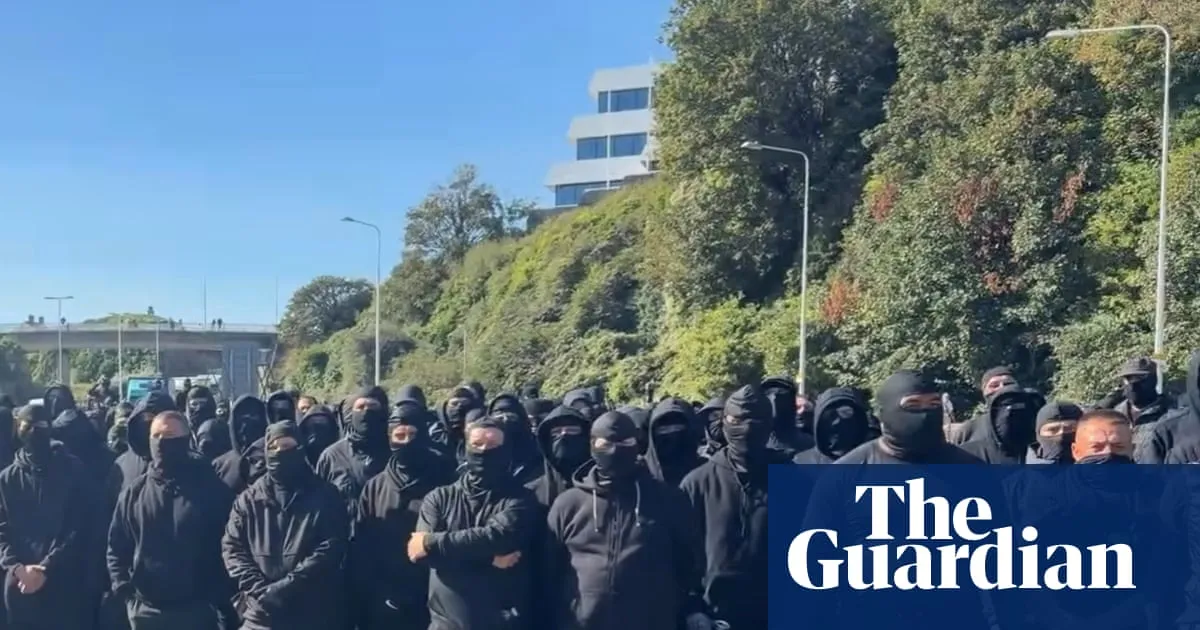
At least 28 anti-migrant vigilante groups have formed in the UK in the last 18 months, ranging from unauthorised street patrols claiming to protect women and children to groups harassing migrants in France and blocking ports.From Belfast to the south coast of England, the number of active groups has surged since the summer of 2025, according to analysis by the Guardian, amid widespread concerns over fresh disorder after black-clad vigilantes, many of them wearing balaclavas, blocked roads in Portsmouth and Dover last weekend.Often arguing that they are filling gaps left by the police or taking action on migration that the government is unable to, the groups range from small-scale community patrols near asylum-seeker accommodation to those attempting to stop migrants crossing the Channel from France.They include Scots Active, which conducts late-night patrols around Glasgow city centre claiming to protect the public from migrants, sometimes wearing balaclavas and stab-proof vests. It says its activities help ensure the safety of women and girls. It was one of two groups banned from TikTok earlier this year after reportedly sharing footage claiming to expose migrant hotels.Another is the British Security Project, a self-styled civilian safety group that has described itself as the “tip of the spear in mass deportation under a Rupert Lowe government”. It recruits “visible deterrent patrol” volunteers via its website and social media platforms, and responds to reports from the public about incidents claiming to involve migrants. It aims to “provide 124,000 security personnel to public spaces by 2035”, according to its Facebook page.When the Guardian contacted the group for comment, a spokesperson said it was neither vigilante nor anti-migrant. “The British Security Project is a developing non-profit community protection organisation committed to lawful, peaceful and accountable volunteer action,” they said. “It has no police or Immigration-enforcement powers, does not permit people to be targeted because of their nationality or Immigration status, and expressly prohibits vigilantism, intimidation, racism and unlawful discrimination.”Members of another group, Raise the Colours, made several trips to France in 2025 to try to stop migrants crossing the Channel in small boats. They filmed themselves claiming to have slashed dinghies on French beaches. France subsequently banned 10 members from the country.Members of far-right Patriot Platform blocked roads near Dover for several hours last Saturday, disrupting traffic to and from the port. Kent police initially said they had received no warning, but later admitted officers had failed to act on calls made on Friday evening.On Sunday, about 200 black-clad men gathered in Portsmouth after 120 asylum seekers rescued from a dinghy were brought ashore there. They blocked roads and allegedly assaulted several police officers.Riot police clash with far-right protesters in Portsmouth – videoThe home secretary, Shabana Mahmood, urged police on Thursday to curb the activities of such groups, telling senior officers to make full use of their powers.The rise in vigilante groups is a recent phenomenon, overwhelmingly happening in the last year. Of the 31 active groups the Guardian was able to establish initiation dates for, 28 were set up since last summer, with a spike in August 2025 after Raise the Colours’ flag operation and unrest at an asylum hotel in Epping. Setup dates were taken from online activity on Facebook and Instagram, domain name registrations and media reports.To classify as anti-migrant vigilantes, the Guardian considers that a group must have taken the law into its own hands in the name of opposing migrants or asylum seekers. Groups limited to more conventional protests and far-right political parties were not included.skip past newsletter promotionafter newsletter promotionAnti-migrant demonstrators march in Epping, Essex, in September 2025. Photograph: Ian Davidson/Alamy Stock Photo/Alamy Live News.In a campaign of intimidation last summer, a vigilante group called the Belfast Nightwatch First Division was involved in targeting dark-skinned males in the city, challenging them to produce identification documents.Dr Julia Ebner, an expert on extremism at the University of Oxford, said the figures showed a rapid shift in the ways anti-migrant activists were mobilising which was particularly striking.“At the heart of most vigilante groups is the claim that the authorities are incapable or unwilling to protect a country’s citizens,” she said. “This is a dangerous dynamic, because when trust in authorities is undermined this can quickly translate into justifications of running their own policing operations or even violent campaigns – all supposedly for a good cause.“Another underlying narrative that is not new but has been amplified across social media is the idea that ‘our’ women and children are threatened by men of migrant backgrounds. There is also a performative aspect of vigilante movements: uniforms, patrols and security equipment can project authority and legitimacy even when the groups themselves are relatively small.Patriot Platform hold a silent vigil at the RNLI station in Poole from where a volunteer crew rescued about 140 migrants last weekend. Photograph: Finnbarr Webster/Getty Images“This can help far-right movements recruit new members and produce visually appealing social media content to increase their public profile and expand their followership.” Alex MacKinnon, a researcher at Hope Not Hate, said vigilantism had long been part of far-right activism, but that there had been a dramatic increase in extremists’ grassroots efforts in the last 18 months. “While vigilante groups typically purport to protect the wider community, the majority do not properly vet their members, resulting in several being exposed for their violent criminal histories,” he said.“Furthermore, they regularly engage in intimidatory behaviour, as seen in Patriot Platform’s Dover demonstration. Vigilante groups of this type often promote aggressive anti-migrant agendas, using ‘community protection’ as a cover for racist thuggery.” In response to the Guardian’s analysis, the National Police Chiefs’ Council said it was important for the public to report concerns about crime and safety.“Police officers are specially trained to respond to a wide range of incidents safely and lawfully,” a spokesperson said. “While we understand people may want to protect their communities, taking enforcement into your own hands can be dangerous, and could compromise a police investigation.”
SRCThe Guardian - World News
LANGEN
LEANCenter-Left
WORDS987
ENT12
SAT · 2026-09-12 · 16:00 GMTBRIEF NSR-2026-0912-110817
NSR-2026-0912-110817News Report·EN·Social Justice
Number of UK anti-migrant vigilante groups surges in last 18 months
At least 28 anti-migrant vigilante groups have formed in the UK in the last 18 months, with a surge in activity since the summer of 2025. These groups, operating from Belfast to the south coast, engage in unauthorized street patrols, harass migrants in France, and block ports.
Patrick Greenfield and Michael GoodierThe Guardian - World NewsFiled 2026-09-12 · 16:00 GMTLean · Center-LeftRead · 4 min
The Guardian - World NewsFIG 01
Reading time
4min
Word count
987words
Sources cited
3cited
Entities identified
12entities
Quality score
100%
§ 01
Briefing Summary
AI-generatedNEWSAR · AI
At least 28 anti-migrant vigilante groups have formed in the UK in the last 18 months, with a surge in activity since the summer of 2025. These groups, operating from Belfast to the south coast, engage in unauthorized street patrols, harass migrants in France, and block ports. They often claim to fill gaps left by authorities or address government inaction on migration. Recent incidents include road blockades in Portsmouth and Dover by groups like Patriot Platform, and attempts by Raise the Colours to stop Channel crossings. Experts express concern that these groups undermine trust in authorities and can justify violent campaigns. The Home Secretary has urged police to curb their activities.
Confidence 0.90Sources 3Claims 5Entities 12
§ 02
Article analysis
Model · rule-basedFraming
Social Justice
National Security
Tone
Mixed Tone
AI-assessed
CalmNeutralAlarmist
Factuality
0.70 / 1.00
Factual
LowHigh
Sources cited
3
Well sourced
FewMany
§ 03
Key claims
5 extracted01
Patriot Platform blocked roads near Dover, disrupting traffic.
factualThe Guardian
Confidence
0.90
02
Groups range from street patrols claiming to protect women and children to those harassing migrants and blocking ports.
factualThe Guardian
Confidence
0.90
03
At least 28 anti-migrant vigilante groups have formed in the UK in the last 18 months.
statisticThe Guardian
Confidence
0.90
04
Members of Raise the Colours filmed themselves claiming to have slashed dinghies on French beaches.
factualRaise the Colours
Confidence
0.80
05
Scots Active claims its activities help ensure the safety of women and girls.
quoteScots Active
Confidence
0.80
§ 04
Full report
4 min read · 987 words§ 05
Entities
12 identifiedKey playerOppositionContextPositiveNeutralNegative
Organizations5
Locations5
§ 06
Keywords & salience
10 termsanti-migrant vigilante groups
1.00
migration
0.90
uk
0.80
vigilantism
0.70
channel crossings
0.60
community patrols
0.50
asylum seekers
0.50
social media
0.40
ports
0.40
far-right
0.40
§ 07
Topic connections
Interactive graph Network visualization showing 51 related topics
View Full Graph Person Organization Location Event|Click node to navigate|Edge numbers = shared articles