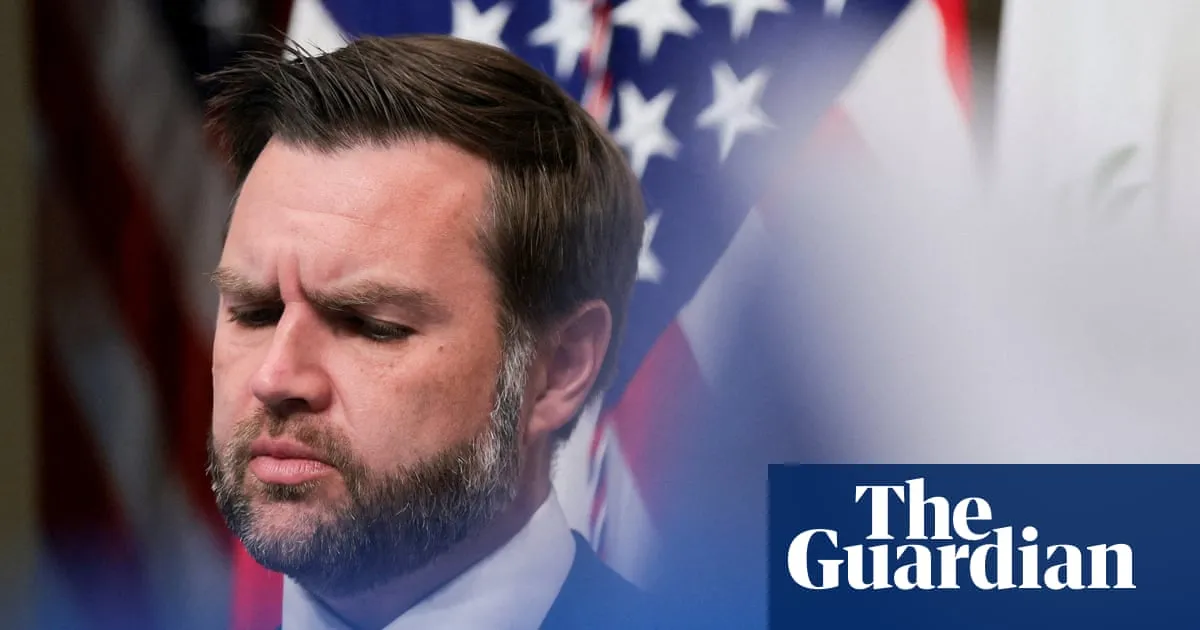
US vice-president JD Vance has worn his religion on his sleeve since converting to the Catholicism in 2019. He recently published a book, Communion: Finding My Way Back to Faith, and memorably met the late Pope Francis at the Vatican on Easter Sunday in 2025, a day before the pontiff died.But his religious identity could take on new weight as he positions himself for a presidential run in 2028, in which a successful campaign would make him only the third Catholic president in US history. Vance’s winding spiritual path – combined with his avowed evangelical roots – have the potential to stymie him, as he seeks to retain the Christian nationalist voters that have sustained Donald Trump’s Make America Great Again (Maga) movement while wooing fellow Catholics.His presidential ambitions and religious convictions were both on show in a keynote speech to the Republicans’ midterm convention in Dallas on Thursday evening, where he invoked scripture and the Apostle Paul in paying homage to the rightwing activist Charlie Kirk, who was assassinated last year.“We live in the city of man, not the city of God,” Vance said. “But I believe that our founders built this nation on a promise that echoes our creator.”The address amounted to “the beginning of 2028 Republican primary competition”, according to Larry Jacobs, a political scientist at the University of Minnesota.“Vance has thrown his hat in the ring,” he said. “One of the dimensions that JD Vance is bringing to the Republican ticket is the white Christian nationalism. He is trying to put together a coalition that will support him, and he wants the white Christian nationalists to be a key part of that.”One impediment to that, some religious analysts say, is his conversion to Catholicism – something they believe could leave him with an identity crisis that alienates both evangelicals and Catholic voters.Both waysVance expounded on his beliefs and the evangelical influences that shaped his upbringing in a recent interview with Bryce Crawford, a 22-year-old Christian podcaster with 929,000 subscribers on YouTube.Commentators say his dilemma was crystallized when Crawford asked for his views on “end times”, an event signifying the second coming of Christ that is much discussed in evangelicalism, but much less so in Catholicism.Vance expressed a long-held fascination with “end times” beliefs – saying that he had owned a John Hagee bible, which emphasizes end times teachings – before subtly trying to sidestep the issue.He said: “What I’m trying to focus on is doing as much of God’s work as possible right now, and if that leads to the end times, OK. And if that leads to, you know, us building a better world that thrives and survives for a very long time after I’m gone, that’s great too.“I just think you’ve got to kind of try to have an attitude of the end times may be coming. In fact, they are coming. It’s just a question of whether they’re coming thousands of years down the road, or a few months down the road, and we’ve got a lot of work to do right now. I‘ve got to try to do the work I can right now.”The response showed Vance trying to “have things both ways”, suggested Robert Jones, president and founder of the Public Religion Research Institute.“It reminded me of the kind of conversation that young evangelical men would have sitting around in their dorm room at university,” argued Jones, who comes from an evangelical Christian background. “He’s basically saying, ‘I have no stake in the debate.’“Anyone schooled inside that evangelical debate would find that position either dismissive of theological of deep theological concerns, or deeply uninformed about them.”After Pope Leo XIV criticized the Trump administration over the Iran war this year, Vance risked upsetting Catholic voters by telling the pontiff to be “careful” if he was “going to opine on matters of theology”.The exchange followed an earlier difference of opinion with Pope Francis, in February 2025, when Vance invoked the medieval Christian concept of “ordo amoris” – which translates from Latin as order of love – to justify the Trump administration’s hardline policy of detaining and expelling undocumented people.“You love your family, and then you love your neighbor, and then you love your community, and then you love your fellow citizens in your own country,” he wrote on social media. “And then after that, you can focus and prioritize the rest of the world.”The late pope wrote an open letter rejecting the idea and citing the parable of the Good Samaritan.‘A huge threat’Daniel Hummel, director of the Lumen Center, a Christian research group in Madison, Wisconsin, said Vance’s public statements highlighted potential pitfalls as he tries to win over both evangelicals and Catholics.“Vance is a recent Catholic convert, and he still talks a lot like an evangelical,” he said.That, in itself, could be sufficient to antagonize even conservative Catholics, warned Hummel. “There’s a certain way that Catholics, even conservative Catholics, who might actually disagree with the pope – his view on the Iran war, or something – but respect the pope and would never speak ill of whatever he says, versus an evangelical tradition, where … it’s fine to tell Christian leaders to stay in their lane.”Vance, who has said he drifted from his evangelical upbringing into atheism by the time he joined the US Marines Corps, may face a further barrier to his political ambitions through a lack of clarity around his religious views.“It’s pretty clear to me that he understands himself to be a Christian, who is being driven into politics in part because of his Christian faith,” said Hummel. “But it’s unclear to me – even as someone who observes him regularly – what exactly is the content of that Christianity.“It’s unclear sort of where he’s actually drawing his ideas from when it comes to political theology or how he understands the relationship between religion and politics.“I think that’s a huge threat to him, because he’s with communities that have strong opinions on these things, and talk about them in very certain ways. So there’s a danger he’ll either commit too much to one side, or the other, and then alienate the other side.”AuthenticityJacobs, the University of Minnesota political scientist, said Vance – once a fierce critic of Trump, and warned that he could be “America’s Hitler” – could be derailed by less abstract factors than theological differences.“The challenge with Vance is authenticity,” he said. “The thing with Trump is the guy resonated authenticity with a variety of Americans, even if the reality behind the scenes would suggest otherwise. He came off as someone who meant what he said.“But JD Vance too often comes off as someone who is playing the political game.”Jones said Vance’s appeal to Christian values was underpinned by demographic factors that showed self-identified Republicans to be “more than two-thirds white and Christian”. “A majority of them explicitly support this Christian nationalist movement,” he said.Vance’s interview with Crawford revealed a further “deeply troubling” trait in his religious beliefs, according to Jones, when the vice-president professed to seeing God’s actions in small coincidences.The vice-president cited the failed assassination attempt against Trump in Butler, Pennsylvania, in July 2024. Shots fired by a lone gunman left Trump with a grazed ear, but killed one rallygoer and critically injured two others.Vance appeared to attribute that to divine providence, noting that Trump had bowed his head slightly to look at a chart on immigration at the instant the bullet passed. If Trump had been killed, he argued, millions of Americans would not have accepted the election result, and the US would have been irreparably split.Jones said: “A view like that, un-interrogated – especially from a leader as high up as he is – is quite dangerous, because it is always interpreted as the hand of providence when it is something that favors you.“If Trump had been killed that day, he even says he would not have taken that as the hand of God. He would have taken that as a grand conspiracy. So that tells you right there that the hand of God will only be seen in things that benefit you.”The Guardian contacted Vance’s office for comment.
SRCThe Guardian - World News
LANGEN
LEANCenter-Left
WORDS1 356
ENT12
SUN · 2026-09-13 · 09:00 GMTBRIEF NSR-2026-0913-110913
NSR-2026-0913-110913Analysis·EN·Political Strategy
Religious Vance seeks to avoid Maga schism as he keeps the faith for 2028
US Vice President JD Vance is positioning himself for a 2028 presidential run, a move that highlights the potential challenges of his religious identity. Having converted to Catholicism in 2019, Vance also retains evangelical roots, creating a complex spiritual path.
Robert Tait in WashingtonThe Guardian - World NewsFiled 2026-09-13 · 09:00 GMTLean · Center-LeftRead · 6 min
The Guardian - World NewsFIG 01
Reading time
6min
Word count
1 356words
Sources cited
2cited
Entities identified
12entities
Quality score
100%
§ 01
Briefing Summary
AI-generatedNEWSAR · AI
US Vice President JD Vance is positioning himself for a 2028 presidential run, a move that highlights the potential challenges of his religious identity. Having converted to Catholicism in 2019, Vance also retains evangelical roots, creating a complex spiritual path. He aims to appeal to Christian nationalist voters within the MAGA movement while also seeking support from fellow Catholics. Vance's recent public statements, including a speech at a Republican convention and an interview discussing "end times" beliefs, demonstrate his efforts to bridge these religious demographics. However, his approach to theological issues and past exchanges with Pope Francis suggest potential difficulties in unifying both evangelical and Catholic voters.
Confidence 0.90Sources 2Claims 5Entities 12
§ 02
Article analysis
Model · rule-basedFraming
Political Strategy
Human Interest
Tone
Mixed Tone
AI-assessed
CalmNeutralAlarmist
Factuality
0.40 / 1.00
Mixed
LowHigh
Sources cited
2
Limited
FewMany
§ 03
Key claims
5 extracted01
Vance believes that the founders built the nation on a promise that echoes their creator.
quoteJD Vance
Confidence
1.00
02
Vance expressed a long-held fascination with 'end times' beliefs, referencing owning a John Hagee bible.
quoteJD Vance
Confidence
1.00
03
Vance's speech at the Republican midterm convention was seen as the 'beginning of 2028 Republican primary competition'.
quoteLarry Jacobs
Confidence
1.00
04
JD Vance's religious identity could be a significant factor in his potential 2028 presidential run.
factual
Confidence
0.90
05
Vance's conversion to Catholicism might alienate evangelical and Catholic voters, posing a challenge to his coalition-building efforts.
factualreligious analysts
Confidence
0.70
§ 04
Full report
6 min read · 1 356 words§ 05
Entities
12 identifiedKey playerOppositionContextPositiveNeutralNegative
People7
Organizations3
Locations1
§ 06
Keywords & salience
10 terms2028 presidential run
1.00
jd vance
1.00
catholicism
0.90
maga movement
0.80
white christian nationalism
0.80
religious identity
0.70
evangelicalism
0.60
republican primary
0.50
communion: finding my way back to faith
0.40
end times beliefs
0.40
§ 07
Topic connections
Interactive graph Network visualization showing 51 related topics
View Full Graph Person Organization Location Event|Click node to navigate|Edge numbers = shared articles