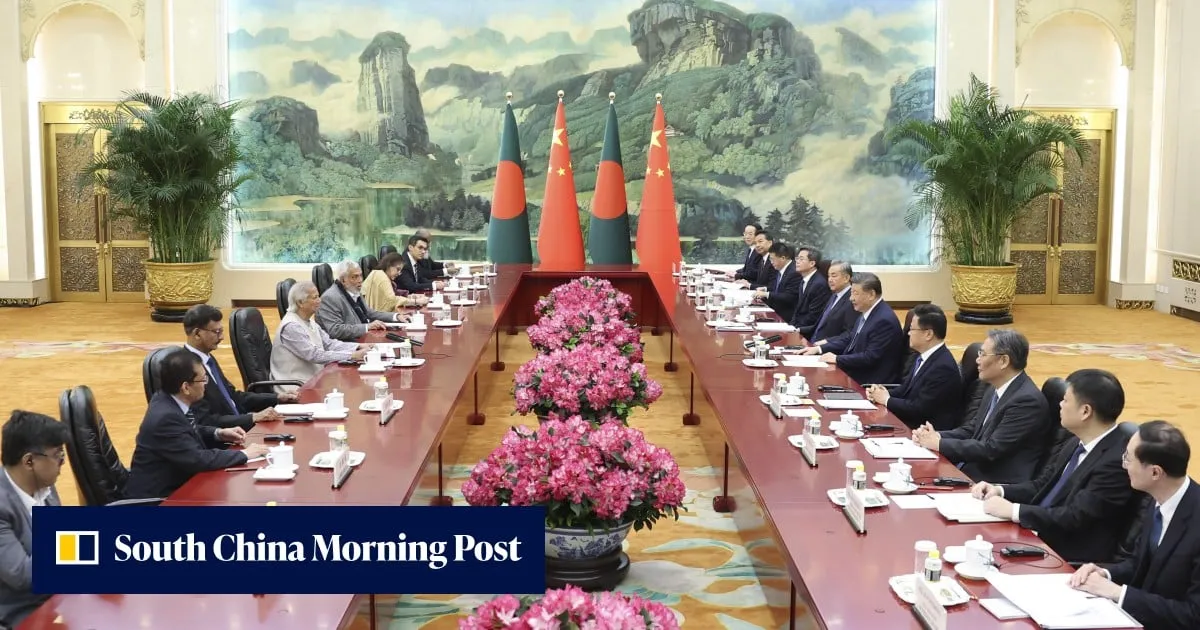
Bangladesh’s tilt towards China has added a new dimension to security and trade in South Asia, signalling what observers see as Dhaka’s desire to be a strategic actor in the region and ease its overreliance on India.The hedging policy comes after the fall of Sheikh Hasina’s Awami League government in 2024 amid a student-led uprising.Under an interim government led by Nobel laureate Muhammad Yunus, and then the Bangladesh-nationalist-party" class="entity-link entity-organization" data-entity-id="5960" data-entity-type="organization">Bangladesh Nationalist Party (BNP) after it came to power in February, the country’s diplomatic, economic and strategic ties with Beijing have deepened.
SRCSouth China Morning Post
LANGEN
LEANCenter-Right
WORDS89
ENT9
SUN · 2026-09-13 · 08:00 GMTBRIEF NSR-2026-0913-110917
NSR-2026-0913-110917Analysis·EN·Political Strategy
Bangladesh draws closer to China in ‘political chessboard’ to balance India ties
Bangladesh is deepening its diplomatic, economic, and strategic ties with China following the fall of Sheikh Hasina's Awami League government in 2024. This shift, occurring under an interim government and subsequently the Bangladesh Nationalist Party (BNP), is seen by observers as Dhaka's strategy to become a more significant regional actor and reduce its dependence on India.
Junaid KathjuSouth China Morning PostFiled 2026-09-13 · 08:00 GMTLean · Center-RightRead · 1 min
South China Morning PostFIG 01
Reading time
1min
Word count
89words
Sources cited
0cited
Entities identified
9entities
Quality score
100%
§ 01
Briefing Summary
AI-generatedNEWSAR · AI
Bangladesh is deepening its diplomatic, economic, and strategic ties with China following the fall of Sheikh Hasina's Awami League government in 2024. This shift, occurring under an interim government and subsequently the Bangladesh Nationalist Party (BNP), is seen by observers as Dhaka's strategy to become a more significant regional actor and reduce its dependence on India. This evolving relationship between Bangladesh and China introduces new dynamics to security and trade within South Asia.
Confidence 0.85Claims 4Entities 9
§ 02
Article analysis
Model · rule-basedFraming
Political Strategy
Diplomatic
Tone
Measured
AI-assessed
CalmNeutralAlarmist
Factuality
0.60 / 1.00
Mixed
LowHigh
Sources cited
0
No named sources
FewMany
§ 03
Key claims
4 extracted01
The country’s diplomatic, economic and strategic ties with Beijing have deepened under an interim government led by Muhammad Yunus and then the BNP.
factual
Confidence
0.90
02
Bangladesh's hedging policy comes after the fall of Sheikh Hasina’s Awami League government in 2024 amid a student-led uprising.
factual
Confidence
0.80
03
Bangladesh's tilt towards China adds a new dimension to security and trade in South Asia.
factual
Confidence
0.80
04
Observers see Dhaka's desire to be a strategic actor in the region and ease its overreliance on India.
quoteobservers
Confidence
0.70
§ 04
Full report
1 min read · 89 words§ 05
Entities
9 identifiedKey playerOppositionContextPositiveNeutralNegative
Locations4
§ 06
Keywords & salience
10 termsbangladesh china relations
1.00
india bangladesh ties
0.90
south asia security
0.80
strategic actor
0.70
hedging policy
0.60
student-led uprising
0.50
sheikh hasina
0.50
muhammad yunus
0.40
bangladesh nationalist party
0.40
awami league government
0.40
§ 07
Topic connections
Interactive graph Network visualization showing 51 related topics
View Full Graph Person Organization Location Event|Click node to navigate|Edge numbers = shared articles