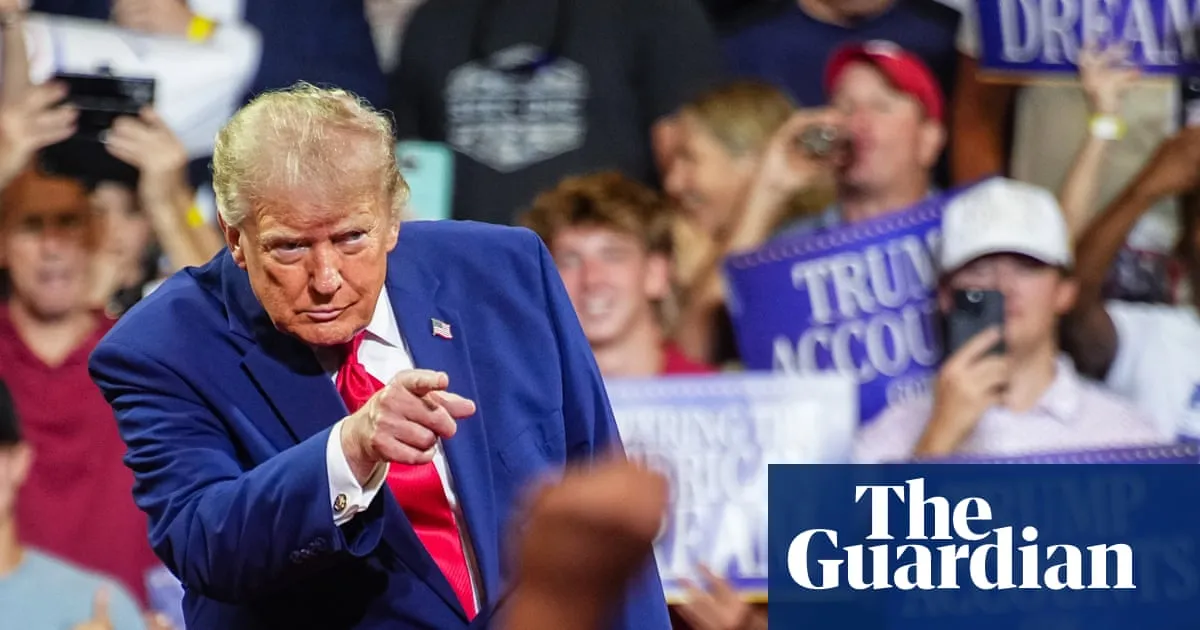
Since returning to the White House, Donald Trump has scrapped rules that made childcare more affordable and pushed to cut funding for the nation’s public schools. But with midterm elections fast approaching and his approval ratings very low, the US president has repeatedly trumpeted a two-month-old program designed to help the nation’s children. That program, unhumbly named “Trump accounts”, calls for the federal government to give a one-time $1,000 seed deposit to every newborn whose family applies.In campaign speeches this summer, Trump has sought to milk these accounts for maximum political advantage, making big promises about how much these accounts will help the nation’s children. In a speech in Las Vegas last month, Trump hailed the program, saying: “It’s really giving [children] a head start on the American dream… They start off with $1,000 … and they can end up with $100,000, $200,000, $300,000” and if the stock market booms, “you’d end up with $1m”.With these accounts, Trump seems to want to come across as a Santa Claus stuffing $1,000 into every newborn’s stocking (although that money comes from the federal government).He and other Republicans boast that these accounts will significantly lift up all children, including children from low-income families, and also narrow the wealth gap between rich and poor. When Trump kicked off these accounts in early July, the treasury department said: “Trump accounts level the playing field by allowing every parent to invest in their children’s future, not just wealthy families with trust funds.”A big problem, however, is that many economists say Trump’s claims about these accounts are vastly exaggerated or false.As Trump seeks to excite voters about these accounts, he has hyped how much they will grow, especially with regard to non-affluent families who don’t have the wherewithal to deposit money into these tax-deferred accounts to help their children. In his speeches, Trump sometimes gives the inaccurate impression that a newborn’s account with a $1,000 seed deposit will mushroom to $200,000 or $300,000 by the time the child turns 18, even when that child’s family doesn’t have money to make subsequent deposits.What’s more, “Trump accounts” are likely to increase, not decrease, the wealth gap between rich and poor. These accounts have definite tax advantages for wealthier families, who, unlike most low-income or working-class families, are able to make the maximum $5,000 deposit allowed each year into these tax-deferred accounts. It’s the families rich enough to contribute $5,000 a year who could see their children’s accounts grow to $200,000 or $300,000, far outstripping the accounts of children from poorer families.“This policy is not about giving poor kids a leg up. It’s more likely to widen the gap between rich and poor,” said Justin Wolfers, an economics professor at the University of Michigan, in a video.Kush Desai, a White House spokesperson, said in an email: “Trump accounts are already shaping up to make a generational difference for working-class children who have not historically benefitted from traditional tax advantaged accounts.” He noted that the billionaires Michael Dell and Ray Dalio, as well as multinational corporations, have “pledged to donate billions of dollars of their wealth to the Trump accounts of working-class children”.Desai rejected any assertions that the program would increase inequality, saying: “High income parents have always had an array of tools to grow wealth for their kids, but Trump accounts are giving middle class parents the same opportunity – with billionaires chipping in to help. Only a moron would argue billionaires giving money away to working-class kids will worsen inequality.”The Trump administration has hyped the accounts with extremely optimistic claims. A White House website forecasts that many children with “Trump accounts” will have $271,000 in their account by age 18 and $13m by age 55. That sounds fabulous, but according to Wolfers, those big numbers are based on an impressive 10% annual rate of return for decades – a rate of return that is extraordinarily hard to achieve year after year. Moreover, those higher numbers are for children whose parents put in $5,000 annually until age 18, and then $7,000 a year when their children are in their 20s.Wolfers derided these White House estimates, saying in his video: “They’re ridiculous, they’re dishonest and they’re misleading.”Administration officials defended their estimates of how much the accounts would grow, saying those estimates are “not dissimilar to similar projections issued by retirement account providers”.In his speeches, Trump omits something important: he fails to note that for families unable to contribute beyond the initial $1,000 seed deposit, that amount would, according to White House estimates, grow to $6,000 by age 18. (That too is also based an optimistic 10% annual return.)No one should pooh-pooh a government-given deposit of $1,000 or a possible $6,000 at age 18. But Darrick Hamilton, a New School economics professor and one of the inventors of the baby bonds idea, said those amounts are too small to change the life of a child in need – too small to make college affordable or to buy a house.skip past newsletter promotionafter newsletter promotion“It’s really an income transfer, not a wealth-building tool,” Hamilton said. He said it is the wealthiest 20%, especially the top 10%, who save money, while “people in the bottom 80% are usually dis-savers, they’re usually borrowers.” In other words, he said, the richest 20% will benefit from the tax breaks by depositing $5,000 a year into Trump accounts for their children.“The main mechanism for these accounts is active savings by parents, and that’s by nature regressive,” Hamilton said. “These accounts will actually increase wealth inequality because they favor people wealthy enough to have money to put into savings.”As part of the program, employers can contribute $2,500 a year to the account of an employee’s child. That $2,500 becomes a nice tax break for well-paid employees – the $2,500 contribution won’t be counted as taxable income. As a result, high-income workers in higher tax brackets will receive bigger tax breaks than lower-paid workers.The $1,000 seed deposits for newborns – the main part of the program helping the non-affluent – are to expire when Trump’s second term ends. But the parts of the program that help the wealthy most – the tax deferrals and tax breaks – are to continue indefinitely.The shadowy movement behind ‘Trump accounts’ – Stateside with Kai and CarterMany Republicans and business executives have hailed “Trump accounts” as a way to make American children participants in the capitalist system. Senator Ted Cruz said: “Trump accounts are, in many ways, Donald Trump’s New Deal – but instead of having government taking care of everyone, Trump accounts are about making every child and every American a capitalist.”Hamilton sees things differently. Noting that Trump accounts are invested in the stock market, he said: “This is part of their larger plan to privatize our social safety net. This is in line with Republican plans to dismantle social security.”Senator Cory Booker and Representative Ayanna Pressley introduced a never-enacted baby bonds bill in 2019 under which children would receive $1,000 in their birth year and up to $2,000 more every year to age 18. Under their proposal, based on ideas from Hamilton and the Duke professor William Darity, lower-income families would receive larger government contributions than affluent ones. Children from families at the poverty level would see their accounts rise to an estimated $46,000 by age 18, about three times as much as children from families making twice the poverty line and more than 20 times as much as children from wealthy families.Hamilton said giving larger deposits to children from poorer families would give those kids more of a leg up. But that’s not the program that Trump and the Republican-controlled Congress approved. Like so much that Trump and GOP lawmakers have done, Trump accounts will help the rich far more than the non-rich.
SRCThe Guardian - World News
LANGEN
LEANCenter-Left
WORDS1 291
ENT9
SUN · 2026-09-13 · 11:00 GMTBRIEF NSR-2026-0913-110928
NSR-2026-0913-110928Analysis·EN·Political Strategy
‘Trump accounts’ promise to mint child millionaires. Experts have their doubts
President Trump is promoting a new federal program called "Trump accounts," which provides a one-time $1,000 seed deposit to every newborn whose family applies. He has claimed these accounts will help children achieve significant financial success, potentially reaching millions of dollars.
Steven GreenhouseThe Guardian - World NewsFiled 2026-09-13 · 11:00 GMTLean · Center-LeftRead · 6 min
The Guardian - World NewsFIG 01
Reading time
6min
Word count
1 291words
Sources cited
2cited
Entities identified
9entities
Quality score
100%
§ 01
Briefing Summary
AI-generatedNEWSAR · AI
President Trump is promoting a new federal program called "Trump accounts," which provides a one-time $1,000 seed deposit to every newborn whose family applies. He has claimed these accounts will help children achieve significant financial success, potentially reaching millions of dollars. However, experts express doubts, arguing that Trump's projections are vastly exaggerated and based on unrealistic investment returns. Economists suggest the program may actually widen the wealth gap, as wealthier families can contribute more to benefit from tax advantages, while low-income families may see minimal growth from the initial deposit alone. While White House spokespeople defend the program's potential to benefit working-class children, citing private donations, critics argue the policy's design favors those already financially secure.
Confidence 0.90Sources 2Claims 5Entities 9
§ 02
Article analysis
Model · rule-basedFraming
Political Strategy
Economic Impact
Tone
Sensational
AI-assessed
CalmNeutralAlarmist
Factuality
0.60 / 1.00
Mixed
LowHigh
Sources cited
2
Limited
FewMany
§ 03
Key claims
5 extracted01
“This policy is not about giving poor kids a leg up. It’s more likely to widen the gap between rich and poor,” said Justin Wolfers.
quoteJustin Wolfers
Confidence
1.00
02
“Trump Accounts are already shaping the future for children across America by providing a foundation for financial security and upward mobility,” stated a White House spokesperson.
quoteKush Desai
Confidence
1.00
03
Trump claims these accounts can grow from $1,000 to $100,000, $200,000, $300,000, or even $1 million with stock market booms.
quoteDonald Trump
Confidence
1.00
04
Donald Trump has repeatedly trumpeted a program called “Trump accounts” designed to give every newborn a $1,000 seed deposit.
factualarticle
Confidence
1.00
05
Many economists say Trump’s claims about these accounts are vastly exaggerated or false.
factualeconomists
Confidence
0.80
§ 04
Full report
6 min read · 1 291 words§ 05
Entities
9 identifiedKey playerOppositionContextPositiveNeutralNegative
Organizations3
§ 06
Keywords & salience
8 termstrump accounts
1.00
child millionaire
0.90
wealth gap
0.80
economic claims
0.70
political advantage
0.60
investment program
0.50
federal government
0.40
donald trump
0.40
§ 07
Topic connections
Interactive graph Network visualization showing 51 related topics
View Full Graph Person Organization Location Event|Click node to navigate|Edge numbers = shared articles