Last month, the People’s Liberation Army (PLA) released footage showing its H-6N bomber flying with a nuclear-capable Jing Lei-1 (JL-1) air-launched ballistic missile (ALBM), offering a rare look at China’s airborne nuclear strike capability.The H-6N is one of the latest modernised variants of the H-6, the country’s only strategic bomber. Its flight carrying the ALBM during a joint anti-ship exercise was featured in a documentary by state broadcaster CCTV for the PLA’s 99th anniversary.The unveiling comes as China expands the scope of its H-6 bombers’ activities beyond its nearby airspace.In July 2024, two H-6s were spotted conducting joint patrol near Alaska for the first time with their Russian counterpart, the Tu-95, prompting the US-Canadian North American Aerospace Defence Command to scramble their fighter jets.For the past six decades, the H-6 has served as Beijing’s primary strategic strike aircraft. With the JL-1 ALBM able to be mounted on the H-6N bomber, China is now considered to have completed its nuclear triad, boosting its nuclear deterrence and second-strike capability.History and development
SRCSouth China Morning Post
LANGEN
LEANCenter-Right
WORDS169
ENT12
SUN · 2026-09-13 · 14:00 GMTBRIEF NSR-2026-0913-110983
NSR-2026-0913-110983News Report·EN·National Security
For China, H-6N bomber enhances nuclear deterrence and second-strike capability
China's People's Liberation Army (PLA) recently showcased its H-6N strategic bomber carrying a nuclear-capable Jing Lei-1 (JL-1) air-launched ballistic missile (ALBM). This footage, released in a state broadcaster documentary for the PLA's 99th anniversary, offers a rare glimpse into China's airborne nuclear strike capabilities.
Seong Hyeon ChoiSouth China Morning PostFiled 2026-09-13 · 14:00 GMTLean · Center-RightRead · 1 min
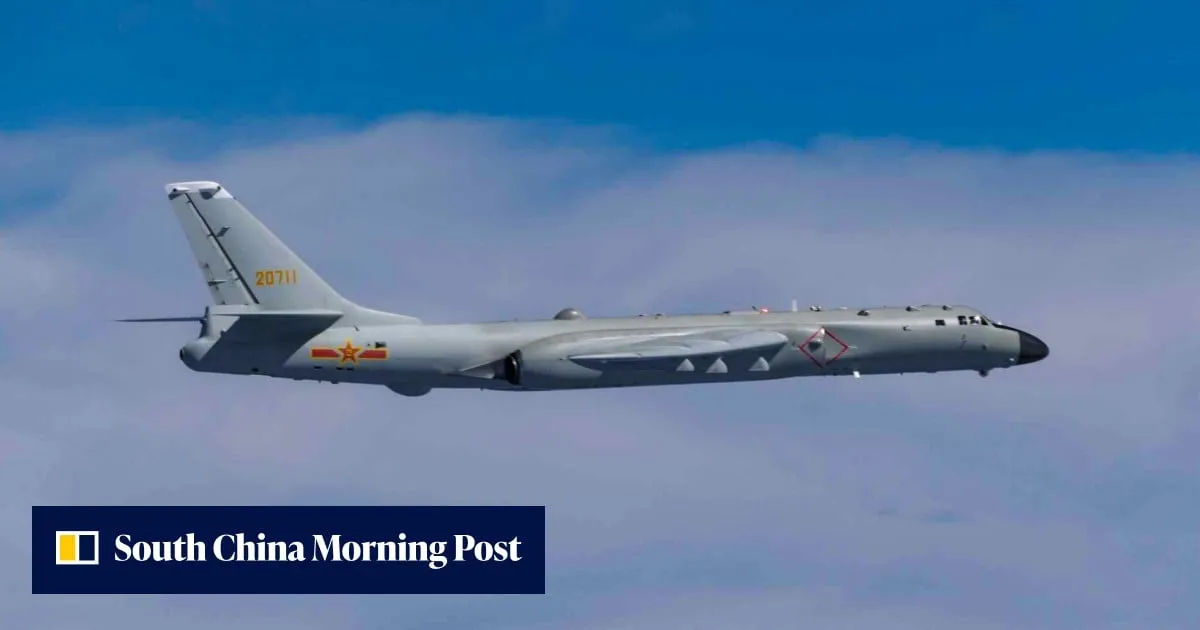
South China Morning PostFIG 01
Reading time
1min
Word count
169words
Sources cited
1cited
Entities identified
12entities
Quality score
100%
§ 01
Briefing Summary
AI-generatedNEWSAR · AI
China's People's Liberation Army (PLA) recently showcased its H-6N strategic bomber carrying a nuclear-capable Jing Lei-1 (JL-1) air-launched ballistic missile (ALBM). This footage, released in a state broadcaster documentary for the PLA's 99th anniversary, offers a rare glimpse into China's airborne nuclear strike capabilities. The H-6N, a modernized variant of China's sole strategic bomber, is now capable of deploying the JL-1 ALBM. This development is significant as it reportedly completes China's nuclear triad, enhancing its nuclear deterrence and second-strike capacity. The H-6 bomber's operational scope has also expanded, with recent joint patrols near Alaska alongside Russian aircraft.
Confidence 0.90Sources 1Claims 4Entities 12
§ 02
Article analysis
Model · rule-basedFraming
National Security
Technology
Tone
Measured
AI-assessed
CalmNeutralAlarmist
Factuality
0.80 / 1.00
Factual
LowHigh
Sources cited
1
Limited
FewMany
§ 03
Key claims
4 extracted01
In July 2024, two H-6 bombers conducted a joint patrol near Alaska with Russian Tu-95 bombers.
factualarticle
Confidence
1.00
02
The H-6N is one of the latest modernized variants of the H-6, China's only strategic bomber.
factualarticle
Confidence
1.00
03
The PLA released footage of its H-6N bomber flying with a nuclear-capable Jing Lei-1 (JL-1) air-launched ballistic missile (ALBM).
factualarticle
Confidence
1.00
04
With the JL-1 ALBM mounted on the H-6N, China is considered to have completed its nuclear triad, boosting its nuclear deterrence and second-strike capability.
factualarticle
Confidence
0.90
§ 04
Full report
1 min read · 169 words§ 05
Entities
12 identifiedKey playerOppositionContextPositiveNeutralNegative
Organizations3
§ 06
Keywords & salience
10 termsnuclear deterrence
1.00
second-strike capability
1.00
h-6n bomber
1.00
jl-1 albm
0.90
nuclear triad
0.80
strategic bomber
0.70
people's liberation army
0.60
airborne nuclear strike
0.50
china
0.50
military modernization
0.40
§ 07
Topic connections
Interactive graph Network visualization showing 51 related topics
View Full Graph Person Organization Location Event|Click node to navigate|Edge numbers = shared articles