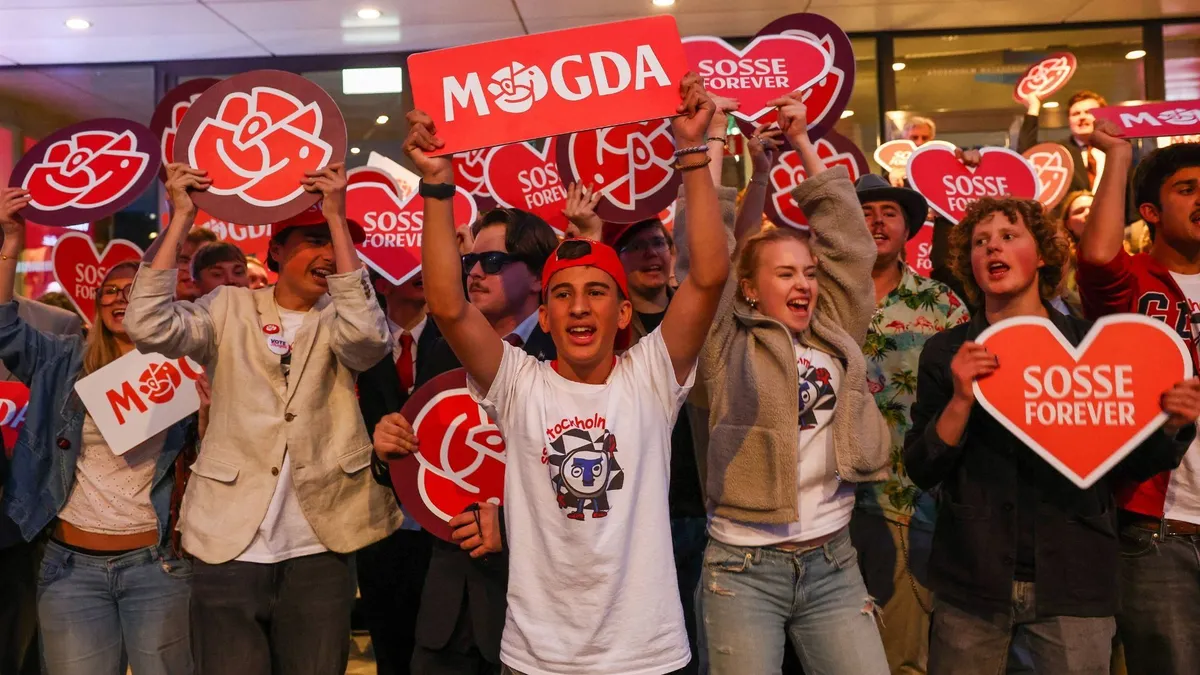
Opposition bloc leads in tight Swedish election with 95% counted.Sweden’s centre-left opposition bloc has held a narrow lead as the far-right party saw its support slip, with about 95 percent of the districts counted.The Swedish election Authority reported on Monday that the four opposition parties were projected to hold 176 seats in the 349-seat parliament, called the Riksdag, while the remaining 173 would go to four parties that make up or support the current conservative-led government.Recommended Stories list of 3 itemslist 1 of 3Photos: Large Oslo crowd bids farewell to Norway’s King Harald Vlist 2 of 3Multicultural Malmo: Swedish city loathed by far right braces for electionlist 3 of 3Sweden’s centre-left leads by three seats as vote counting continuesend of listResults may not be clear until early votes and overseas ballots are counted on Wednesday. If the left-leaning bloc emerges victorious, it could take even longer to form a government because of ideological tensions among its parties.Prime Minister Ulf Kristersson is seeking a second term and has been leading the country since 2022 with a centre-right coalition that relies on the Sweden-democrats" class="entity-link entity-organization" data-entity-id="9626" data-entity-type="organization">Sweden Democrats, a party with neo-Nazi roots. He could remain in office if the left-wing bloc wins its thin majority but fails to form a government.The Sweden-democrats" class="entity-link entity-organization" data-entity-id="9626" data-entity-type="organization">Sweden Democrats saw an unexpected drop in support, losing three percentage points compared with the 2022 general election, slipping from 20.5 percent to 17.5 percent. This marked the first time the far-right party suffered a loss in voter backing since it entered parliament in 2010.Magdalena Andersson’s Social Democrats held onto first place, but a 28.1 percent share registered as one of their worst performances in more than 100 years, complicating any bid to assemble a working majority.Moderate Party leader Ulf Kristersson (C) speaks during the Moderates’ election night watch party in Stockholm, Sweden, 13 September 2026 [Christine Olsson/Sweden Out/EPA]While the result appears somewhat out of step with recent far-right gains across parts of Europe, including Germany and Italy, the Sweden-democrats" class="entity-link entity-organization" data-entity-id="9626" data-entity-type="organization">Sweden Democrats remain firmly entrenched as a dominant force in parliament.
SRCAl Jazeera
LANGEN
LEANCenter
WORDS337
ENT12
TUE · 2026-09-15 · 00:06 GMTBRIEF NSR-2026-0915-111306
NSR-2026-0915-111306News Report·EN·Political Strategy
Sweden election is too close to call as far right loses ground
Sweden's center-left opposition bloc is narrowly leading in the general election with 95% of districts counted, projected to hold 176 seats in the 349-seat parliament. This outcome comes as the far-right Sweden Democrats saw a slip in support, losing three percentage points from their 2022 performance.
Al Jazeera StaffAl JazeeraFiled 2026-09-15 · 00:06 GMTLean · CenterRead · 2 min
Al JazeeraFIG 01
Reading time
2min
Word count
337words
Sources cited
1cited
Entities identified
12entities
Quality score
100%
§ 01
Briefing Summary
AI-generatedNEWSAR · AI
Sweden's center-left opposition bloc is narrowly leading in the general election with 95% of districts counted, projected to hold 176 seats in the 349-seat parliament. This outcome comes as the far-right Sweden Democrats saw a slip in support, losing three percentage points from their 2022 performance. While the opposition bloc's lead is slim, final results may be delayed until early and overseas votes are counted. If the opposition wins, forming a government could be challenging due to internal ideological differences. Prime Minister Ulf Kristersson, seeking a second term, leads a center-right coalition that relies on the Sweden Democrats, who, despite losing ground, remain a significant parliamentary force.
Confidence 0.90Sources 1Claims 5Entities 12
§ 02
Article analysis
Model · rule-basedFraming
Political Strategy
Social Justice
Tone
Measured
AI-assessed
CalmNeutralAlarmist
Factuality
0.80 / 1.00
Factual
LowHigh
Sources cited
1
Limited
FewMany
§ 03
Key claims
5 extracted01
This marks the first time the far-right party has suffered a loss in voter backing since entering parliament in 2010.
factual
Confidence
0.95
02
The Sweden Democrats saw a drop in support, losing three percentage points from 20.5% to 17.5%.
statistic
Confidence
0.95
03
Sweden’s centre-left opposition bloc holds a narrow lead with 95% of districts counted.
statistic
Confidence
0.95
04
Magdalena Andersson’s Social Democrats registered a 28.1% share, one of their worst performances in over 100 years.
statistic
Confidence
0.90
05
The four opposition parties are projected to hold 176 seats in the 349-seat parliament.
statisticSwedish Election Authority
Confidence
0.90
§ 04
Full report
2 min read · 337 words§ 05
Entities
12 identifiedKey playerOppositionContextPositiveNeutralNegative
Organizations4
Locations5
§ 06
Keywords & salience
8 termsswedish election
1.00
far right
0.90
opposition bloc
0.80
sweden democrats
0.70
centre-left
0.70
parliament
0.60
government formation
0.50
voter backing
0.40
§ 07
Topic connections
Interactive graph Network visualization showing 51 related topics
View Full Graph Person Organization Location Event|Click node to navigate|Edge numbers = shared articles