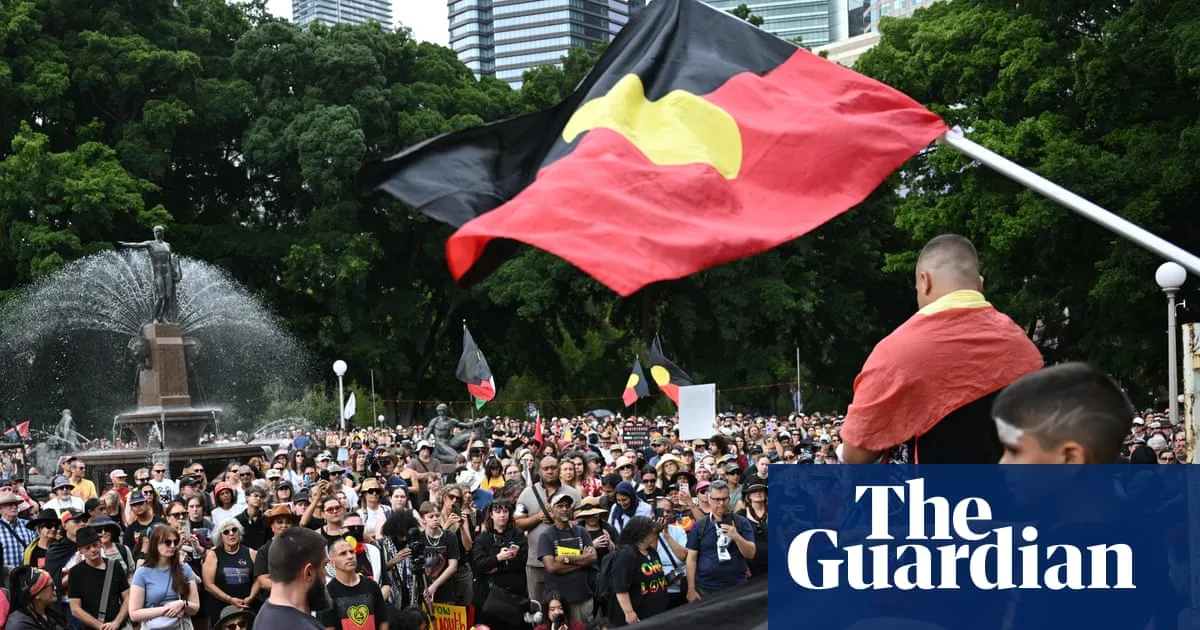
A large crowd gathers and waves the Australian Aboriginal flag during an Invasion Day protest in Hyde Park in Sydney on 26 January 2026. Photograph: Dean Lewins/AAP View image in fullscreen A large crowd gathers and waves the Australian Aboriginal flag during an Invasion Day protest in Hyde Park in Sydney on 26 January 2026. Photograph: Dean Lewins/AAP Australia’s Indigenous population estimated at 2.2m before ‘demographic catastrophe’ of colonisation Study finds earlier numbers were underestimated, suggesting impact of diseases and massacres were much greater than previously thought Get our breaking news email, free app or daily news podcast The number of Aboriginal and Torres Strait Islander people in Australia before colonisation was dramatically underestimated, according to new research that suggests many more of them were killed. Modelling by a national research group puts the population levels before the 1788 first fleet arrived at 2.2 million, compared with early estimates of 250,000 people. The research, by the Australian Research Council Centre of Excellence for Indigenous and Environmental Histories and Futures (CIEHF), has been published in the peer-reviewed Nature Human Behaviour. The authors wrote that, historically, population estimates have been poor “due to lethal diseases, frontier and structural violence, and absence of systematic censuses” and that it’s “invaluable to truth-telling and reconciliation” to try to rectify that. They warn readers that the content of the study is confronting and possibly distressing. The modelling showed there had to be millions of excess deaths from smallpox and other diseases, massacres, and the other results of colonisation such as dispossession and malnutrition, according to co-author Prof Corey Bradshaw, a global ecology professor at Flinders University. His previous research found that an 1789 smallpox outbreak alone killed as many as 220,000 Aboriginal people. There were also other smallpox epidemics, as well as outbreaks of measles, influenza, tuberculosis, typhoid and other diseases. Bradshaw said he would bet his career that massacre databases were underestimated by an “order of magnitude”. “If you’re a frontier farmer, a colonialist that came out to a new area, and you were trying to remove people from ‘your’ land, you’re not going to write extensively about how many people you killed to do that,” he said. “There’s another component here that’s essentially greed and racism – the entire concept of terra nullius was based on not many people being here. If there’s a systematic desire to take land [fewer people means a] better justification for imperialism.” Australia was colonised on the basis of terra nullius, that it belonged to no one. That concept was overthrown with the high court’s Mabo decision, when it was recognised that First Nations people had been here for tens of thousands of years. Aboriginal and Torres Strait Islander people were not properly counted in the census until 1971, after the 1967 referendum. A that point, 115,953 people identified as Aboriginal and/or Torres Strait Islander. In 2021, 812,728 Aboriginal and Torres Strait Islander people were counted in the census, a figure revised upwards to 983,257 with post-census recounts. The 2.2 million figure, as well as a new estimate of 2.06 million excess deaths between 1788 and 1861, means the population was reduced to about 7% of its original size. “We are not talking about a marginal consequence of colonisation but a demographic catastrophe at the heart of the Australian story,” distinguished professor Larissa Behrendt said. A Euahleyai/Gamillaroi woman, she is also the chair of the CIEHF’s advisory committee. Early on after colonisation, various people estimated how many Aboriginal people were in their region. For example, governor Arthur Phillip estimated Gadigal people of the Eora nation came to about 1,500. The first continent-wide estimate by social anthropologist Alfred Radcliffe-Brown put the number between 250,000 and 300,000, but mainly used observations from after the impacts of colonisation had been felt. Radcliffe-Brown was aware that was an underestimate, but many researchers since have relied on that count as a baseline. Again, often recognising that it would be an undercount because of historical reasons and because changes in who identified/was identified as Aboriginal. In 1983, economic historian Noel Butlin estimated the population at about 900,000. Later he increased that to between 1.1 million and 1.3 million. In 1987, archaeologists John Mulvaney and J. Peter White argued it was more likely 750,000. There have been many and varied estimates since, usually based on historical and ethnographic information. The Australian team used different approaches to model the population. They looked at archaeological items to reconstruct how many people would have been there at a particular time, reconstructed the climate and the productivity of the land to infer how many people it could sustain, and looked at genetic data to work back in time based on known DNA mutation rates. They also reviewed, but did not rely on, ethnographic estimates. “The findings highlight the scale of demographic catastrophe experienced by Indigenous Australians due to colonisation, with the implications being a heightened understanding of intergenerational trauma and to inform future policy that assists Indigenous people,” said co-author and distinguished professor Lynette Russell of the Monash University Indigenous Studies Centre and CIEHF. The authors wrote that Australia must prioritise reconciliation, engagement and policymaking with Indigenous people who still suffer intergenerational trauma and that the broader community should embrace the rich culture that survived these events. The lead author, James Cook University associate professor Alan Williams, said the “devastating findings” highlight the impacts of invasion. But they also demonstrate the “remarkable survival, resilience and recovery over the past century of Aboriginal and Torres Strait Island people”. Behrendt said the research “tells us something extraordinary”. “Our survival is one of Australian history’s most remarkable stories,” she said. Explore more on these topics Indigenous Australians Colonialism Anthropology news Share Reuse this content
SRCThe Guardian - World News
LANGEN
LEANCenter-Left
WORDS951
ENT12
TUE · 2026-09-15 · 09:00 GMTBRIEF NSR-2026-0915-111394
NSR-2026-0915-111394News Report·EN·Social Justice
Australia’s Indigenous population estimated at 2.2m before ‘demographic catastrophe’ of colonisation
New research by the Australian Research Council Centre of Excellence for Indigenous and Environmental Histories and Futures (CIEHF) suggests Australia's pre-colonisation Indigenous population was significantly underestimated. Using modeling, the study estimates 2.2 million Aboriginal and Torres Strait Islander people were present before 1788, a stark contrast to earlier figures around 250,000.
Tory ShepherdThe Guardian - World NewsFiled 2026-09-15 · 09:00 GMTLean · Center-LeftRead · 4 min
The Guardian - World NewsFIG 01
Reading time
4min
Word count
951words
Sources cited
2cited
Entities identified
12entities
Quality score
100%
§ 01
Briefing Summary
AI-generatedNEWSAR · AI
New research by the Australian Research Council Centre of Excellence for Indigenous and Environmental Histories and Futures (CIEHF) suggests Australia's pre-colonisation Indigenous population was significantly underestimated. Using modeling, the study estimates 2.2 million Aboriginal and Torres Strait Islander people were present before 1788, a stark contrast to earlier figures around 250,000. This revised estimate indicates that diseases, massacres, and other impacts of colonisation led to a "demographic catastrophe," with an estimated 2.06 million excess deaths between 1788 and 1861. The researchers highlight that historical population estimates were poor due to violence, disease, and a lack of systematic censuses, and that rectifying these numbers is crucial for truth-telling and reconciliation.
Confidence 0.90Sources 2Claims 5Entities 12
§ 02
Article analysis
Model · rule-basedFraming
Social Justice
Human Rights
Tone
Mixed Tone
AI-assessed
CalmNeutralAlarmist
Factuality
0.80 / 1.00
Factual
LowHigh
Sources cited
2
Limited
FewMany
§ 03
Key claims
5 extracted01
Massacre databases are likely underestimated by an order of magnitude.
factualProf Corey Bradshaw
Confidence
0.90
02
The impact of colonisation, including diseases and massacres, was much greater than previously thought.
factualProf Corey Bradshaw
Confidence
0.90
03
Australia's Indigenous population before colonisation was dramatically underestimated, with new research suggesting 2.2 million people.
statisticAustralian Research Council Centre of Excellence for Indigenous and Environmental Histories and Futures (CIEHF)
Confidence
0.90
04
A 1789 smallpox outbreak alone may have killed as many as 220,000 Aboriginal people.
statisticProf Corey Bradshaw
Confidence
0.80
05
Previous population estimates of 250,000 Indigenous people before colonisation were likely poor due to lethal diseases, frontier violence, and lack of censuses.
factualAustralian Research Council Centre of Excellence for Indigenous and Environmental Histories and Futures (CIEHF)
Confidence
0.80
§ 04
Full report
4 min read · 951 words§ 05
Entities
12 identifiedKey playerOppositionContextPositiveNeutralNegative
Organizations3
§ 06
Keywords & salience
10 termscolonisation
1.00
indigenous population
1.00
demographic catastrophe
0.90
aboriginal and torres strait islander people
0.80
historical population estimates
0.80
massacres
0.70
diseases
0.70
truth-telling and reconciliation
0.60
frontier violence
0.50
excess deaths
0.40
§ 07
Topic connections
Interactive graph Network visualization showing 51 related topics
View Full Graph Person Organization Location Event|Click node to navigate|Edge numbers = shared articles