Seoul is set to host its first presidential meeting with five Russia-allied states positioning themselves as a bloc.Kazakhstan's President Kassym-Jomart Tokayev shakes hands with South Korea's President Lee Jae Myung at the Blue House in Seoul, South Korea, on September 15, 2026, ahead of the first South Korea-Central Asia summit [Jung Yeon-je/Pool via Reuters]Published On 15 Sep 2026South Korea is set to welcome the heads of the five Central Asian states for the first-ever presidential summit between Seoul and the region, a meeting local media have dubbed “historic”.Wednesday’s summit, preceded by bilateral meetings between South Korean President Lee Jae Myung and leaders of Uzbekistan, Kazakhstan, Turkmenistan, Tajikistan and Kyrgyzstan, aims to deepen economic engagement between Central Asia and the host, and put them on a more permanent footing.Recommended Stories list of 4 itemslist 1 of 4Kazakhstan’s Tokayev appoints longtime adviser as vice presidentlist 2 of 4Kyrgyzstan hosts pivotal SCO summit amid global geopolitical shiftslist 3 of 4BRICS meets in India: What’s on the agenda, why it matterslist 4 of 4South Korean officials decry ‘worst ever’ Asian Games accommodationend of list“The first expectation is political. The summit will raise a dialogue that has existed since 2007 to the level of heads of state. But the real test is whether it produces a workable agenda in critical minerals, energy, digital technologies and transport,” Sanat Kushkumbayev, from the Kazakhstan Institute for Strategic Studies, told Al Jazeera.“For Central Asia, the value of the meeting is also in showing that the region can engage external partners collectively without giving up national priorities. I would expect a framework for regular high-level cooperation, followed by more detailed bilateral deals.”Central Asian states, which are increasingly positioning themselves as a bloc known as C5+, are looking for investments, access to technology and to diversify their international partnerships beyond Moscow and Beijing, analysts said, while South Korea needs to diversify its economic and supply-chain dependencies.“Currently, South Korea has a limited domestic resource base and a significant supply-chain exposure to China, particularly in critical materials, components and other industrial inputs. Central Asia can offer South Korea critical minerals, energy, alternative production opportunities and greater supply chain diversification. Korea, in return, can provide technology, capital and industrial expertise,” said Sabina Insebayeva, a political scientist at Nazarbayev University.She explained that the K-Silk Road initiative, South Korea’s strategy for Central Asia launched in 2024, aims to go beyond securing raw materials to develop processing, manufacturing and technology capacity in partnership with local companies.Central Asia no longer wants to position itself as an exporter of raw materials. Instead, it is seeking the skills and technology needed for domestic industrial hubs. South Korea can act as a long-term partner to achieve this goal, particularly in Kazakhstan and Uzbekistan.“Kazakhstan already accounts for much of South Korea’s trade and investment presence in the region, so it can reasonably push for larger industrial projects, research facilities and local supplier networks. The difficult part will be moving from assembly and memorandums to genuine localisation and commercial production,” Kushkumbayev explained.By the end of 2025, the lump-sum volume of South Korea’s direct investment in Central Asia reached about $6.4bn.But its appeal in Central Asia goes beyond its potential as an investor and technology provider, as a social connection has long been in place.South Korea’s historical ties to the regionIn 1937, at the order of Joseph Stalin, more than 170,000 Soviet Koreans were forcibly relocated from the USSR’s Far East to Soviet Uzbekistan and Kazakhstan, under the pretext of preventing Japanese sabotage.“When my grandparents arrived in southern Kazakhstan, it was autumn, and it was already cold, but they had no houses to live in. That winter they lived with local Kazakh people who supported them and deportees from other countries,” said Roman Zakharov, a half-Korean artist from Kazakhstan.His grandparents waited for a year to receive housing from the authorities, but as deportees, they had no permission to leave the collective farms they worked on until Stalin’s death.The deportees and their descendants, collectively called Koryo-saram, have sought to stay connected to their roots, but this has not been easy.“Koryo-saram tried to adapt local products like carrots to make Korean pickled food. But local Korean culture changed through time … My grandmother tried to listen to South Korean programmes on TV, but she couldn’t understand anything. It was a different language than my grandparents spoke,” said Zakharov, whose art pieces were shown at an exhibition in South Korea in 2023.When the Soviet Union collapsed, South Korea began founding cultural centres across Central Asia, where local people, including Koryo-saram, could learn the language and engage with Korean culture. Zakharov’s sister attended traditional Korean dance classes.But the breakthrough for Korean soft power in Central Asia came in the 2010s when soap operas and K-pop became the talk of the town.“The South Korean government has been popularising Korean culture in Central Asia and using it as a soft power which is already very strong,” said Aiganym Toleuliyeva, a 28-year-old Kazakh researcher, who moved to South Korea to study in 2019.“In Astana, there is a Korean kimchi festival, and a Korean music festival funded by the Korean embassy. It’s through this kind of soft power and encouraging young people from Central Asia to study in South Korea that Korea is expanding in the region.”When she first visited Korea in 2015, few locals were familiar with her homeland. But as time went by, the relations grew too.Today, Central Asia is a tourist destination for South Koreans and for some in the region, Seoul’s appeal extends beyond music, the beauty industry and soap operas.“Central Asian workers in Korea are also treated better than immigrants in Russia, where the situation is becoming increasingly dangerous,” said Toleuliyeva. “Today Korea offers more opportunities for immigrants from Central Asia; they feel supported. People from Uzbekistan, Kyrgyzstan – and soon Kazakhstan, too – can join special programmes for labour workers, study the language for free and move to Korea to work on construction sites.”In a region trying to diversify its partnerships beyond China and Russia, South Korea could be seen as a less politically loaded partner.“There is a geopolitical element too. Seoul wants a stronger and more visible position in a region where China, Russia, the European Union, Turkiye and the Gulf states are already active,” Kushkumbayev said. “But the Korean approach is likely to remain commercially driven and relatively low-key, rather than openly geopolitical.”
SRCAl Jazeera
LANGEN
LEANCenter
WORDS1 059
ENT12
TUE · 2026-09-15 · 13:30 GMTBRIEF NSR-2026-0915-111438
NSR-2026-0915-111438News Report·EN·Political Strategy
South Korea embraces Central Asian leaders, looking to boost regional clout
South Korea is hosting its first presidential summit with five Central Asian nations—Kazakhstan, Uzbekistan, Turkmenistan, Tajikistan, and Kyrgyzstan—aiming to elevate existing dialogue to the head-of-state level. The summit, held on September 15, 2026, seeks to deepen economic ties, particularly in critical minerals, energy, digital technologies, and transport.
Agnieszka Pikulicka-WilczewskaAl JazeeraFiled 2026-09-15 · 13:30 GMTLean · CenterRead · 5 min
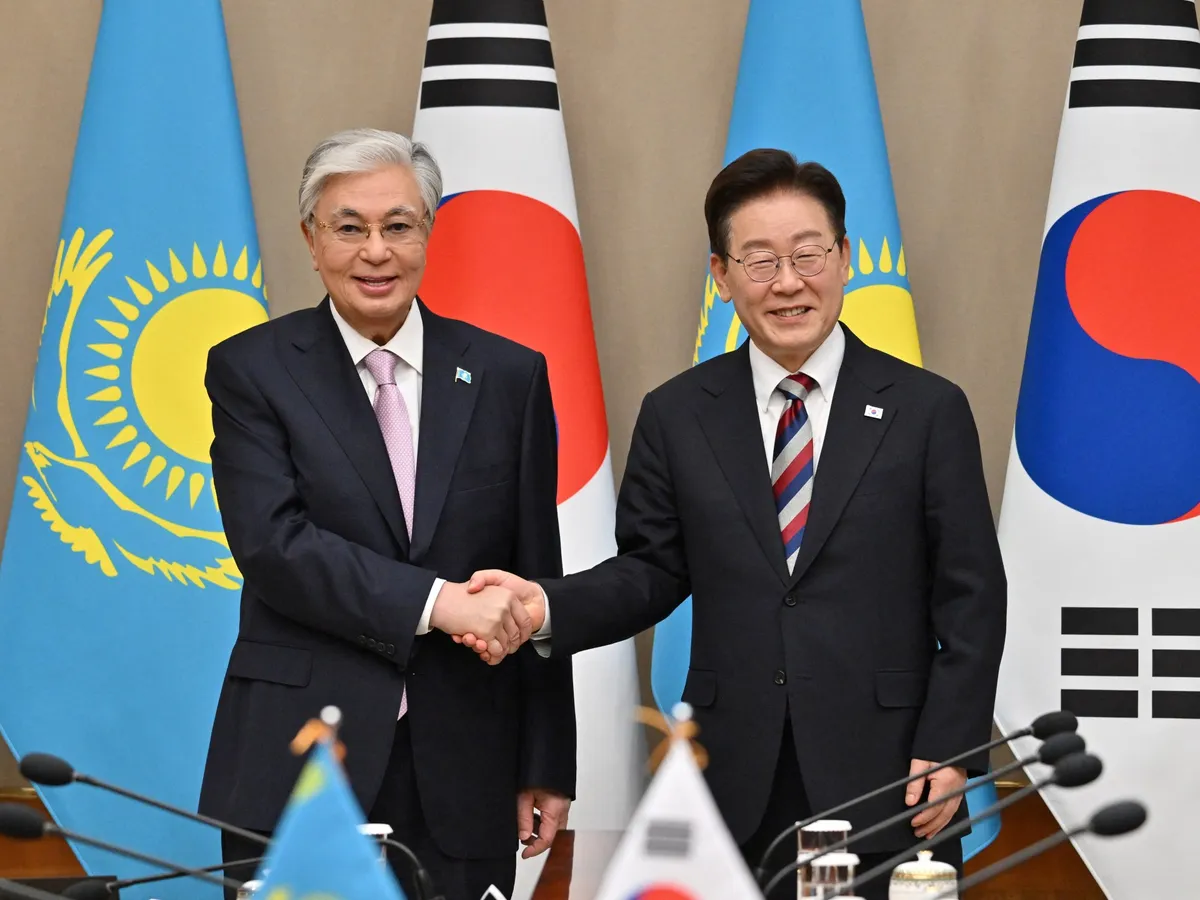
Al JazeeraFIG 01
Reading time
5min
Word count
1 059words
Sources cited
2cited
Entities identified
12entities
Quality score
100%
§ 01
Briefing Summary
AI-generatedNEWSAR · AI
South Korea is hosting its first presidential summit with five Central Asian nations—Kazakhstan, Uzbekistan, Turkmenistan, Tajikistan, and Kyrgyzstan—aiming to elevate existing dialogue to the head-of-state level. The summit, held on September 15, 2026, seeks to deepen economic ties, particularly in critical minerals, energy, digital technologies, and transport. Central Asian states are looking to diversify partnerships beyond Russia and China, while South Korea aims to secure supply chains and access to resources. This initiative builds on South Korea's K-Silk Road strategy, launched in 2024, which focuses on developing processing and manufacturing capacity in the region. The summit also acknowledges historical connections, as descendants of Koreans forcibly relocated to Central Asia in 1937 maintain ties to their heritage.
Confidence 0.90Sources 2Claims 5Entities 12
§ 02
Article analysis
Model · rule-basedFraming
Political Strategy
Economic Impact
Tone
Measured
AI-assessed
CalmNeutralAlarmist
Factuality
0.70 / 1.00
Factual
LowHigh
Sources cited
2
Limited
FewMany
§ 03
Key claims
5 extracted01
The summit aims to deepen economic engagement and raise dialogue to the head of state level.
factual
Confidence
1.00
02
South Korea is hosting its first presidential summit with five Central Asian states.
factual
Confidence
1.00
03
The K-Silk Road initiative aims to develop processing, manufacturing, and technology capacity in partnership with local companies.
factualSabina Insebayeva
Confidence
0.90
04
South Korea needs to diversify its economic and supply-chain dependencies, particularly from China.
factualSabina Insebayeva
Confidence
0.90
05
Central Asian states seek investments, technology access, and diversification beyond Moscow and Beijing.
factualanalysts
Confidence
0.90
§ 04
Full report
5 min read · 1 059 words§ 05
Entities
12 identifiedKey playerOppositionContextPositiveNeutralNegative
Locations8
§ 06
Keywords & salience
10 termssouth korea
1.00
central asia
1.00
regional cooperation
0.90
economic engagement
0.80
supply chain diversification
0.70
critical minerals
0.60
presidential summit
0.50
geopolitical shifts
0.50
energy
0.40
digital technologies
0.40
§ 07
Topic connections
Interactive graph Network visualization showing 51 related topics
View Full Graph Person Organization Location Event|Click node to navigate|Edge numbers = shared articles