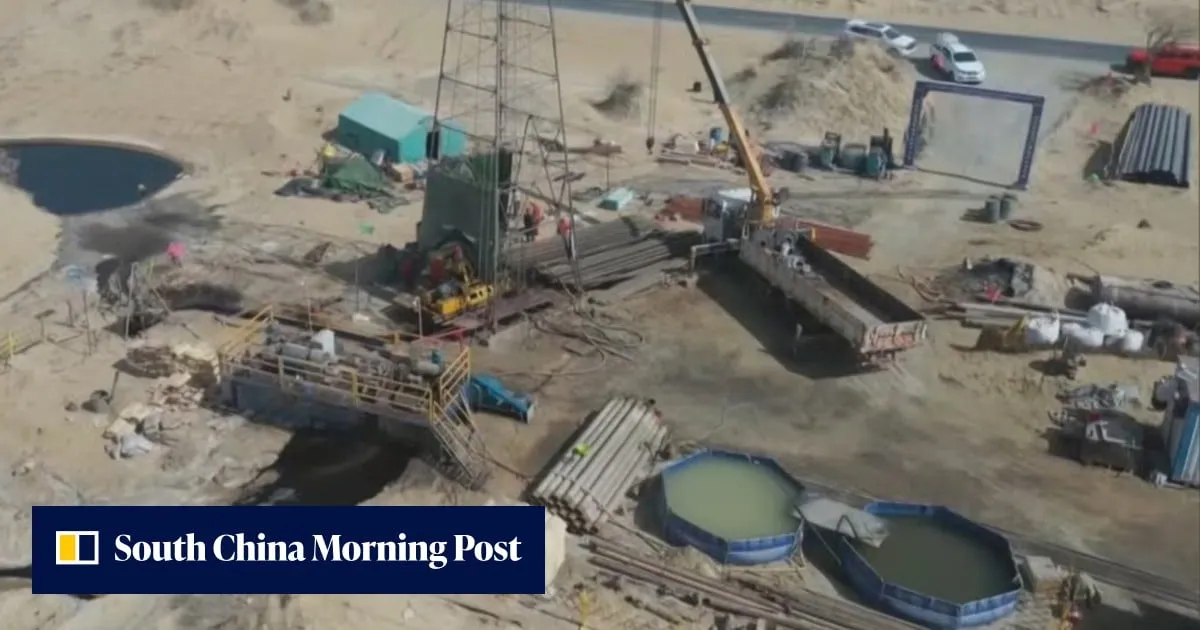
Geologists have discovered two large water sources beneath China’s largest desert, potentially offering the northwestern region a vital new tap for sand-control projects and agriculture.The desert region has drawn attention for extensive afforestation and anti-desertification efforts taking place around its edges under the Great Green Wall initiative, alongside a rainfall trend that is transforming arid western China.The groundwater discoveries were made as part of a water-finding project in the Taklamakan Desert conducted in the Xinjiang Uygur autonomous region by the region’s geological bureau, according to a report by CCTV Finance on Monday.09:35How is China building a great green wall to protect itself from desertificationThe findings challenge the perception that “there is only stagnant water and salt water underground in the desert”, according to the report.Stagnant groundwater is a source that has slowed or stopped moving, allowing bacteria and chemicals to build up and making it unsuitable for drinking and food production.
SRCSouth China Morning Post
LANGEN
LEANCenter-Right
WORDS151
ENT6
WED · 2026-09-16 · 10:00 GMTBRIEF NSR-2026-0916-111689
NSR-2026-0916-111689News Report·EN·Environmental
Geologists find unexpectedly large water sources in Xinjiang beneath China’s largest desert
Geologists in China's Xinjiang region have discovered two significant underground water sources beneath the Taklamakan Desert. These findings, made during a water-finding project by the region's geological bureau, challenge the assumption that desert groundwater is primarily stagnant and saline.
Victoria BelaSouth China Morning PostFiled 2026-09-16 · 10:00 GMTLean · Center-RightRead · 1 min
South China Morning PostFIG 01
Reading time
1min
Word count
151words
Sources cited
1cited
Entities identified
6entities
Quality score
100%
§ 01
Briefing Summary
AI-generatedNEWSAR · AI
Geologists in China's Xinjiang region have discovered two significant underground water sources beneath the Taklamakan Desert. These findings, made during a water-finding project by the region's geological bureau, challenge the assumption that desert groundwater is primarily stagnant and saline. The discovery offers a potential new resource for sand-control initiatives and agricultural development in the arid northwestern area. This comes as the region is already engaged in large-scale afforestation and anti-desertification efforts under the Great Green Wall initiative, alongside observed rainfall trends transforming western China.
Confidence 0.90Sources 1Claims 4Entities 6
§ 02
Article analysis
Model · rule-basedFraming
Environmental
Economic Impact
Tone
Measured
AI-assessed
CalmNeutralAlarmist
Factuality
0.90 / 1.00
Factual
LowHigh
Sources cited
1
Limited
FewMany
§ 03
Key claims
4 extracted01
The findings challenge the perception that deserts only have stagnant or saltwater underground.
quoteCCTV Finance
Confidence
1.00
02
The groundwater discoveries were made as part of a water-finding project in the Taklamakan Desert.
factualCCTV Finance
Confidence
1.00
03
Geologists discovered two large water sources beneath China's largest desert in Xinjiang.
factual
Confidence
1.00
04
These water sources could provide a vital new resource for sand-control projects and agriculture in the region.
factual
Confidence
0.90
§ 04
Full report
1 min read · 151 words§ 05
Entities
6 identifiedKey playerOppositionContextPositiveNeutralNegative
Locations3
§ 06
Keywords & salience
9 termswater sources
1.00
taklamakan desert
0.90
xinjiang
0.80
desertification
0.70
groundwater
0.60
great green wall
0.60
afforestation
0.50
agriculture
0.40
stagnant water
0.40
§ 07
Topic connections
Interactive graph Network visualization showing 2 related topics
View Full Graph Person Organization Location Event|Click node to navigate|Edge numbers = shared articles