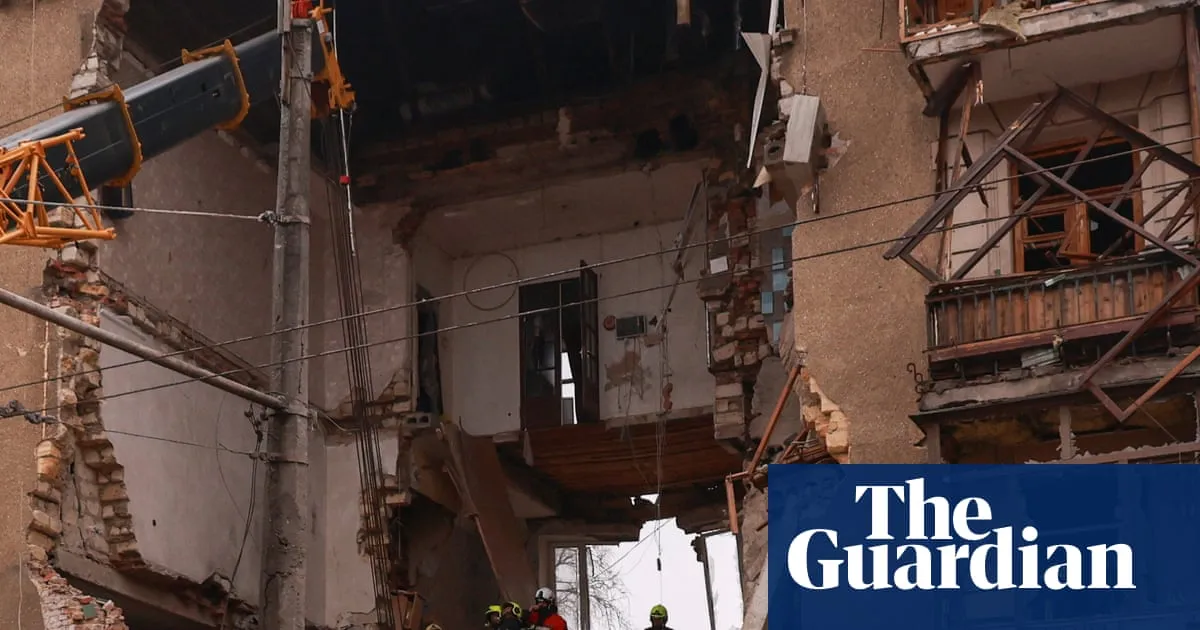
Outside the Kadorr apartment complex in Ukraine’s Black Sea city of Odesa, about 500 metres from the seafront, residents and rescue workers mill around in freezing temperatures.Above an office on the 25th floor, a block of wall has been blown out by a Russian drone. Below, rubble and glass have been moved quickly into piles as owners survey cars crushed by the falling masonry.Anastasia, 35, who lives in a nearby block, was displaced to Odesa from Donetsk after the Russian invasion and occupation in the east. Now she is contemplating the implications of the strike.“I was sleeping. I thought it was a dream at first as the building shook. I didn’t hear the explosion but I heard another Russian Shahed drone that was extremely loud. It had been quite quiet since I’ve been here. Recently it’s started to feel more dangerous. I haven’t decided whether to move, but right now I’m scared.”She is not alone. Russian strikes against Odesa have escalated sharply in recent months, as conflict centred on the Black Sea has heated up again after it had settled into stalemate.The aftermath of a Russian drone attack in Odesa. Photograph: Nina Liashonok/ReutersA woman sits inside a residential building heavily damaged by a Russian airstrike. Photograph: Oleksandr Gimanov/AFP/Getty ImagesUkrainian strikes late last year on oil tankers in Russia’s shadow fleet, and farther afield on the Russian naval base at Novorossiysk, coincided with renewed Russian attention on Odesa. Vladimir Putin has long claimed Ukraine’s main port as Russian, and in December he threatened to cut the city off from the sea.Taking Odesa, or even placing it under naval blockade, remains far beyond Moscow’s reach. Ukrainian naval missile batteries sank its warships, including most famously the Moskva,at the beginning of the war. So instead Russia has pounded the city with missiles and drones.The biggest recent strike, on 13 December, in which 160 drones and missiles targeted energy infrastructure, left large parts of the city without water and electricity for days on end, marking the beginning of a period of almost daily attacks.A power cut caused by Russian attacks plunged Odesa into darkness on 22 December. Photograph: Oleksandr Gimanov/AFP/Getty ImagesIn his office in Odesa, the spokesperson for Ukraine’s navy, Dmytro Pletenchuk, brings out a calendar for the month of January so far. “Shahed. Shahed. Shahed … There are two days this month without attack,” he says. It is 19 January. 16 days of rockets and missiles in total.“The Russians attack the energy infrastructure day after day and night after night because it is so cold now they think we must capitulate.“Right now the situation in the Black Sea is like a chess board. There’s no way for anyone to move. We’ve pushed the Russian warships away to Novorossiysk, but Russian aviation still controls the air over large parts of the Black Sea. So now it is a grey zone, 25,000 km of sea turned into a grey zone.”Residents of a building damaged in a Russian strike on 27 January gather in its courtyard Photograph: Oleksandr Gimanov/AFP/Getty ImagesThat has meant a war fought at long range, but no less violently, as Ukraine has pursued crucial Russian oil shipments, and Moscow has tried to target Kyiv’s key economic lifeline, its export of agricultural products by sea.“It has escalated since the autumn when Russia increased the frequency of its shelling of Ukrainian ports,” Pletenchuk said.In tandem with that effort – as elsewhere across Ukraine – has been Moscow’s targeting of civilian energy infrastructure, which Ukrainian officials say is intended to “disconnect” the country from the grid.mapAccording to the governor of the Odesa region, Oleh Kiper, in military terms the Black Sea is an asset for the country’s defence but also a complicating factor.“On the one hand it is nature’s barrier protecting us,” he said. But unlike other cities farther inland, including the capital, whose air defences are layered like an onion around it, the sea makes it more difficult to construct the same defence in depth, creating vulnerabilities to long-range strikes by drones fired from Russian-occupied Crimea and from missiles.“The worst attack was 13 December,” Kiper said. “After that massive attack at least 60% of the total Odesa region was without electricity, with no water, no heat and no water supply. It depends on wider situation in the country, but there are houses and districts without electricity now for up to 10 hours a day.”Oleh Kiper. Photograph: Peter Beaumont/The GuardianAmong those responsible for protecting Odesa is Lt Col Denys Nosicov, the head of the territorial defence groups in the south.“The last couple of months have seen the enemy uses combined attacks by rockets and Shahed drones,” he said. “The aim is to put psychological pressure on the population of the Odesa region. They want to damage our morale. So everyday we have Shahed attacks. At the same time we are seeing Russian psychological operations on social media.”How important Odesa and the Black Sea remained to Moscow’s ambitions last year was underlined in a recent statement of Ukraine’s chief of staff Oleksandr Syrski.The aftermath of a Russian strike on Odesa on 27 January. Photograph: Michael Shtekel/AP“The Russian aggressor sought to end the war against Ukraine, but planned to do so by devastating us, imposing its terms from a position of strength,” he said. “They attempted to seize the remaining territories of Donetsk, Luhansk and Zaporizhzhia regions, as well as the right bank of Kherson, and aimed to reach Odesa to completely cut off our access to the sea.”That was echoed at the beginning of January by the country’s president, Volodomyr Zelenskyy.“They definitely want to cut off Odesa and other cities in terms of infrastructure,” he said. “They are striking and killing both people and the economy by reducing our export capabilities through the maritime corridor.”With 90% of Ukraine’s agricultural produce exported by sea through the Odesa region’s ports, shipping routes have been turned into a war zone. “The Black Sea, which feeds us and is an integral part of our economy, is also our weak spot,” the Ukrainian military analyst Oleksandr Kovalenko told the Wall Street Journal in a recent interview.The waterfront not far from the port area of Odesa. Photograph: Peter Beaumont/The GuardianAll of which, says Nosicov, requires Ukraine to treat all elements of the Russian threat on land, sea and air with equal seriousness.“Even now we are preparing Odesa for a circular defence with anti-tank traps, kill zones and mines,” he said. “We will always take this Russian threat seriously, even if I believe that Putin giving an order to take Odesa would be the biggest Russian defeat in this region.”While Russia appears only able to strike at a long range, it is freezing civilians who bear the brunt of its attacks.At the Lyceum for Construction and Architecture, a trade school in the centre of Odesa, its director, Igor Chernenko, is supervising the cleanup and repairs after his institution was hit recently by three Shahed drones.Igor Chernenko examines the damage caused by one of three Russian drones that struck the site in January. Photograph: Peter Beaumont/The GuardianWith no heating, the smell of smoke permeates Chernenko’s office, where he is bundled up in a winter coat and hat in a place that once hosted more than 320 students and 72 staff.“The strike happened on 13 January at around 2.40am. A duty night guard had been in the basement and she called to say everything was shaking. When I arrived at 4am the building was still on fire.“I can’t think why the Russians would hit here. My only thought is that they don’t want us to prepare workers who will rebuild Ukraine.”He leads the Guardian on to a second-floor roof covered in snow where two of the drones punched through, shattering windows of an office building a block away and showering a neighbouring tower in shrapnel.“Among the most valuable things we lost was our archive, which we’ve kept since 1945. To be honest the situation is just getting worse. Before that we had attacks once a week but now it’s every night.“What they are doing it. It’s because Odesa is a pearl next to the sea. The Russians still think it belongs to them. And the person who heads Russia thinks like a terrorist.”
SRCThe Guardian - World News
LANGEN
LEANCenter-Left
WORDS1 367
ENT9
WED · 2026-01-28 · 05:00 GMTBRIEF NSR-2026-0128-11191
NSR-2026-0128-11191News Report·EN·Conflict
‘Attacks day after day’: Odesa in Russia’s crosshairs as war pivots back to Black Sea
Odesa, Ukraine, has experienced a sharp increase in Russian attacks in recent months, marking a renewed focus on the Black Sea region. Residential areas, including the Kadorr apartment complex, have been struck by Russian drones, causing damage and displacing residents.
Peter Beaumont in OdesaThe Guardian - World NewsFiled 2026-01-28 · 05:00 GMTLean · Center-LeftRead · 6 min
The Guardian - World NewsFIG 01
Reading time
6min
Word count
1 367words
Sources cited
2cited
Entities identified
9entities
Quality score
100%
§ 01
Briefing Summary
AI-generatedNEWSAR · AI
Odesa, Ukraine, has experienced a sharp increase in Russian attacks in recent months, marking a renewed focus on the Black Sea region. Residential areas, including the Kadorr apartment complex, have been struck by Russian drones, causing damage and displacing residents. The escalation follows Ukrainian strikes on Russian naval assets and infrastructure late last year. Russia has intensified its attacks with missiles and drones, targeting energy infrastructure and leaving parts of the city without essential services. According to Ukraine's navy, January has seen almost daily attacks, with only two days without strikes.
Confidence 0.90Sources 2Claims 5Entities 9
§ 02
Article analysis
Model · rule-basedFraming
Conflict
Human Interest
Tone
Mixed Tone
AI-assessed
CalmNeutralAlarmist
Factuality
0.70 / 1.00
Factual
LowHigh
Sources cited
2
Limited
FewMany
§ 03
Key claims
5 extracted01
There are two days this month without attack.
quoteDmytro Pletenchuk, spokesperson for Ukraine’s navy
Confidence
1.00
02
The biggest recent strike, on 13 December, targeted energy infrastructure, leaving parts of the city without water and electricity.
factual
Confidence
1.00
03
Vladimir Putin has long claimed Ukraine’s main port as Russian.
factual
Confidence
1.00
04
Russian strikes against Odesa have escalated sharply in recent months.
factual
Confidence
0.90
05
The Russians attack the energy infrastructure day after day and night after night because it is so cold now they think we must capitulate.
quoteDmytro Pletenchuk, spokesperson for Ukraine’s navy
Confidence
0.80
§ 04
Full report
6 min read · 1 367 words§ 05
Entities
9 identifiedKey playerOppositionContextPositiveNeutralNegative
§ 06
Keywords & salience
8 termsodesa
1.00
russian attacks
0.90
drone attacks
0.80
black sea
0.70
war
0.60
energy infrastructure
0.50
naval blockade
0.40
missile attacks
0.40
§ 07
Topic connections
Interactive graph Network visualization showing 16 related topics
View Full Graph Person Organization Location Event|Click node to navigate|Edge numbers = shared articles