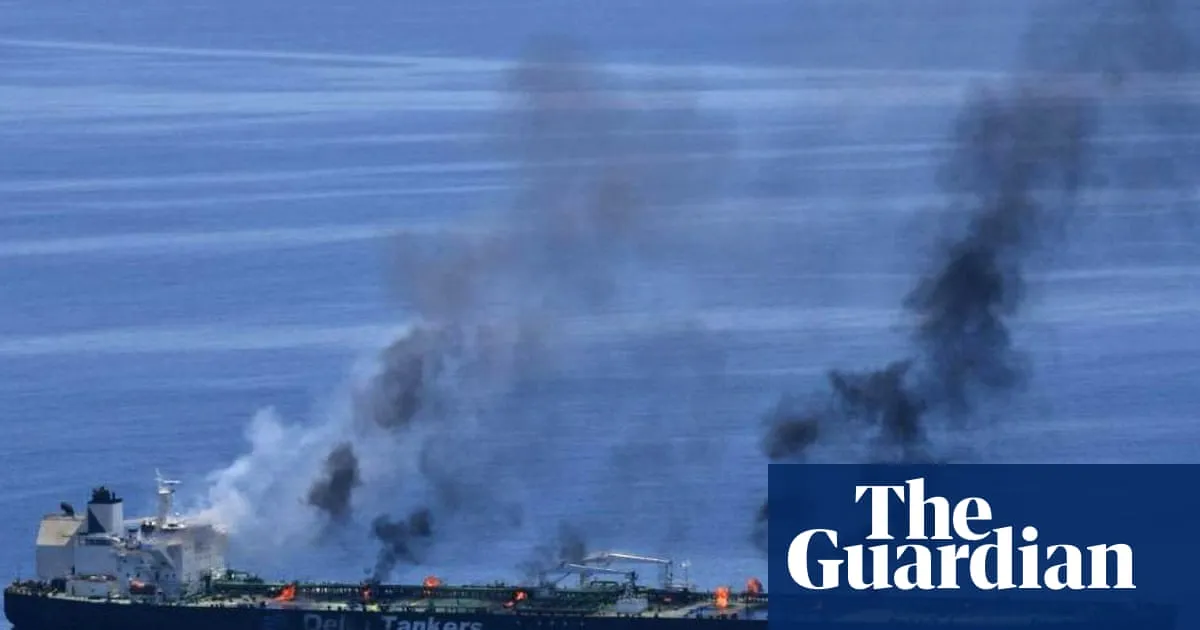
The latest escalation has displaced at least 100,000 people in Yemen, adding to a humanitarian crisis that has already lasted a decade. Photograph: Eunavfor Aspides Handout/EPA View image in fullscreen The latest escalation has displaced at least 100,000 people in Yemen, adding to a humanitarian crisis that has already lasted a decade. Photograph: Eunavfor Aspides Handout/EPA Thursday briefing: Yemen’s war continues to threaten oil supplies– but what about its people? In today’s newsletter: The Houthi advance along the Red Sea coast raised fears for global trade and energy supplies, while more than 100,000 Yemenis have been displaced by the fighting Good morning. The lightning advance of Houthi militants along the west coast of Yemen over the past week has prompted fears of a spiralling conflict in the region and a new oil supply crisis. For families living in the Middle East’s poorest country, the most significant fighting between the Iran-aligned Houthis and the Saudi-backed Yemeni government forces in years is a crisis upon a catastrophe, with escalating civilian casualties and at least 100,000 displaced in recent days. Houthi fighters have captured strategic islands across a critical Red Sea trade route, the Bab al-Mandab strait, one of the most important shipping routes in the world – almost 15% of global sea trade passes through it. The strait of Hormuz, through which a fifth of the world’s traded oil and gas transited in peacetime, has remained largely blocked since the US and Israel launched airstrikes in February, so the prospect of Iran and its allies exerting pressure on two maritime choke points has global implications. The price of crude oil has already begun to spike. For today’s newsletter, I spoke to Farea Al-Muslimi, a research fellow at Chatham House, about this new and dangerous dimension to the ongoing war in Yemen, and why fears over oil and global trade must not overshadow the plight of ordinary Yemenis. First, this morning’s headlines. UK politics | Key allies of Andy Burnham have warned the prime minister not to back down over his promises to put water companies under public control, after details emerged about the prime minister’s plan to give mayors more oversight of the industry. Environment | Climate breakdown probably weakened the glacier that collapsed causing catastrophic floods and killing hundreds of people in Nepal and Tibet last month, the first scientific study of the disaster has found. Health | Women with the same medical condition as men are less likely to be offered treatment such as surgery, a stent or a strong painkiller, research has found. Europe | The UK government’s EU reset summit will be delayed again unless the bloc agrees to discuss legislation that could lock British business out of parts of EU industry, government sources have said. UK news | Police searching for a three-year-old boy who went missing from a playground on the Suffolk-Essex border have found a body. In depth: The fight for Yemen’s Red Sea coast View image in fullscreen Yemen refugees arrive in Djibouti as intensified fighting drives displacement. Photograph: International Organization for Migration/Reuters The current escalation of violence in Yemen has its roots in a civil war that broke out in 2014 between the Yemeni army and the Houthi movement, which champions Yemen’s Shia Muslim minority. A year later, the Houthis – part of Iran’s “axis of resistance”, a loose coalition of armed groups that includes Hamas and Hezbollah – toppled the Saudi-backed Yemeni government. Al-Muslimi grew up in a remote mountain village in Yemen, where his family made honey, one of the country’s most lucrative and popular exports. His mother used to tease him because the bees didn’t recognise him after he spent long periods studying away from home – he was the only person in his family who had to wear a beekeeping suit. Al-Muslimi now writes about how the years-long internecine conflict has had a devastating impact on the honey trade and the farmers who tend Yemeni bees. At least 150,000 people have been killed since 2014, mainly through aerial bombardment by the Saudi-backed coalition that supports the Yemeni government, which has resumed this week. About 4.5 million people – the population of Birmingham and Greater Manchester combined – have already been displaced by fighting over the past decade, while the UN estimates that more than 18.2 million – twice the population of London – are in dire need of humanitarian assistance. The situation now is “worse than 2015”, says Al-Muslimi, with global attention diverted to crises in Syria, Sudan, and Ukraine and now focused on oil prices and regional consequences. “There is even less willingness to help civilians.” After the Houthis captured the port city of Mocha, birthplace of the global coffee trade, last week, Al-Muslimi heard local media reports of more than 240 pregnant women ready to give birth without accessible healthcare. “It’s absolutely nuts,” he says. “This is a country that was already suffering so many things, including indifference.” It has been plain for months to Yemen-watchers that the Houthis were preparing for a significant offensive, says al-Muslimi. This erupted about a week ago with the militants seizing control of parts of the west coast and gaining a hold over the Bab al-Mandab strait, including the strategic port of Mocha and key islands of Perim, Greater and Lesser Hanish in the 20-mile stretch of water that forms a natural chokepoint on the trade route connecting Asia with Europe. With government supporters in disarray, the degree of division among anti-Houthi forces is complicating the fight back. The Houthis have achieved what Al-Muslimi calls “the most consequential change in territorial control in Yemen for years”. Since then, the Houthis have claimed responsibility for missile and drone attacks on Saudi Arabia, including the bombing of a critical east-west oil pipeline. On Wednesday a military spokesperson for the Houthis denied attempting to fly a drone close to the holy city of Mecca, and claimed that Saudi Arabia has carried out as many as 450 airstrikes in Yemen this week in retaliation. The ongoing aggression is driving fears that more Muslim nations could be drawn into the conflict. If the Houthis were to close the Bab al-Mandab strait, vessels would be forced to reroute all the way around the southern tip of Africa. The consequences for the global economy could be dire, particularly when taken along with the ongoing blockade of Hormuz. With Iran and its Houthi allies controlling potentially a third of energy trade globally, “it’s more dangerous than a nuclear bomb,” says Al-Muslimi bluntly, “especially at a time when the world still depends massively on this type of energy”. Attacks on Saudi Arabia’s east-west pipeline – which is now closed for repairs and has been crucial for moving oil from the strait of Hormuz to the Red Sea export hub of Yanbu – will add further pressure to global supplies. Al-Muslimi advises caution over Houthi claims that they don’t intend to impose transit fees on vessels passing through Bab al-Mandab. The UN security council has seen evidence that, since the militants started attacks on Red Sea shipping in 2023, in response to Israel’s decimation of Gaza, the Houthis have been extracting informal payments from some shipping agencies in return for safe passage. Meanwhile, Saudi anger with Iran for assisting Houthi attacks saw the cancellation of a meeting with Gulf states about the future of the strait of Hormuz on Monday. Reports in the early hours today that Saudi Arabia may be offering more crude cargoes through Oman saw the price of Brent crude drop to $104.59 a barrel after hitting $108 earlier this week. But for perspective, it was trading at $80 a barrel in early July. This comes as the average price of diesel in the US hit $6 per gallon for the first time last week, with the Iran war, combined with Ukrainian attacks on Russian refineries, continuing to squeeze supply. The UN security council held an emergency meeting in New York on Tuesday to discuss the escalating violence in Yemen and threats to maritime security, with members urging maximum restraint to avoid the situation devolving into a wider regional war. The conflict is the first test of a mutual defence pact between Saudi Arabia, Turkey and Pakistan, announced in August – but Saudi has yet to publicly call on either for assistance. Meanwhile, Al-Muslimi says the US, a close Saudi ally, faces a dilemma. The States reached a truce with the Houthis in May 2025, after conducting airstrikes against the group after attacks on Red Sea shipping. “The existing truce gives both sides reasons for restraint,” he says. “For Trump, preserving that arrangement helps keep the US away from another costly Middle Eastern military confrontation while it remains engaged in the strait of Hormuz. The Houthis have equally strong incentives to not be drawn into conflict with the US, which caused them serious damage in the 2025 bombing campaign.” Yesterday the Guardian confirmed that officials from the US had met Houthi leaders over the weekend in Oman, where they received assurances that the ceasefire still held and that the movement had no intention of attacking US shipping in the Red Sea. While Trump condemned the Houthi advance for threatening freedom of navigation, he has far rejected any military response in support of Riyadh. Al-Muslimi calls for a more coherent international approach to his country, which he considers one of the least understood in the region. Yemen analysts have frequently criticised the US and allies for approaching Yemen’s challenges with a focus on security rather than diplomacy or development, while internal instability has been exploited by larger regional powers to fight their own proxy battles. Most importantly, he says: “While this new international dimension of Yemen’s war makes the country strategically more important to the world, it should not overshadow the plight of ordinary Yemenis”. What else we’ve been enjoying View image in fullscreen Dawn Butler writes: ‘We know Diane Abbott has received extraordinary levels of abuse, while I often feel specifically targeted because I am a Black woman.’ Photograph: UK Parliament/Jessica Taylor/PA Following the release of a report into the significant abuse faced by those who run for office, Labour MP Dawn Butler writes here about how politics is becoming a “no-go zone” for too many. Charlie Lindlar, newsletters team Who do teenage girls dream of becoming? I loved seeing the variety of items significant to young women in this picture gallery by Belgian photographer Eva Verbeeck. Sundus Abdi, newsletters team We may be hurtling toward autumn, but don’t let that stop you from reading our Filter team’s rundown of the best ice-cream makers for every budget. (Kudos to Danielle Amato for bravely taking on the assignment.) Charlie I loved this piece in the Atlantic that boils down to being an ode to being silly. “Few social situations encourage or even allow unadulterated loopiness,” Lily Mayer writes. “In general, art made for adults tends to abide by this taboo. We get satire, scatological jokes, imitations, and absurdity, but rarely do we get silliness.” Charlie Sport View image in fullscreen Maxim De Cuyper scored what proved to be Brighton’s winner three minutes after coming on. Photograph: Allstar Picture Library Ltd/Nigel French/Apl/Sportsphoto Football | Manchester United scored two early goals but lost 3-2 to Brighton in the Carabao Cup, while Tammy Abraham scored his first goals of the season in Aston Villa’s 3-1 win at Coventry. Formula One | Formula One has announced its calendar for 2027, with an increase in sprint races to 10 events, including at Monaco, and the addition of meetings in Portugal and Turkey. Rugby union | The inaugural women’s British & Irish Lions tour of New Zealand next year is expected to be broadcast live on Sky Sports in a significant boost for the women’s game. The front pages View image in fullscreen Photograph: The Guardian “Prisoners to ‘double up’ in single prefab jail cell units”, is the Guardian’s front page today. The Mail splashes on “‘Rest assured, we will forget her soon enough’”, the Times has “King: Grief has coloured earl’s claims over Diana”, the Telegraph writes “Palace hits back at Diana’s brother”, and the Sun’s take is “Recollections may vary … again”. The Mirror’s front page is “Heartbreak”, the i Paper’s splash is “Burnham warns of ‘challenging’ budget after 3.1% inflation”, and the Express says “We are ‘paying the price’ for Labour’s economy failure”. The FT leads on “Fed raises rates despite Trump pressure in bid to tame prices”. Lastly, Metro runs with “‘Putney pusher’ suspect dead”. Today in Focus: The Latest Photograph: The Guardian Ed Sheeran support acts quit after Macklemore ‘Free Palestine’ row All four supporting acts for the upcoming dates of Ed Sheeran’s tour have withdrawn in solidarity with fellow opener Macklemore. The American rapper was removed from Sheeran’s tour after comments made onstage in support of Palestine. Sheeran responded that venue owners – including Robert Kraft who owns the New England Patriots and its home stadium – had objected to Macklemore’s appearance on the tour. But after he had tried to negotiate with the venue owners ‘at length to build bridges’, ultimately the promoters made the decision to pull the plug. Artists who have pulled out include Finneas, Aaron Rowe and Beoga. Lucy Hough speaks to Guardian assistant opinion editor Jason Okundaye. Cartoon of the day | Nicola Jennings View image in fullscreen Illustration: Nicola Jennings/The Guardian The Upside A bit of good news to remind you that the world’s not all bad View image in fullscreen Princessan Glittergull, Tove Jansson (1922). Photograph: ©️Tove Jansson Estate The Moomin books about lovable trolls with hippopotamus snouts are coming to life in a new London exhibition, featuring previously unseen drawings by their creator, Tove Jansson. Opening in November, the show will include more than 100 works, from early Moomin sketches to photographs and films, celebrating Jansson’s enduring themes of nature, friendship, tolerance and being yourself. And finally, the Guardian’s puzzles are here to keep you entertained throughout the day. Until tomorrow. Explore more on these topics Yemen First Edition newsletter Houthis Strait of Hormuz Middle East and north Africa newsletters Share Reuse this content
SRCThe Guardian - World News
WORDS2 353
THU · 2026-09-17 · 05:45 GMTBRIEF NSR-2026-0917-111924
NSR-2026-0917-111924·
Thursday briefing: Yemen’s war continues to threaten oil supplies– but what about its people?
In today’s newsletter: The Houthi advance along the Red Sea coast raised fears for global trade and energy supplies, while more than 100,000 Yemenis have been displaced by the fighting Good morning. The lightning advance of Houthi militants along the west coast of Yemen over the past week has prompt
Libby BrooksThe Guardian - World NewsFiled 2026-09-17 · 05:45 GMTRead · 10 min
The Guardian - World NewsFIG 01
Reading time
10min
Word count
2 353words
Sources cited
—cited
Entities identified
0entities
Quality score
0%
§ 04