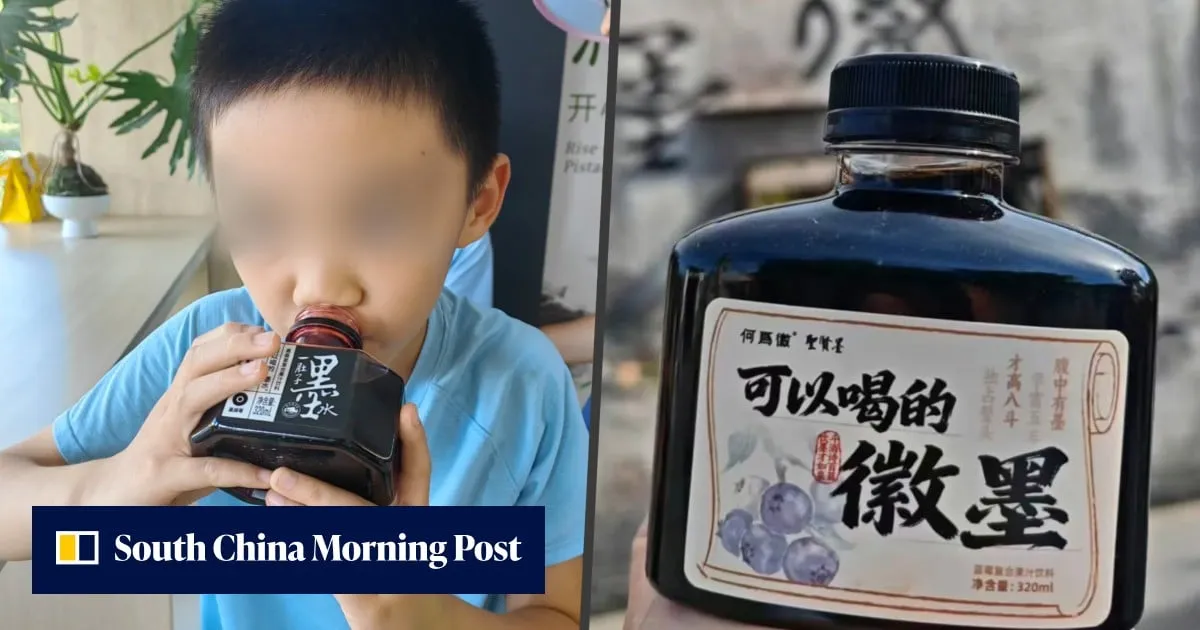
While the Chinese idiom, “Having ink in their stomach”, serves as a metaphor to commend the knowledgeable, the act of ingesting ink was a common practice among ancient literati.The earliest documentation of ink drinking dates back to the Northern and Southern dynasties (420–589), where it was used as a sanctioned punishment for scholars with illegible handwriting.According to the Book of Sui, the official history of the Sui dynasty (581–618), during an exam administered by a palace attendant to assess local officials, scholars who presented poor handwriting faced the penalty of consuming one sheng of ink. This traditional Chinese unit of volume varied by dynasty, with one sheng equating to 600 millilitres during the Sui period.This rule was abolished after Li Shimin ascended the throne in the Tang dynasty (618–907). Nevertheless, some scholars willingly consumed ink to enhance their literary skills.At social gatherings, people now recreate the ancient practice of drinking ink by using safe, edible substitutes to connect with traditional culture. Photo: ZhihuFor instance, the Tang dynasty poet Wang Bo (650–676) was noted for having drunk “several shengs of ink” when he felt creatively blocked, which effectively enabled him to complete an essay in one continuous effort, without making any revisions.Wang’s action of consuming ink is likened to “creating mental drafts.”In another example, the Song dynasty (960–1279) wordsmith Su Shi (1037–1101) famously stated: “If I were to don the hemp robe once more, the exam ink would indeed be worthy of my drink.”In the Brush Records of Qiuchi, believed to be authored by Su, three literary figures from the Song dynasty were also recorded grinding ink for both writing and drinking during their gatherings as a scholarly pastime.To connect with this historical practice, brands in China have created drinkable ink products made from black mulberry, blueberry, and plum juice, allowing people to funfully experience traditional culture. Photo: ZhihuThe text describes how “True pine soot yields a lingering aroma, naturally imbued with the fragrance of ambergris and musk.”Unlike today’s inks, which are made from industrial pigments and chemical additives harmful to health, ancient Chinese ink was produced using soot from burning natural plants or animal oils, making it safe for consumption.Moreover, some inks were infused with traditional Chinese medicinal herbs. One such ink from the Qing dynasty (1644–1912), known as Eight Treasures Five Bile Medical Ink, featured a unique formula incorporating a dozen precious Chinese herbal medicines, believed to possess beneficial properties for disease prevention and beauty care.The renowned female Song dynasty poet Li Qingzhao (1084–1155) was said to have “ink in her stomach,” a praise reflecting her vast knowledge and immense talent as a poet and essayist. Photo: ZhihuThough the practice of drinking ink is no longer carried out today, the idiom, “Ink in the stomach”, continues to describe well-informed individuals.For instance, during discussions about casting for an upcoming TV drama portraying the renowned female Song dynasty poet Li Qingzhao (1084–1155), actress Chen Duling, who holds a bachelor’s degree in aircraft manufacturing engineering, was recommended because she “has ink in her stomach.”Additionally, some cultural organisations have introduced drinkable ink products to connect with this historical practice. For example, last year, the Nanjing Imperial Examination Museum of China unveiled a drinkable ink product made from black mulberry, blueberry, and plum juice, allowing visitors to “experience traditional culture in a fun way.”Further Reading
SRCSouth China Morning Post
LANGEN
LEANCenter-Right
WORDS551
ENT9
THU · 2026-09-17 · 10:27 GMTBRIEF NSR-2026-0917-111978
NSR-2026-0917-111978News Report·EN·Human Interest
Ancient Chinese scholars drank ink for poetic inspiration or poor handwriting penalties
Ancient Chinese scholars sometimes drank ink, a practice documented as early as the Northern and Southern dynasties. Initially, it served as a penalty for illegible handwriting during exams, with scholars forced to consume a specific volume of ink.
Fran LuSouth China Morning PostFiled 2026-09-17 · 10:27 GMTLean · Center-RightRead · 3 min
South China Morning PostFIG 01
Reading time
3min
Word count
551words
Sources cited
3cited
Entities identified
9entities
Quality score
100%
§ 01
Briefing Summary
AI-generatedNEWSAR · AI
Ancient Chinese scholars sometimes drank ink, a practice documented as early as the Northern and Southern dynasties. Initially, it served as a penalty for illegible handwriting during exams, with scholars forced to consume a specific volume of ink. This punishment was abolished in the Tang dynasty. However, some scholars also willingly drank ink for poetic inspiration, believing it could enhance their literary skills and facilitate continuous writing. Ancient Chinese ink, made from natural materials and sometimes medicinal herbs, was considered safe for consumption. Today, the idiom "having ink in their stomach" still signifies knowledge, and some cultural initiatives offer edible ink products to connect with this historical practice.
Confidence 0.90Sources 3Claims 5Entities 9
§ 02
Article analysis
Model · rule-basedFraming
Human Interest
Social Justice
Tone
Measured
AI-assessed
CalmNeutralAlarmist
Factuality
0.80 / 1.00
Factual
LowHigh
Sources cited
3
Well sourced
FewMany
§ 03
Key claims
5 extracted01
Modern brands create drinkable ink products using safe, edible substitutes to connect with traditional culture.
factual
Confidence
0.90
02
The practice of drinking ink was documented as early as the Northern and Southern dynasties (420–589).
factual
Confidence
0.90
03
Ancient Chinese scholars drank ink as a punishment for poor handwriting.
factualBook of Sui
Confidence
0.90
04
Ancient Chinese ink was made from natural materials and was safe for consumption, sometimes even containing medicinal herbs.
factual
Confidence
0.80
05
Tang dynasty poet Wang Bo drank ink to overcome creative blocks.
factualArticle's interpretation of historical accounts
Confidence
0.70
§ 04
Full report
3 min read · 551 words§ 05
Entities
9 identifiedKey playerOppositionContextPositiveNeutralNegative
Organizations1
§ 06
Keywords & salience
10 termsink drinking
1.00
ancient chinese literati
1.00
poetic inspiration
0.90
poor handwriting penalty
0.90
tang dynasty
0.70
song dynasty
0.70
scholarly pastime
0.60
traditional culture
0.50
wang bo
0.40
su shi
0.40
§ 07
Topic connections
Interactive graph No topic relationship data available yet. This graph will appear once topic relationships have been computed.