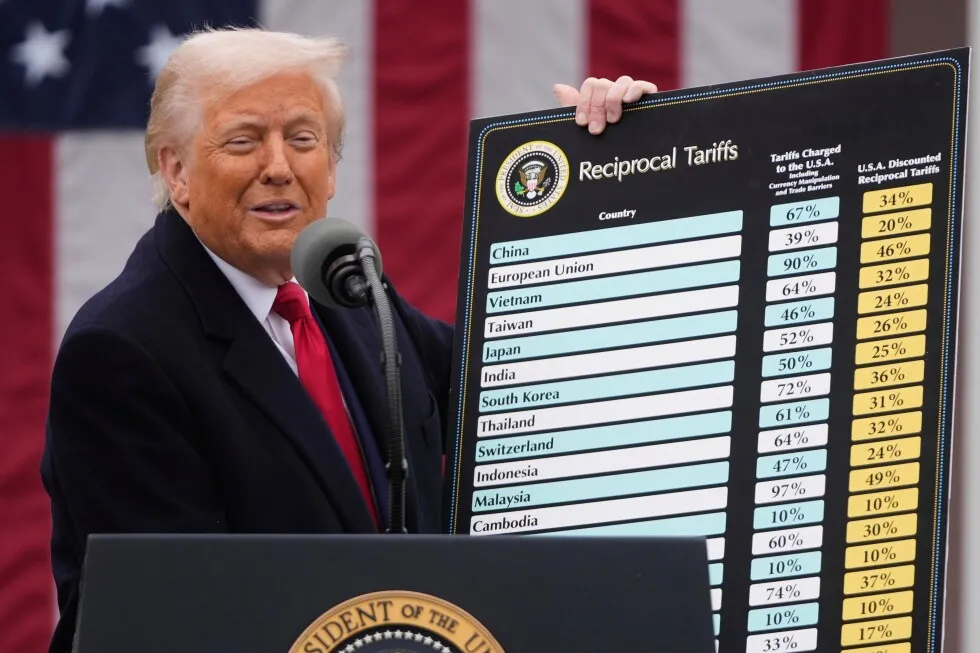
President Donald Trump speaks during an event to announce new tariffs in the Rose Garden at the White House, April 2, 2025, in Washington. (AP Photo/Mark Schiefelbein, File) Updated [hour]:[minute] [AMPM] [timezone], [monthFull] [day], [year] Washington (AP) — When the Supreme Court granted an unusually quick hearing over President Donald Trump’s tariffs, a similarly rapid resolution seemed possible.After all, Trump’s lawyers told the court that speed was of the essence on an issue central to the president’s economic agenda. They pointed to a statement from Treasury Secretary Scott Bessent warning that the “longer a final ruling is delayed, the greater the risk of economic disruption.”But nearly three months have elapsed since arguments in the closely watched case and the court isn’t scheduled to meet in public for more than three weeks.No one knows for sure what is going on among the nine justices, several of whom expressed skepticism about the tariffs’ legality at arguments in November. But the timeline for deciding the case now looks more or less typical and could reflect the normal back-and-forth that occurs not just in the biggest cases, but almost all the disputes the justices hear. Several Supreme Court practitioners and law professors scoffed at the idea that the justices are dragging their feet on tariffs, putting off a potentially uncomfortable ruling against Trump. “People suspect this kind of thing from time to time, but I am not aware of instances in which we have more than speculation,” said Jonathan Adler, a law professor at the College of William & Mary in Williamsburg, Virginia. The timeframe alone also doesn’t point to one outcome or the other. One possible explanation, said Carter Phillips, a lawyer with 91 arguments before the high court, “is that the court is more evenly divided than appeared to be the case at oral argument and the fifth vote is wavering.”Even if the majority opinion has been drafted and more or less agreed to by five or more members of the court, a separate opinion, probably in dissent, could slow things down, Phillips said. Just last week, the court issued two opinions in cases that were argued in October. All nine justices agreed with the outcome, a situation that typically allows decisions to be issued relatively quickly. But a separate opinion in each case probably delayed the decision. The court is generally moving more slowly in argued cases, perhaps because of the flood of emergency appeals the administration has brought to the justices. The first argued case wasn’t decided until January this year. Typically, that happens in December, if not November.Over the last 20 years, the average turnaround time for a Supreme Court opinion was just over three months, according to data gathered by Adam Feldman, creator of Empirical SCOTUS. The timeline has increased in recent years, with the court releasing half or more of its cases in June.Decision times can vary widely. The court can move quickly, especially in cases with hard external deadlines: The landmark Bush v. Gore case that effectively decided the 2000 election took just over a single day. The recent case over TikTok took seven days.On the higher end, when the justices are on their own timelines, cases can take much longer to resolve. Gundy v. U.S., a case argued in 2018 about how the sex-offender registry is administered, took more than eight months to be decided. Major decisions on expanding gun rights, overturning Roe v. Wade and ending affirmative action in college admissions were handed down six to eight months after the cases were argued.Also undecided so far is a second major case in which the court sped up its pace over redistricting in Louisiana and the future of a key provision of the Voting Rights Act.The tariffs case took on added urgency because the consequences of the Trump administration’s policy were playing out in real time, in ways that have been both positive and negative. “Like many, I had hoped that the Supreme would rush the decision out,” said Marc Busch, an expert on international trade policy and law at Georgetown University. “But it’s not a surprise in the sense that they have until June and lots of issues to work through.”The separation of powers questions central to the case are complicated. Whatever the majority decides, there will likely be a dissent and both sides will be carefully calibrating their writing. “It is the language at the end of the day that’s going to make this more or less meaningful,” he said.Meanwhile, as the justices weigh the case, Trump continues to invoke the threat of tariffs, extol their virtues and refer to the case as the court’s most important. “I would hope, like a lot of people, the justices have been watching the tariff threats over Greenland and realize the gravity of this moment,” Busch said. Sherman has covered the Supreme Court for The Associated Press since 2006. His journalism career spans five decades. He is based in Washington, D.C., and previously lived in New York, Paris and Atlanta. Whitehurst covers the Supreme Court and legal affairs for The Associated Press. She’s won multiple journalism awards in a career that’s spanned two decades.
SRCAssociated Press (AP)
LANGEN
LEANCenter
WORDS858
ENT5
WED · 2026-01-28 · 07:23 GMTBRIEF NSR-2026-0128-11199
NSR-2026-0128-11199News Report·EN·Legal & Judicial
Three months after rapidly scheduled arguments, Supreme Court has yet to decide on Trump’s tariffs
Three months after a quickly scheduled hearing, the Supreme Court has yet to rule on President Trump's tariffs, despite the administration's initial urgency. Arguments were heard in November, with Trump's lawyers emphasizing the need for a swift decision to avoid economic disruption.
By
MARK SHERMAN and LINDSAY WHITEHURSTAssociated Press (AP)Filed 2026-01-28 · 07:23 GMTLean · CenterRead · 4 min
Associated Press (AP)FIG 01
Reading time
4min
Word count
858words
Sources cited
3cited
Entities identified
5entities
Quality score
100%
§ 01
Briefing Summary
AI-generatedNEWSAR · AI
Three months after a quickly scheduled hearing, the Supreme Court has yet to rule on President Trump's tariffs, despite the administration's initial urgency. Arguments were heard in November, with Trump's lawyers emphasizing the need for a swift decision to avoid economic disruption. The delay has led to speculation, though legal experts suggest the timeline is now typical and could reflect internal debate among the justices. The court's silence doesn't necessarily indicate a specific outcome, but potentially suggests a divided court or the drafting of dissenting opinions. The Supreme Court's decision-making process can be slowed by separate opinions, as seen in other recent cases argued in October.
Confidence 0.90Sources 3Claims 5Entities 5
§ 02
Article analysis
Model · rule-basedFraming
Legal & Judicial
Economic Impact
Tone
Measured
AI-assessed
CalmNeutralAlarmist
Factuality
0.70 / 1.00
Factual
LowHigh
Sources cited
3
Well sourced
FewMany
§ 03
Key claims
5 extracted01
Over the last 20 years, the average turnaround time for a Supreme Court opinion was just over three months.
statisticAdam Feldman, creator of Empirical SCOTUS
Confidence
1.00
02
The court isn’t scheduled to meet in public for more than three weeks.
factual
Confidence
1.00
03
Treasury Secretary Scott Bessent warned that the “longer a final ruling is delayed, the greater the risk of economic disruption.”
quoteScott Bessent
Confidence
1.00
04
The Supreme Court granted an unusually quick hearing over President Donald Trump’s tariffs.
factual
Confidence
1.00
05
One possible explanation is that the court is more evenly divided than appeared to be the case at oral argument and the fifth vote is wavering.
quoteCarter Phillips
Confidence
0.70
§ 04
Full report
4 min read · 858 words§ 05
Entities
5 identifiedKey playerOppositionContextPositiveNeutralNegative
Locations1
§ 06
Keywords & salience
9 termstariffs
1.00
supreme court
0.90
donald trump
0.80
economic agenda
0.70
legal ruling
0.60
justices
0.60
economic disruption
0.60
oral argument
0.50
dissenting opinion
0.50
§ 07
Topic connections
Interactive graph Network visualization showing 51 related topics
View Full Graph Person Organization Location Event|Click node to navigate|Edge numbers = shared articles