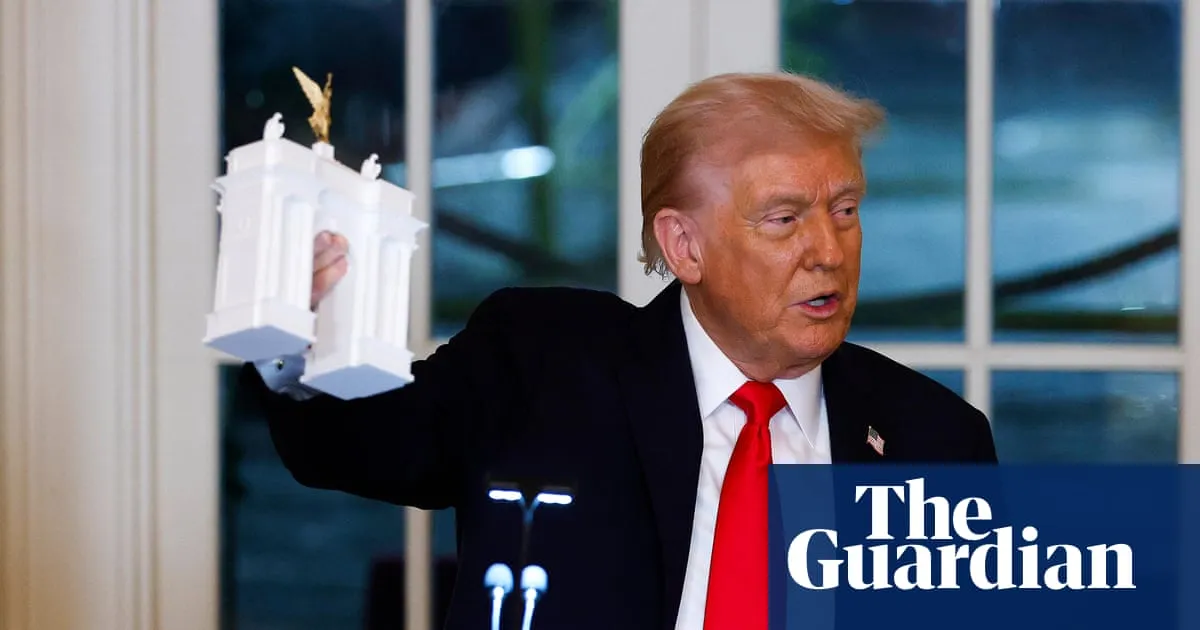
Donald Trump’s desired triumphal arch in downtown Washington DC will likely contribute “to adverse effects to historic properties”, according to the National Park Service’s planning document, but the construction is still planned to go forward.The president’s 250ft arch could interfere with some of the most well-known views in the nation’s capital, including the symbolic relationship between Arlington House, the Arlington National Cemetery, the Arlington Memorial Bridge and the Lincoln Memorial, which face each other to represent the reunification of the United States after the civil war.As a result, the arch’s construction could require supplemental planning and programming to preserve history, a document and emails obtained by the Washington Post on Wednesday outlined.“Such adverse effects cannot be fully avoided while retaining the location-dependent purpose of the undertaking,” the National Park Service wrote in the document.Despite concerns that the arch could interfere with historic sites and would require substantial construction management control, the Trump administration wants to move forward. The document was circulated among preservationists and other groups to review and sign by noon on Monday, according to an email obtained by the Washington Post.The Guardian has asked the National Park Service for comment.Historic preservationists, veterans and lawmakers have consistently raised concerns about the Trump administration building the massive triumphal arch in downtown DC.Veterans filed a lawsuit in September, seeking to halt construction of the arch, believing it would harm the symbolic relationship of historic sites representing the reconciliation of war or disrupt burials at the Arlington National Cemetery.Some lawmakers shared fears that the arch could further complicate DC’s airspace. But Trump has been emphatic about the arch, insisting it should be 250ft high to mark the US’s 250th anniversary.Should construction of the arch move forward, the National Park Service outlined several ways it would mitigate disruptions and potential damage to nearby monuments.That includes installing vibration plates near the Arlington Memorial Bridge and other sensitive sites to ensure construction remains within prescribed limits, enforcing limits on noise-generating activities, prohibiting unnecessary lighting, limiting work hours and more.skip past newsletter promotionafter newsletter promotionThe National Park Service’s document outlined roughly 37 nearby historic sites that could be affected, including the Lincoln Memorial, the National Mall, the Washington Monument, the Pentagon, the US Capitol and more.But the National Park Service also outlined methods it could implement to preserve the history of the area, such as developing digital programs to explain the commemorative relationship between the Lincoln Memorial and Arlington House, to show before-and-after scenes of the skyline over the Potomac River, and to describe the significance of triumphal arches.Local preservation officers could refuse to sign the agreement, which could trigger another process that involves the Advisory Council on Historic Preservation, a federal agency.However, the Trump administration does not need the preservationists’ consent to move forward because it already received approval from the US Commission on Fine Arts, a federal advisory council made up of Trump appointees, and preliminary approval from the National Capital Planning Commission.
SRCThe Guardian - World News
LANGEN
LEANCenter-Left
WORDS489
ENT10
THU · 2026-09-17 · 14:46 GMTBRIEF NSR-2026-0917-112043
NSR-2026-0917-112043News Report·EN·Political Strategy
Trump arch could have ‘adverse effects’ on nearby DC monuments, US park service says
The National Park Service has stated that Donald Trump's proposed 250-foot triumphal arch in Washington D.C. will likely cause "adverse effects to historic properties," potentially interfering with significant views and symbolic relationships between sites like Arlington House and the Lincoln Memorial.
Ariana BaioThe Guardian - World NewsFiled 2026-09-17 · 14:46 GMTLean · Center-LeftRead · 2 min
The Guardian - World NewsFIG 01
Reading time
2min
Word count
489words
Sources cited
3cited
Entities identified
10entities
Quality score
100%
§ 01
Briefing Summary
AI-generatedNEWSAR · AI
The National Park Service has stated that Donald Trump's proposed 250-foot triumphal arch in Washington D.C. will likely cause "adverse effects to historic properties," potentially interfering with significant views and symbolic relationships between sites like Arlington House and the Lincoln Memorial. Despite these concerns, the Trump administration intends to proceed with construction. The Park Service's planning document acknowledges that these adverse effects cannot be fully avoided. Preservationists, veterans, and lawmakers have raised objections, with some filing lawsuits. The Park Service has outlined mitigation strategies to preserve history, but local preservation officers could refuse to sign off, potentially triggering further review. The administration has already secured preliminary approval from federal advisory councils.
Confidence 0.90Sources 3Claims 5Entities 10
§ 02
Article analysis
Model · rule-basedFraming
Political Strategy
Legal & Judicial
Tone
Mixed Tone
AI-assessed
CalmNeutralAlarmist
Factuality
0.70 / 1.00
Factual
LowHigh
Sources cited
3
Well sourced
FewMany
§ 03
Key claims
5 extracted01
Veterans filed a lawsuit seeking to halt construction of the arch, believing it would harm historic sites and reconciliation symbolism.
factualVeterans
Confidence
0.90
02
Donald Trump’s desired triumphal arch will likely contribute to adverse effects on historic properties, according to the National Park Service.
factualNational Park Service
Confidence
0.90
03
The National Park Service outlined mitigation methods to preserve history, including digital programs and limiting construction activities.
factualNational Park Service
Confidence
0.80
04
The 250ft arch could interfere with symbolic relationships between Arlington House, Arlington National Cemetery, Arlington Memorial Bridge, and the Lincoln Memorial.
factualNational Park Service
Confidence
0.80
05
Roughly 37 nearby historic sites could be affected by the arch construction.
factualNational Park Service
Confidence
0.70
§ 04
Full report
2 min read · 489 words§ 05
Entities
10 identifiedKey playerOppositionContextPositiveNeutralNegative
Organizations3
§ 06
Keywords & salience
9 termstriumphal arch
1.00
historic properties
0.90
national park service
0.80
adverse effects
0.80
dc monuments
0.70
arlington national cemetery
0.60
lincoln memorial
0.50
historic preservation
0.50
donald trump
0.40
§ 07
Topic connections
Interactive graph Network visualization showing 51 related topics
View Full Graph Person Organization Location Event|Click node to navigate|Edge numbers = shared articles