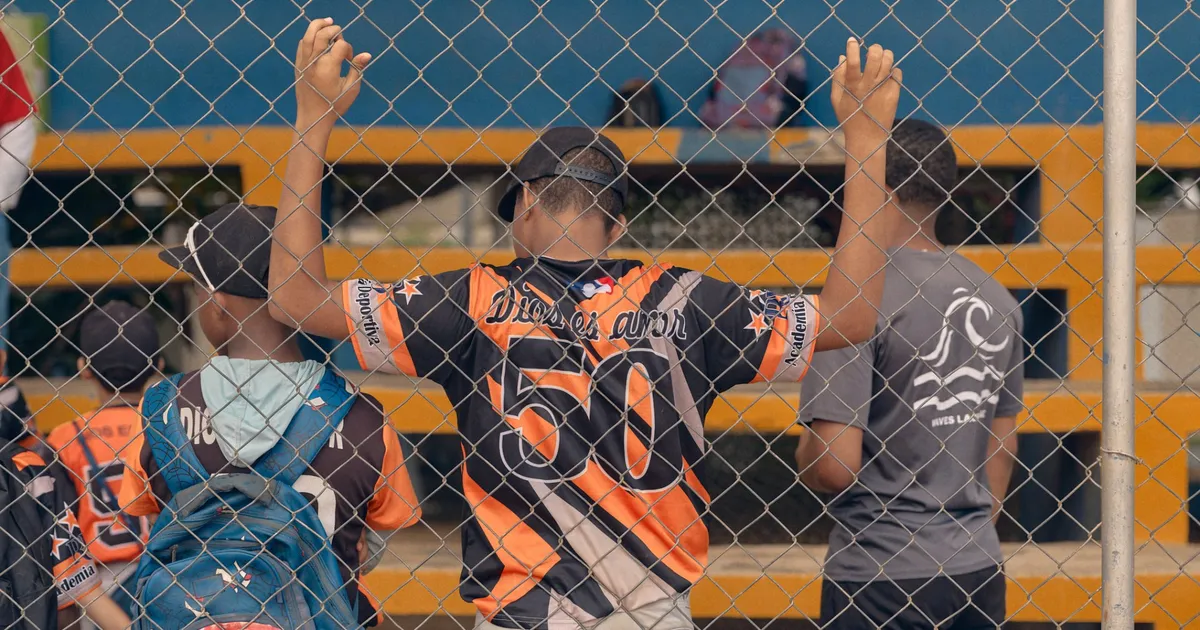
The Rafael Baez Baseball Academy practices in Santo Domingo, Dominican Republic. Christopher Gregory-Rivera for ProPublica If you have seen the headlines of the major investigation we recently published, “ The Dominican Baseball Factory ,” you may have wondered: Why is ProPublica, with its serious-sounding mission of accountability and its focus on abuses of power, reporting on baseball? The answer would be: Exactly. Baseball fans have long marveled at how the Dominican Republic, a tiny island nation with a population akin to Ohio, has produced so many brilliant players — roughly 10% of the major league. Major League Baseball and the owners of its 30 teams have regularly harvested bumper crops of sluggers to build their rosters and their fanbase, including most recently the Toronto Blue Jays’ Vladimir Guerrero Jr., the New York Mets’ Juan Soto and the San Diego Padres’ Fernando Tatis Jr., whose playing contracts total more than $1.6 billion. But as with many such tales of extraordinary success, the origin story is much darker. When we hired reporter Gus Garcia-Roberts from The Washington Post as our first reporter dedicated to sports, he arrived with an idea: He’d long heard that the Dominican Republic system that had churned out so many stars was deeply problematic. Garcia-Roberts wanted to dig into that world, not just to explain how it operated but to identify the individuals who were taking advantage of the young players and those who were allowing it to happen. What if he was afforded the time to track a promising young player — a potential superstar — as he was plucked from obscurity by a major league team? Even prepped, Garcia-Roberts was surprised by what he found: For generations, poor parents in the Dominican Republic have shunted their children into an unforgiving juggernaut of baseball academies praying for a chance at a life-altering signing bonus from an MLB team. Since the bonus could not be delivered until age 16, teams had begun locking up talent younger and younger with verbal IOUs. As for the kids who don’t make the cut, well, they paid with their childhoods, and sometimes with their health. Garcia-Roberts also detailed the rapacious industry that had sprung up around these young players and their parents: Trainers and moneylenders, he found, were siphoning away those signing bonuses with predatory, high-interest loans and other, often questionable, claims before they even arrived. Significantly, Garcia-Roberts found, MLB itself has long known about the often brutal world surrounding its youngest prospects. The players union has as well; Dominican players, led by former Boston Red Sox star David “Big Papi” Ortiz, have argued against efforts to establish an international draft — a move that would end early bonuses, cutting off a revenue stream for moneylenders. Ortiz told players, according to an audio message, that an international draft would be “trouble” for people in the Dominican Republic. In a statement sent through his lawyer, Ortiz told Garcia-Roberts that his opposition to the proposal “was never motivated by personal interests.” The Dominican Baseball Factory The Rising Baseball Star, a Fatal Car Crash and the Fixer There’s big money in sports, and with it lots of reasons to explore how it is being wielded and who is paying the cost. And that is why ProPublica is diving in. These days, you’d be hard-pressed to find a slice of society untouched by the Big Money tentacles of the sports industry — and the lack of accountability that often goes along with them. Got a gleaming new stadium in town ? Your tax dollars likely paid for much or all of it, despite its billionaire owners (while you may not be able to afford a ticket — unless it’s to a Mets game). Got a kid in youth sports? You may have experienced the boggling cost of travel teams or noted that private equity is buying up leagues and tournaments. Watch sports on TV? The ads for online gambling can seem as ubiquitous as the score, luring legions into a new scourge of addiction. And the Los Angeles Lakers just sold for $12.5 billion ! With a B, amid, of course, a scandal about how the previous owner financed his purchase. All of that big money is ramping up just as the landscape of sports journalism has contracted along with the larger media industry. What ProPublica brings to sports is the time, the skill set and the resources to go beyond the games and the individual stories. Our approach to investigative reporting required Garcia-Roberts to get inside the system, to find out how it works and who is being harmed, and then reveal who is responsible and who is preventing the problems from being fixed. Without the expectation to cover games or daily sports news, reporters like Garcia-Roberts won’t be hamstrung by what one of my colleagues called “the conundrum of access.” You dig out the unsightly bits and suddenly your sources dry up and with them your scoops. And we haven’t covered a topic so long that we have become blind to its flaws. This isn’t ProPublica’s first dive into sports investigations. In 2021, reporters Robert Faturechi, Justin Elliott and Ellis Simani were scrutinizing a trove of federal tax data and noticed that the billionaire owners of the nation’s sports teams were taking fat write-offs on team assets, from media deals to player contracts. In 2015, former ProPublica reporter David Epstein wrote about how one of the most powerful track coaches in the world was accused of experimenting with testosterone and pressuring athletes to use prescription medications they didn’t need to gain a performance benefit . The story touched off an investigation by the United States Anti-Doping Agency that eventually led to the coach’s four-year ban . And most recently, Molly Hensley-Clancy, in partnership with The Washington Post, published an investigation that found a youth sports giant failed to put in place promised reforms to prevent child abuse. You can expect to see more of ProPublica’s reporting on sports in coming months, and like the box scores, they will be spelling out who is winning and who is losing. That’ll just likely mean something different to us. If you’d like to read those stories, we’d love to send our Big Story newsletter right to your inbox. In the meantime, if you have a story tip for a terrific sports investigation, or just something sports-related you think we should know, we’d love to hear it. Please get in touch with reporter Gus Garcia-Roberts or contact ProPublica via any of these secure methods . The post Why ProPublica Is Leaning Into Sports Investigations appeared first on ProPublica .
SRCProPublica
LANGEN
LEANCenter-Left
WORDS1 102
ENT12
FRI · 2026-09-18 · 09:00 GMTBRIEF NSR-2026-0918-112242
NSR-2026-0918-112242Analysis·EN·Social Justice
Why ProPublica Is Leaning Into Sports Investigations
ProPublica is expanding its investigative journalism into the sports world, recognizing the significant financial influence and potential for abuses of power within the industry. Their recent investigation, "The Dominican Baseball Factory," exposed the dark realities behind the Dominican Republic's prolific production of Major League Baseball talent.
Tracy WeberProPublicaFiled 2026-09-18 · 09:00 GMTLean · Center-LeftRead · 5 min
ProPublicaFIG 01
Reading time
5min
Word count
1 102words
Sources cited
3cited
Entities identified
12entities
Quality score
100%
§ 01
Briefing Summary
AI-generatedNEWSAR · AI
ProPublica is expanding its investigative journalism into the sports world, recognizing the significant financial influence and potential for abuses of power within the industry. Their recent investigation, "The Dominican Baseball Factory," exposed the dark realities behind the Dominican Republic's prolific production of Major League Baseball talent. Reporter Gus Garcia-Roberts uncovered how young players are exploited through predatory loans and verbal agreements by academies and MLB teams, with many sacrificing their childhoods and health. The article highlights that MLB and the players' union are aware of these issues, with some Dominican players, like David Ortiz, opposing reforms like an international draft that could disrupt existing revenue streams. ProPublica aims to provide in-depth reporting on sports, free from the constraints of daily news coverage, to uncover systemic problems and hold those responsible accountable.
Confidence 0.90Sources 3Claims 5Entities 12
§ 02
Article analysis
Model · rule-basedFraming
Social Justice
Human Interest
Tone
Mixed Tone
AI-assessed
CalmNeutralAlarmist
Factuality
0.70 / 1.00
Factual
LowHigh
Sources cited
3
Well sourced
FewMany
§ 03
Key claims
5 extracted01
The Dominican Republic produces approximately 10% of Major League Baseball players.
statisticarticle
Confidence
1.00
02
Major League Baseball and the players union are aware of the exploitative conditions surrounding young Dominican prospects.
factualarticle
Confidence
0.90
03
Trainers and moneylenders siphon signing bonuses from young players through predatory loans and questionable claims.
factualGus Garcia-Roberts
Confidence
0.90
04
Poor parents in the Dominican Republic send their children to baseball academies for a chance at a life-altering signing bonus.
factualGus Garcia-Roberts
Confidence
0.90
05
David 'Big Papi' Ortiz argued against an international draft, stating it would be 'trouble' for people in the Dominican Republic.
quoteDavid 'Big Papi' Ortiz
Confidence
0.80
§ 04
Full report
5 min read · 1 102 words§ 05
Entities
12 identifiedKey playerOppositionContextPositiveNeutralNegative
People3
Organizations6
§ 06
Keywords & salience
9 termsdominican republic baseball
1.00
sports investigations
1.00
player exploitation
0.90
major league baseball
0.80
baseball academies
0.80
signing bonuses
0.70
predatory loans
0.60
youth sports
0.50
accountability journalism
0.40
§ 07
Topic connections
Interactive graph Network visualization showing 15 related topics
View Full Graph Person Organization Location Event|Click node to navigate|Edge numbers = shared articles