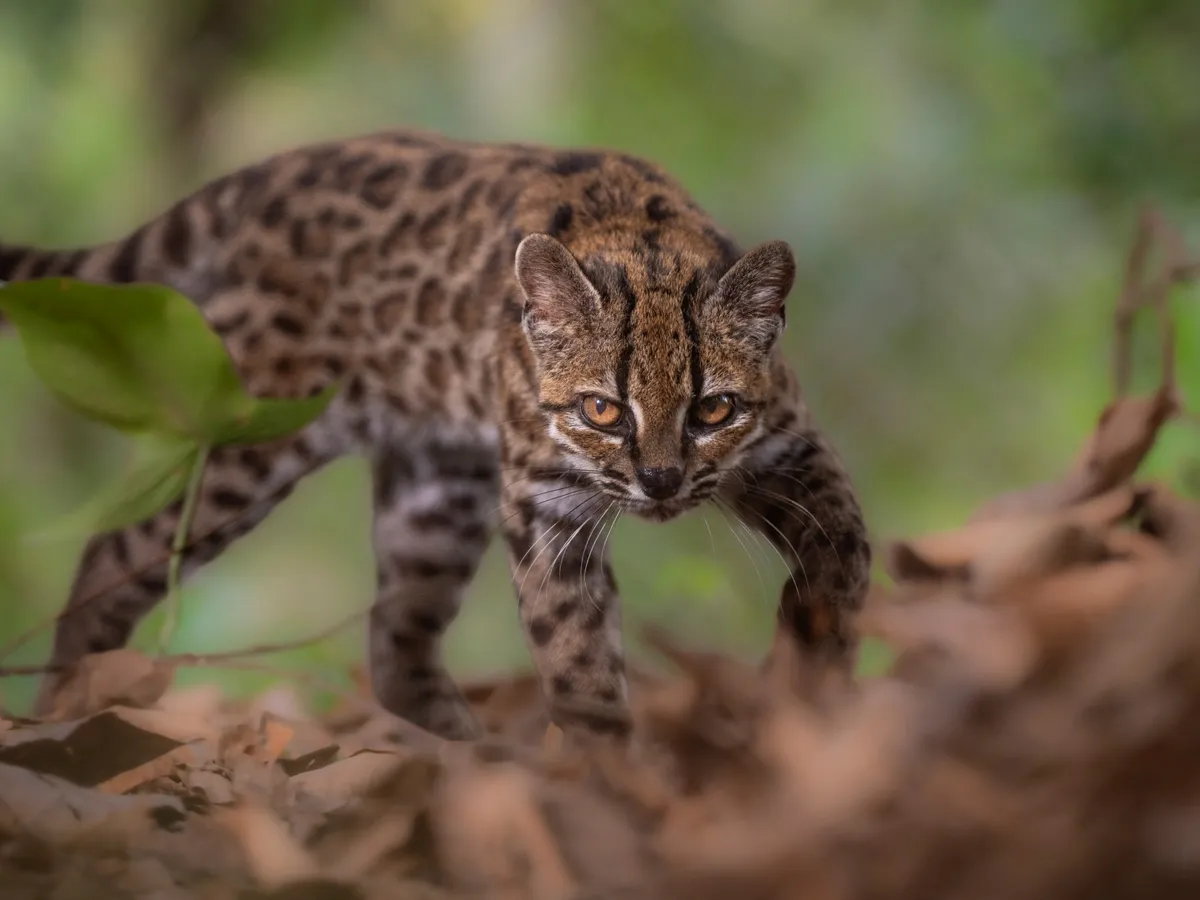
Share New Bolivian cat claws its way into species list: What we meow on social media Add Al Jazeera on Google A Leopardus tilcayo cat, a newly identified species through research led by National Geographic explorer Paola Nogales Ascarrunz, at the Senda Verde animal refuge in the Yungas region, Bolivia [File: Fernando Faciole/National Geographic/Reuters] By Heba Habib Published On 18 Sep 202618 Sep 2026 A new species of wildcat, discovered in Bolivia, has been formally identified after the accidental discovery of a lost kitten and nearly 10 years of painstaking research. The Leopardus tilcayo, which local people in the Bolivian Yungas, a band of cloud forest which runs along the eastern slope of the Andes, were aware of, was previously thought to be related to other wildcats in the region. Recommended Stories list of 3 items list 1 of 3New tiger cat species identified in Bolivia, first in over a century list 2 of 3How Virunga Park protects people and gorillas from Ebola in eastern DRC list 3 of 3Where water conflicts pose the biggest threat in 2026 end of list A study published in Current Biology this week has announced the first new cat species to be discovered in more than 100 years. The last was the pampas cat, reported in 1923. Scientists have named the new cat Leopardus tilcayo, after the local Bolivian name for the animal. The Leopardus tilcayo has been found living in the Bolivian Yungas, a band of cloud forest which runs along the eastern slope of the Andes, forming a transitional zone between the high mountains and the Amazon basin. This is a rugged, humid and largely under-studied ecoregion, which spreads into Peru and northern Argentina, although so far the tilcayo has only been genetically confirmed in Bolivia. Jonas Lescroart, a researcher at the University of Antwerp and coauthor of the study, said such a discovery is rare for the cat family. New species are sometimes “declared” when older scientific names are reinstated after genetic research shows a population was wrongly grouped with another species. That happened with the clouded tiger cat two years ago and the southern tiger cat, Leopardus guttulus, in 2013. But this cat is different. Get instant alerts and updates based on your interests. Be the first to know when big stories happen. Yes, keep me updated “It had never been given a scientific name, and it had never been formally described in a scientific way that was published,” Lescroart told Al Jazeera. “So we had the honour of coming up with a name for this animal and doing the formal scientific description.” Paola Nogales Ascarrunz, who led the research that identified Leopardus tilcayo as a new species, observes the cat at the Senda Verde animal refuge in the Yungas region, in Bolivia, on September 1, 2026 [Fernando Faciole/National Geographic/Handout via Reuters] How was the cat found? A local man found a kitten alone near the forest and, mistaking it for a stray domestic cat, brought it home to care for it. It lived with his family for about a year until 2016 when its wild instincts became impossible to ignore, and it started chasing the neighbours’ chickens. Once the family could no longer manage the cat themselves, they surrendered it to Senda Verde, a refuge for animals. The refuge called in biologist and lead scientist of the Bolivian Felids Research Program, Paola Nogales Ascarrunz, telling her they had found a “weird cat”. “Unfortunately, that’s the problem with the illegal wildlife trade,” Nogales Ascarrunz, told Al Jazeera. “When you want to pet a wild animal, then you think the power of love is going to change the behaviour of this animal. But a wild animal, it doesn’t matter if you give him the best food, it’s not going to behave.” She added that this kind of case is common in Bolivia, particularly in the aftermath of wildfires, when orphaned young animals are captured and sold into the illegal pet trade before eventually being surrendered once new owners realise they can’t be kept. When she went to see the for herself, she says she found an animal with a small, scrunched face, short round ears, long whiskers, and covered in leopard-like spots – but clearly too large and too wild to be a domestic cat. Initially, she believed it was a Leopardus tigrinus, or tigrina, a small spotted cat found across much of Central and South America. But, she says, something about the size and shape of the cat’s spots bothered her. It would take nearly a decade, a genetics collaboration spanning three countries, and DNA pulled from century-old museum skulls to prove she was right to be suspicious. Perhaps leopards can’t change their spots but apparently, you can discover a new Leopardus with new spots altogether. While Nogales Ascarrunz was puzzling over her “weird cat” in Bolivia, an entirely separate effort was under way to study tiger cats across the continent. Lescroart and co-researchers in Belgium, Brazil, Bolivia, the United States, Colombia, the United Kingdom and Peru were busy collecting tiger cat DNA from across South America to resolve a long-standing taxonomic puzzle. “The group of tiger cats has always been a contentious group with an uncertain taxonomy, and no one could really tell with certainty how many different species of tiger cats there were walking around,” Lescroart said. By combining existing genomic data from northeast Brazil, Colombia and southern Brazil with new samples from the Guianas, Peru and Bolivia, the team built a far more complete picture of the group than had existed before, ultimately identifying five distinct species rather than the two to four previously expected. Lescroart said the results were surprising. “When I started working on tiger cats, I was already aware from the start that, regardless of the results, something would have to be rearranged … but we would never have expected to find a completely undescribed species.” Because tiger cats are what scientists call a “cryptic species” group, nearly identical in appearance but genetically distinct, the differences were essentially invisible without DNA analysis. “Physically, they are very similar and hard to tell apart at first instance,” Lescroart said, “and you need genetic research to dig down and find that there are important differences.” “When we managed to put our data together, that is when the pieces clicked,” Lescroart said, “and we realised that the one in Bolivia is really a separate thing from the other tiger cats that we already had on our radar as suspected species or subspecies.” The name, tilcayo, came from the people who live alongside it and who used the name for the animal to distinguish it from other small spotted cats in the region, such as Geoffroy’s cats and margays. “It doesn’t have any meaning in Spanish, even Quechua,” Nogales Ascarrunz said. When the team asked local people where the name came from, “they would say things like ‘my grandpa told me’ or ‘my mother told me that’s the name of the cat’ – knowledge passed down with no accompanying origin story.” Researchers do not know how many of them may exist. “We hope, thousands of them, but we have no idea,” Lescroart said. They also do not know the cat’s full range within the Yungas, or whether the species extends into neighbouring Peru or Argentina. Nogales Ascarrunz added that basic biology, including diet, predators and reproduction, is still undocumented. Lescroart said the new species classification could change how tiger cats are protected. Tiger cats are assessed collectively as “vulnerable” on the International Union for Conservation of Nature (IUCN) Red List. But splitting one species into five means each newly recognised group covers a smaller population, which conservationists say could mean more of them need urgent, individual protection. Genomic data adds to that concern: most tiger cat lineages show long-term declines, with some populations reduced by as much as 80 percent from historical highs, a trend that lines up with what Bolivian elders have told Nogales Ascarrunz: That they are seeing fewer and fewer tilcayos in the forest.
SRCAl Jazeera
LANGEN
LEANCenter
WORDS1 338
ENT12
FRI · 2026-09-18 · 14:25 GMTBRIEF NSR-2026-0918-112322
NSR-2026-0918-112322News Report·EN·Human Interest
New Bolivian cat claws its way into species list: What we meow
A new species of wildcat, named *Leopardus tilcayo*, has been formally identified in Bolivia's Yungas cloud forest region. This discovery, announced in *Current Biology*, marks the first new cat species identified in over a century, with the last being the pampas cat in 1923.
Al JazeeraFiled 2026-09-18 · 14:25 GMTLean · CenterRead · 6 min
Al JazeeraFIG 01
Reading time
6min
Word count
1 338words
Sources cited
2cited
Entities identified
12entities
Quality score
100%
§ 01
Briefing Summary
AI-generatedNEWSAR · AI
A new species of wildcat, named *Leopardus tilcayo*, has been formally identified in Bolivia's Yungas cloud forest region. This discovery, announced in *Current Biology*, marks the first new cat species identified in over a century, with the last being the pampas cat in 1923. The research, led by Paola Nogales Ascarrunz, was prompted by the accidental discovery of a lost kitten and involved nearly ten years of genetic analysis, including DNA from museum specimens. Local people were aware of the animal, but it had never been scientifically described. The *Leopardus tilcayo* is genetically confirmed in Bolivia and inhabits a transitional zone between the Andes mountains and the Amazon basin.
Confidence 0.90Sources 2Claims 5Entities 12
§ 02
Article analysis
Model · rule-basedFraming
Human Interest
Environmental
Tone
Measured
AI-assessed
CalmNeutralAlarmist
Factuality
0.90 / 1.00
Factual
LowHigh
Sources cited
2
Limited
FewMany
§ 03
Key claims
5 extracted01
Jonas Lescroart stated that this cat had never been given a scientific name or formally described in a published scientific way.
quoteJonas Lescroart
Confidence
1.00
02
The cat was initially found as a kitten by a local man who mistook it for a stray domestic cat.
factual
Confidence
1.00
03
The Leopardus tilcayo was discovered through research led by National Geographic explorer Paola Nogales Ascarrunz.
factual
Confidence
1.00
04
This is the first new cat species discovered in over 100 years, with the last being the pampas cat in 1923.
factual
Confidence
1.00
05
A new species of wildcat, Leopardus tilcayo, has been formally identified in Bolivia.
factual
Confidence
1.00
§ 04
Full report
6 min read · 1 338 words§ 05
Entities
12 identifiedKey playerOppositionContextPositiveNeutralNegative
Organizations3
Locations6
§ 06
Keywords & salience
8 termsnew species discovery
1.00
leopardus tilcayo
1.00
bolivian yungas
0.90
wildcat
0.80
cloud forest
0.70
andes
0.60
scientific research
0.50
taxonomy
0.40
§ 07
Topic connections
Interactive graph Network visualization showing 10 related topics
View Full Graph Person Organization Location Event|Click node to navigate|Edge numbers = shared articles