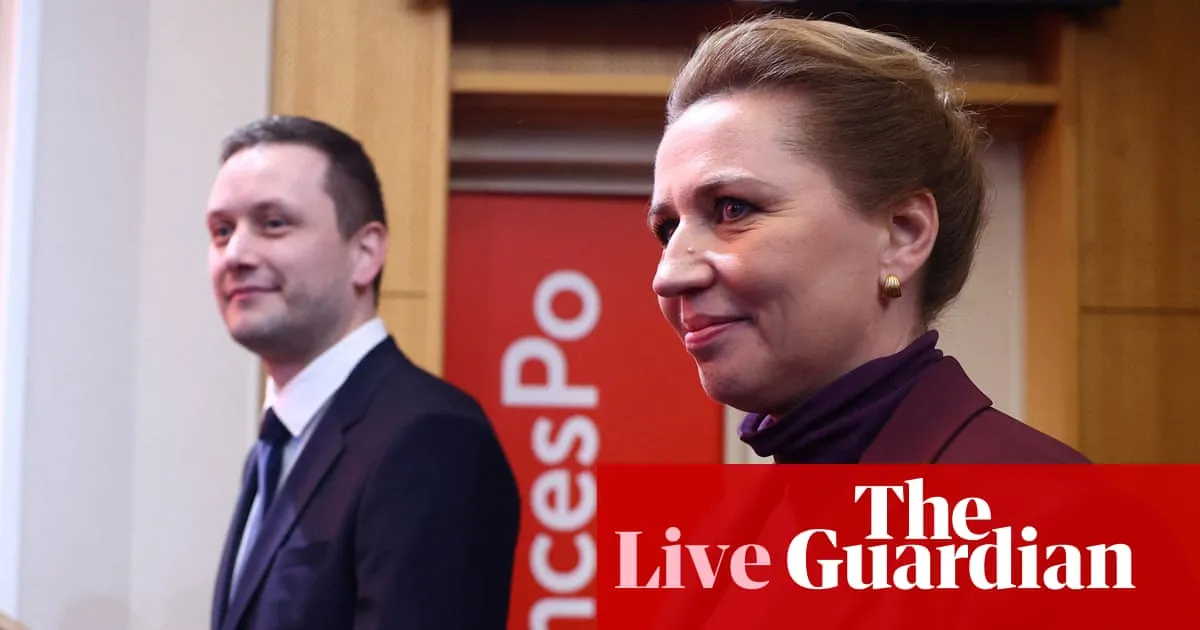
From 2h ago'Russia does not want peace with Europe,' Frederiksen warns, as she urges EU, US unitySpeaking with students at SciencesPo, Frederiksen has also warned that “Russia does not want peace with Europe,” as she urged Europe and the US to “stick together.”Commenting on recent tensions with the US over Greenland, she said that both sides shared concerns on Arctic security, and they “will try to find a way forward with US.”Greenland’s Nielsen also spoke about the impact the confrontation with the US had on the local population.“What we are dealing with as a government is trying to push back from outside and handle our people who are afraid and scared,” he said.I will keep an eye on more lines coming out from that meeting, and the pair is also later expected to meet Emmanuel Macron at the Élysée Palace in Paris.Key events18m agoHungarian prosecutors charge liberal Budapest mayor over Pride march52m agoKremlin rejects US report suggesting Ukraine invasion has led to 1.2 million Russian casualties1h agoFive dead after Russian drone strike on passenger train in Ukraine2h ago'Russia does not want peace with Europe,' Frederiksen warns, as she urges EU, US unity2h ago'World order as we know it is over' and not coming back, Denmark's Frederiksen says2h agoEU needs to 'rapidly' build its defence 'independence' and strengthen European Nato arm, says defence chief2h ago'It cannot be that one country's veto defines policy for others,' EU's Kallas says2h agoNato 'needs to become more European to maintain strength,' EU's Kallas says2h agoMorning opening: EU needs to step up or risk its future in this new dangerous world that is emerging, EU's Kallas warnsShow key events onlyPlease turn on JavaScript to use this featureHungarian prosecutors charge liberal Budapest mayor over Pride marchElsewhere, Hungarian prosecutors have brought charges against Budapest’s liberal mayor, Gergely Karácsony, over his role in arranging an LGBTQ+ rights rally, and are seeking to impose a fine without holding a trial, Reuters reported.Tens of thousands of protesters marched through Budapest last June despite a police ban, turning the Pride march into one of the biggest anti-government demonstrations in years against nationalist prime minister Viktor Orbán.Reuters explained that Karácsony had attempted to circumvent the ban by registering the Pride march as a municipal event, which he argued did not require a permit. Police nevertheless prohibited it, saying it fell under the child-protection law. The march ultimately went ahead peacefully.Prosecutors allege Karácsony violated the law by organising and leading a banned assembly.People cross Elisabeth Bridge during the Budapest Pride March in Budapest, Hungary. Photograph: Bernadett Szabó/ReutersIn his response, the mayor said: “I went from being a proud suspect to a proud defendant.”“Apparently this is the price in this country for standing up for our own and others’ freedom. But if anyone thinks they can stop me from doing this, discourage me, prevent me and my city from doing this, then they are very, very wrong,” he said.The move comes just months before the closely contested parliamentary election in the country, which could see the end of Orbán’s 16 years in power, as the liberal opposition party Tisza is leading in the polls.Kremlin rejects US report suggesting Ukraine invasion has led to 1.2 million Russian casualtiesMeanwhile, the Kremlin has dismissed a report by a Washington-based thinktank that Russia had suffered nearly 1.2 million casualties since it began its war in Ukraine in February 2022, saying that such reports should not be seen as reliable, Reuters reported.The report, by the Center for Strategic and International Studies, estimated that at current rates, combined Russian and Ukrainian casualties could reach 2 million by the spring of 2026.Five dead after Russian drone strike on passenger train in UkraineIf anyone somehow still had any doubts about Russia’s intentions, its last night’s drone strike against a moving passenger train in Ukraine may have offered some further answers.Ukrainian rescuers working at the site of a Russian drone hit on the passenger train near the city of Izyum in Kharkiv’s area, Ukraine. Photograph: State Emergency Service Handout/EPAAt least five people were killed in the attack, local authorities said.Prosecutors said fragments of five bodies had been found at the scene of the strike on the train, which took place near a village in Ukraine’s Kharkiv region.The train had been operating from Chop, near Ukraine’s western borders with Hungary and Slovakia, to the town of Barvinkove. Photographs posted online showed at least two carriages ablaze next to a snow-covered rail bed.“In any country, a drone strike on a civilian train would be considered in exactly the same way – purely as terrorism. There is not and cannot be any military purpose in this,” Ukraine’s Volodymyr Zelenskyy wrote on the Telegram messaging app.'Russia does not want peace with Europe,' Frederiksen warns, as she urges EU, US unitySpeaking with students at SciencesPo, Frederiksen has also warned that “Russia does not want peace with Europe,” as she urged Europe and the US to “stick together.”Commenting on recent tensions with the US over Greenland, she said that both sides shared concerns on Arctic security, and they “will try to find a way forward with US.”Greenland’s Nielsen also spoke about the impact the confrontation with the US had on the local population.“What we are dealing with as a government is trying to push back from outside and handle our people who are afraid and scared,” he said.I will keep an eye on more lines coming out from that meeting, and the pair is also later expected to meet Emmanuel Macron at the Élysée Palace in Paris.'World order as we know it is over' and not coming back, Denmark's Frederiksen saysWe are also getting first lines from a public event with Denmark’s prime minister Mette Frederiksen and Greenlandic’s prime minister Jens-Frederik Nielsen at Sciences Po university in Paris.Picking up the theme of the morning so far, Frederiksen has warned that “the world order as we know it is over and I don’t think it will return”.Ugh. It’s not even 10am.I will bring you more on this as soon as we have it.EU needs to 'rapidly' build its defence 'independence' and strengthen European Nato arm, says defence chiefEU defence commissioner Andrius Kubilius follows Kallas and he strikes very much the same tone of urgency as he outlines the bloc’s defence policies.He says the EU needs to prepare for diminished US presence in Europe, and rapidly build up its “independence” in defence “without delays” or excuses.He stresses that “independence” doesn’t mean going alone, but building on what is already there, strengthening the European arm of Nato.Again, that’s clearly a response to Rutte’s comments earlier this week.He also says that Europe needs to “develop pan-European capabilities, not only national ones,” as “some gaps are so big they can only be filled together”.Kubilius also calls for a new European Security Council – an idea first floated by Emmanuel Macron and Angela Merkel in the late-2010s – to enhance political coordination on defence.'It cannot be that one country's veto defines policy for others,' EU's Kallas saysKallas also sent a warning shot to EU countries trying to occasionally obstruct the bloc’s policies, particularly on Russia, saying this must not be tolerated. “Let’s face it, Europe can be slow. Unanimity means we can not always act at the speed of relevance. Of course, there are policy differences among member states. This is all natural, but unanimity is also used by some as a bargaining tool. And it cannot be that one country’s veto defines the policy for others.” Yes, she probably means Hungary’s Viktor Orbán in particular.Expect to see more comments along these lines as we get closer to the high-stakes parliamentary election in the country in April, which could see the end of Orbán’s time in power after 16 years.Nato 'needs to become more European to maintain strength,' EU's Kallas saysIn comments that will likely be seen as a challenge to Nato’s secretary general Mark Rutte and his recent insistence that Europe cannot defend itself without the US (Europe Live, Monday), EU’s Kallas specifically called for more work to be done on te European side of Nato. “Nato needs to become more European to maintain its strength, and for that Europe must act. For example, we need to ensure that our security and defence initiatives remain complementary to Nato.” In comments that will likely raise eyebrows at Nato HQ across Brussels, she said: “For this, the ball is also in Nato’s court. If you want to use EU instruments such as our budgetary and regulatory power to support and enable Nato, we have to know what these needs and targets are. The more information Nato provides, the better we can align here.” She concluded: “In short, we need to sync our efforts together with Nato so as to complement each other and to demonstrate how distinct European pillar adds to value through more burden sharing and military strength on our continent.” Morning opening: EU needs to step up or risk its future in this new dangerous world that is emerging, EU's Kallas warnsJakub KrupaEU foreign policy chief Kaja Kallas has just been speaking at the European Defence Agency’s annual conference this morning, and the picture she painted is pretty bleak.In summary: “We need to prepare ourselves for the future. Indeed, the crisis we face has deepened dramatically, during the past year.” Who could she possibly mean here?She spoke the continuing impact of Russia’s aggressive behaviour on Ukraine, the growing global uncertainty, but also, yes, the dramatically shifting nature of the EU-US relations that underpinned the transatlantic system over the last eight decades.Kallas has warned that “Europe needs to adapt to new realities” as it is “no longer Washington’s primary centre of gravity.”In a stark warning, she said: “The shift has been ongoing for a while. It is structural, not temporary. It means that Europe must step up. No great power in history has ever outsourced its survival and survived.” She raised alarm that “the risk of full-blown return to coercive power, politics, spheres of influence and world where might makes right is very real.”Kallas says that Europe – and the EU more specifically – needs to respond by raising its defence spending, and getting clarity on what role it wants to play in tomorrow’s world.Drawing on her personal story, she said: “When I was a schoolgirl in Estonia, before anyone had mobile phones in their pocket, many schools used the bell system to tell you the time. The first bell was the signal to go to the class. The second bell was a warning, and the third bell meant that you were late and there would be consequences. We are now dangerously close to the third bell.” Gulp. Who needs coffee, eh?I will bring you more lines from the EU as Kallas and the bloc’s defence commissioner Andrius Kubilius speak at this conference, but also get you all the latest updates from Ukraine, the battle for Greenland’s future, and other key topics of the day.It’s Wednesday, 28 January 2026, it’s Jakub Krupa here, and this is Europe Live.Good morning.
SRCThe Guardian - World News
LANGEN
LEANCenter-Left
WORDS1 833
ENT7
WED · 2026-01-28 · 10:25 GMTBRIEF NSR-2026-0128-11252
NSR-2026-0128-11252News Report·EN·National Security
Russia does not want peace with Europe, says Danish prime minister – Europe live
Danish Prime Minister Mette Frederiksen has stated that Russia does not want peace with Europe, warning of a need for unity between the EU and US. She made this comment during a meeting with students at SciencesPo in Paris.
Jakub KrupaThe Guardian - World NewsFiled 2026-01-28 · 10:25 GMTLean · Center-LeftRead · 8 min
The Guardian - World NewsFIG 01
Reading time
8min
Word count
1 833words
Sources cited
5cited
Entities identified
7entities
Quality score
100%
§ 01
Briefing Summary
AI-generatedNEWSAR · AI
Danish Prime Minister Mette Frederiksen has stated that Russia does not want peace with Europe, warning of a need for unity between the EU and US. She made this comment during a meeting with students at SciencesPo in Paris. The statement comes amid recent tensions between Denmark and Russia over Greenland, which both countries share concerns about Arctic security. Frederiksen also urged Europe and the US to "stick together" in response to these tensions. Additionally, Hungarian prosecutors have charged liberal Budapest mayor Gergely Karácsony with violating a police ban on an LGBTQ+ rights rally, while a Russian drone strike killed five people in Ukraine earlier that day.
Confidence 0.90Sources 5Claims 5Entities 7
§ 02
Article analysis
Model · rule-basedFraming
National Security
Political Strategy
Tone
Measured
AI-assessed
CalmNeutralAlarmist
Factuality
0.70 / 1.00
Factual
LowHigh
Sources cited
5
Well sourced
FewMany
§ 03
Key claims
5 extracted01
Five dead after Russian drone strike on passenger train in Ukraine
factual
Confidence
1.00
02
Kremlin rejects US report suggesting Ukraine invasion has led to 1.2 million Russian casualties
factual
Confidence
1.00
03
Hungarian prosecutors charge liberal Budapest mayor over Pride march.
factual
Confidence
1.00
04
Both the US and Denmark share concerns on Arctic security.
quoteFrederiksen
Confidence
0.90
05
Russia does not want peace with Europe.
quoteFrederiksen
Confidence
0.90
§ 04
Full report
8 min read · 1 833 words§ 05
Entities
7 identifiedKey playerOppositionContextPositiveNeutralNegative
§ 06
Keywords & salience
10 termsrussia
1.00
europe
0.90
peace
0.80
eu
0.70
us
0.70
unity
0.60
defence independence
0.50
arctic security
0.50
ukraine invasion
0.40
pride march
0.40
§ 07
Topic connections
Interactive graph Network visualization showing 20 related topics
View Full Graph Person Organization Location Event|Click node to navigate|Edge numbers = shared articles