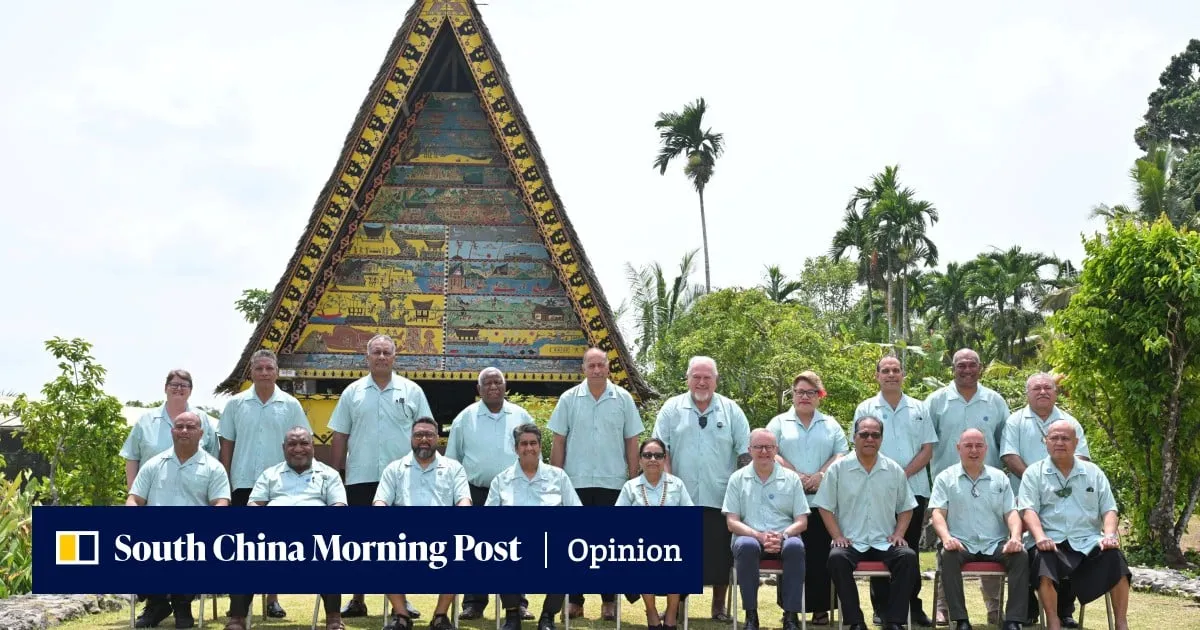
In early July, China fired a test missile from a nuclear submarine into the South Pacific for the first time, a weapon capable of carrying nuclear warheads. Washington and Canberra were livid. The Pacific has long been the exclusive testing ground for such long-range missiles from the United States. How dare China!The reaction from Pacific island states was more measured. While leaders from Tuvalu, Palau and the Solomon Islands strongly criticised the test, the 18-member Pacific Islands Forum (PIF) failed to draft a united statement. Last month, foreign ministers again failed to agree on criticising Beijing, with Kiribati and Nauru reportedly refusing.Finally, this month, a PIF statement that “registered concern on the recent intercontinental ballistic missile (ICBM) test” was issued. China was not named, and Nauru disassociated itself.Kiribati previously said singling out China was unfair when the US regularly tested such missiles near the Marshall Islands. In March, the US launched a Minuteman III ICBM from California, landing near the Marshall Islands 6,700km away; it followed a similar test in November last year. The US has test-fired at least 15 ballistic missiles into the Pacific since 2021.The historical precedent weighs heavily. Between 1946 and 1996, the US, Britain and France conducted over 300 nuclear tests in the Pacific, particularly in French Polynesia and the Marshall Islands, resulting in radioactive contamination, mass displacement, high cancer rates and generational trauma. The double standard is glaring.Geopolitically, the region resembles a feudal hierarchy: small island nations as vassal states, Australia and New Zealand as local lords, and the US as king.
SRCSouth China Morning Post
LANGEN
LEANCenter-Right
WORDS257
ENT12
SUN · 2026-09-20 · 21:30 GMTBRIEF NSR-2026-0920-112764
NSR-2026-0920-112764Analysis·EN·Conflict
Pacific island states are trapped in Cold War 2.0
Pacific island states are caught in a geopolitical struggle following China's first nuclear submarine-launched missile test in the South Pacific in early July. While the United States and Australia reacted strongly, Pacific island nations had a more divided response.
Alex LoSouth China Morning PostFiled 2026-09-20 · 21:30 GMTLean · Center-RightRead · 2 min
South China Morning PostFIG 01
Reading time
2min
Word count
257words
Sources cited
3cited
Entities identified
12entities
Quality score
100%
§ 01
Briefing Summary
AI-generatedNEWSAR · AI
Pacific island states are caught in a geopolitical struggle following China's first nuclear submarine-launched missile test in the South Pacific in early July. While the United States and Australia reacted strongly, Pacific island nations had a more divided response. The 18-member Pacific Islands Forum (PIF) struggled to issue a united statement criticizing the test, with some members like Kiribati and Nauru refusing to single out China, citing the US's regular missile testing in the region. The article highlights a historical precedent of nuclear testing by Western powers in the Pacific, leading to significant environmental and human consequences, and suggests a geopolitical hierarchy where island nations are subordinate to larger powers.
Confidence 0.90Sources 3Claims 5Entities 12
§ 02
Article analysis
Model · rule-basedFraming
Conflict
Diplomatic
Tone
Mixed Tone
AI-assessed
CalmNeutralAlarmist
Factuality
0.60 / 1.00
Mixed
LowHigh
Sources cited
3
Well sourced
FewMany
§ 03
Key claims
5 extracted01
Between 1946 and 1996, the US, Britain and France conducted over 300 nuclear tests in the Pacific.
statisticarticle
Confidence
0.90
02
China fired a test missile from a nuclear submarine into the South Pacific for the first time, capable of carrying nuclear warheads.
factualarticle
Confidence
0.90
03
The US has test-fired at least 15 ballistic missiles into the Pacific since 2021.
statisticarticle
Confidence
0.80
04
Pacific island states are trapped in Cold War 2.0.
factualarticle
Confidence
0.70
05
Geopolitically, the region resembles a feudal hierarchy: small island nations as vassal states, Australia and New Zealand as local lords, and the US as king.
factualarticle
Confidence
0.60
§ 04
Full report
2 min read · 257 words§ 05
Entities
12 identifiedKey playerOppositionContextPositiveNeutralNegative
Locations10
§ 06
Keywords & salience
10 termspacific island states
1.00
cold war 2.0
1.00
missile testing
0.90
nuclear submarine
0.80
intercontinental ballistic missile
0.80
geopolitics
0.70
double standard
0.60
pacific islands forum
0.50
nuclear tests
0.50
china
0.40
§ 07
Topic connections
Interactive graph Network visualization showing 51 related topics
View Full Graph Person Organization Location Event|Click node to navigate|Edge numbers = shared articles