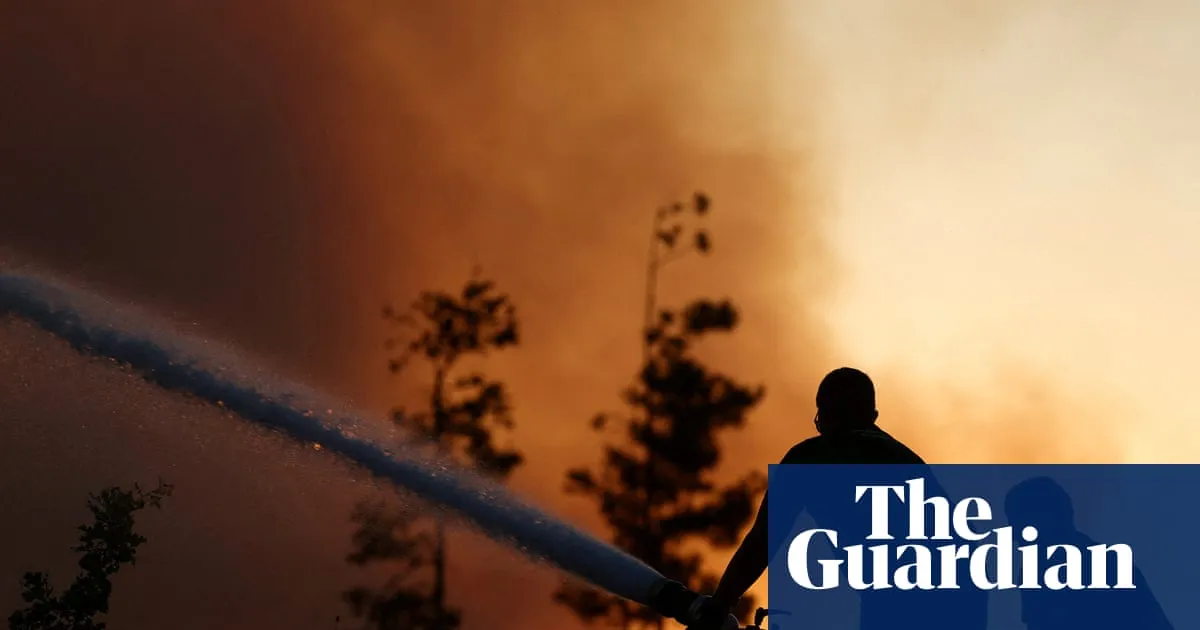
European babies will face almost twice as much extreme fire weather as their great-grandparents if climate action does not ramp up quickly, a study has found.Global Heating under current policies will expose a child born in Europe in 2025 to three more years of brutally fire-conducive weather over their lifetime than someone born in 1950, the researchers found.The number of days with the most severe conditions for fires to burn hotter and spread further will rise fastest in the Mediterranean, where generation Beta, the demographic cohort born from 2025, is to face five more years of lifetime exposure to extreme fire weather than boomers, born in the two decades after the second world war.The hot, dry and windy conditions that let small fires explode into raging infernos have been exacerbated by one-and-a-half centuries of Fossil Fuel Pollution and the widespread destruction of nature, which has heated the planet by 1.4C. In Europe, which has warmed twice as fast as the global average, the worsening weather has increasingly fuelled monster infernos that overwhelm authorities.Rosa Pietroiusti, a climate researcher at Vrije Universiteit Brussel and lead author of the study, said severe fire weather was a “necessary but not sufficient condition” for the kind of extreme fires that ravaged parts of Europe this summer. “The meteorological conditions are an important element of fire risk – the possibility of that fire happening, being super-destructive and difficult to control, and spreading very fast.”The researchers combined demographic data with outputs from global climate models and tallied the number of days when fire weather was more severe than the worst 5% of days for that region in the reference period from 1985 to 2014. They considered 21 scenarios that resulted in 1.5C to 3.5C of Global Heating by the end of the century, a spectrum that roughly covers the best- and worst-case scenarios humanity is likely to face.They found that under current policies, which will result in 2.6C of warming, children born today can expect to experience 84% more exposure to extreme fire weather than those born in 1950. They attributed 86% of the increase to Climate Change and 14% to people living longer.If end-of-century warming is limited to 1.5C – a target likely to be crossed in just a few years – children born in 2025 would face 1.3 fewer years of extreme fire weather than under current policies, the study found.Raúl Cordero, a climate scientist at the University of Groningen, who was not involved in the research, said it highlighted the “inherently intergenerational injustice” of climate breakdown.skip past newsletter promotionafter newsletter promotion“Just one month ago, inhabitants of central Europe experienced fire-weather conditions that their parents or grandparents had never encountered. Unfortunately, these conditions materialised in record-breaking fires in Belgium and western Germany,” said Cordero, whose relatives were among the thousands who fled their homes in Germany in August. “An unstoppable fire engulfing a town? This kind of emergency would have been unthinkable for Germans of older generations.”In southern Europe, the number of fires and the area burned have declined over decades as authorities have grown better at suppressing them, according to a study Cordero co-authored in July, but in recent years the trend has reversed. As well as hotter and drier weather, aggressive fire suppression – preventing even low-intensity fires – has led to buildups of flammable vegetation that has fuelled ferocious blazes in years when climatological conditions are ripe.Relentless heatwaves and widespread drought plagued Europe this summer and led to explosive wildfires across France, Spain, Italy and several other countries. Across the EU, the severity of fire weather this year broke records, while the area burned is shaping up to be the third-worst on record.The EU’s civil protection mechanism was activated nine times as countries scrambled firefighting planes and crews to assist overwhelmed neighbours. In her annual state of the union speech on Wednesday, Ursula von der Leyen, president of the European Commission, paid tribute to a Danish firefighter pilot who died with a colleague in Greece last month, and announced plans for the creation of a European firefighting fleet.“I am so proud of Europe’s response, of our European assets flying across the continent,” said von der Leyen. “But clearly, we need to think bigger and learn faster.”
SRCThe Guardian - World News
LANGEN
LEANCenter-Left
WORDS704
ENT8
MON · 2026-09-21 · 09:00 GMTBRIEF NSR-2026-0921-112872
NSR-2026-0921-112872News Report·EN·Human Interest
Babies ‘will face almost twice as much’ extreme fire weather in Europe than great-grandparents
A new study indicates that children born in Europe after 2025 will experience significantly more extreme fire weather conditions throughout their lives compared to previous generations. Under current climate policies, a child born in 2025 could face three more years of such weather than someone born in 1950, with the Mediterranean region expected to see the most dramatic increase.
Ajit NiranjanThe Guardian - World NewsFiled 2026-09-21 · 09:00 GMTLean · Center-LeftRead · 3 min
The Guardian - World NewsFIG 01
Reading time
3min
Word count
704words
Sources cited
2cited
Entities identified
8entities
Quality score
100%
§ 01
Briefing Summary
AI-generatedNEWSAR · AI
A new study indicates that children born in Europe after 2025 will experience significantly more extreme fire weather conditions throughout their lives compared to previous generations. Under current climate policies, a child born in 2025 could face three more years of such weather than someone born in 1950, with the Mediterranean region expected to see the most dramatic increase. This heightened risk is attributed to global heating, exacerbated by fossil fuel pollution and nature destruction, leading to hotter, drier, and windier conditions conducive to severe fires. Limiting global warming to 1.5C could substantially reduce this exposure. The findings highlight an intergenerational injustice, as recent extreme fire events in Europe have already surpassed the experiences of older generations.
Confidence 0.90Sources 2Claims 5Entities 8
§ 02
Article analysis
Model · rule-basedFraming
Human Interest
Environmental
Tone
Mixed Tone
AI-assessed
CalmNeutralAlarmist
Factuality
0.80 / 1.00
Factual
LowHigh
Sources cited
2
Limited
FewMany
§ 03
Key claims
5 extracted01
Severe fire weather was a 'necessary but not sufficient condition' for extreme fires.
quoteRosa Pietroiusti
Confidence
1.00
02
Under current policies (2.6C warming), children born today can expect to experience 84% more exposure to extreme fire weather than those born in 1950.
statisticstudy
Confidence
0.90
03
Global heating under current policies will expose a child born in Europe in 2025 to three more years of brutally fire-conducive weather over their lifetime than someone born in 1950.
statisticresearchers
Confidence
0.90
04
European babies will face almost twice as much extreme fire weather as their great-grandparents if climate action does not ramp up quickly.
statisticstudy
Confidence
0.90
05
The number of days with the most severe conditions for fires to burn hotter and spread further will rise fastest in the Mediterranean.
statisticstudy
Confidence
0.85
§ 04
Full report
3 min read · 704 words§ 05
Entities
8 identifiedKey playerOppositionContextPositiveNeutralNegative
Organizations1
§ 06
Keywords & salience
8 termsextreme fire weather
1.00
climate action
0.90
global heating
0.80
climate change
0.80
mediterranean
0.70
fossil fuel pollution
0.60
climate models
0.50
demographic data
0.40
§ 07
Topic connections
Interactive graph Network visualization showing 51 related topics
View Full Graph Person Organization Location Event|Click node to navigate|Edge numbers = shared articles