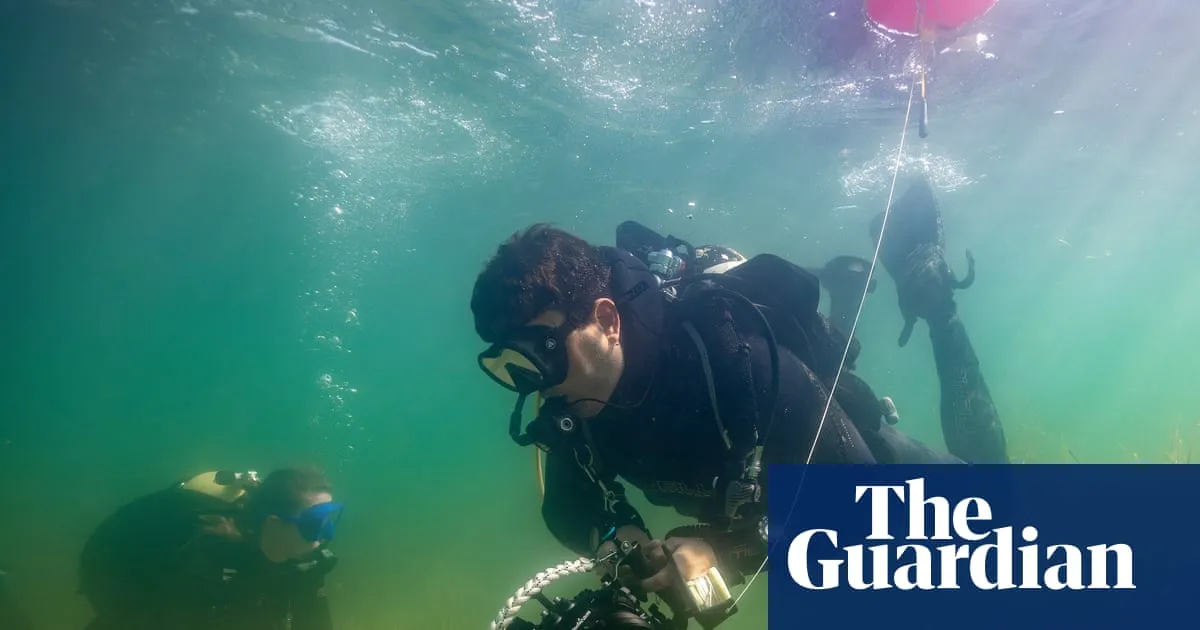
One of the UK’s most precious underwater habitats – Dorset’s seagrass meadows – is recovering thanks to “eco moorings” designed to prevent the seabed being ripped up, a study has revealed.Scars caused by traditional anchors in some areas of seagrass in Studland Bay have almost entirely vanished, which is boosting the number of seahorses that thrive in the submerged meadows.The Studland Bay Marine Partnership, which includes a wide range of organisations including conservationists and boating enthusiasts, hopes the findings could help protect and restore seagrass in other busy marine environments around the UK.seagrass meadows are considered one of the world’s most valuable ecosystems because, as well as supporting creatures such as seahorses, they store carbon and help protect coastlines from erosion.Corkwing fish swimming among the seagrass. Photograph: Pete LightowlerThey are declining globally due to pressures including pollution, coastal development and the climate emergency. The meadows at Studland Bay are particularly at risk because the spot is so popular with leisure boaters.Research conducted by Kira Dunn, as part of her masters degree at the University of Southampton, analysed data collected since eco-moorings were installed by the partnership in 2021.In the area where 10 trial eco-moorings were installed five years ago, bare patches in the seagrass shrank by an average of 94% between 2021 and 2025. In a second study area, where traditional chain moorings remained until 2023, the scars reduced by 65%.Kira Dunn: ‘It’s incredibly encouraging to see how quickly this important habitat can regenerate.’ Photograph: Valerie MatherDunn said: “The results clearly show that seagrass is recovering in areas where physical disturbance has been removed. It’s incredibly encouraging to see how quickly this important habitat can regenerate when given the opportunity.”David Brown, the chair of the Studland Bay Marine Partnership steering group and lead ecologist for the National Trust, said: “The impact has been beyond our expectations, and thanks to robust monitoring and research, we have the science to prove how the eco-moorings benefit seagrass and all the species that rely on it.”A spider crab in seagrass. Photograph: Jon BunkerStudland Bay was designated a marine conservation zone in 2019 and is home to one of the UK’s largest seagrass meadows, supporting numerous marine species including the protected spiny seahorse and the occasionally recorded short-snouted seahorse.skip past newsletter promotionafter newsletter promotionSince eco-moorings were introduced volunteer divers who monitor seahorses have reported increases in numbers. Other creatures spotted in the seagrass include conger eels, spider crabs and corkwing wrasse.eco-moorings consist of a 2-metre helical screw, which is drilled securely into the seabed. Attached to this is a 2-metre elasticated riser that connects to a surface buoy. As the tide rises and falls, the riser stretches and retracts, preventing any scouring of the seabed and seagrass.A boat tied to an eco-mooring at Studland Bay. Photograph: Brad Wakefield/National TrustKen Collins, emeritus research fellow and diving officer at the University of Southampton and supervisor of the study, said: “This research provides robust scientific evidence that eco-moorings are an effective tool for seagrass conservation and restoration.“The findings support the continued use and expansion of eco-mooring schemes, not only in Studland but in other sensitive marine environments where seagrass habitats are under pressure.”A conger eel in seagrass. Photograph: The Seahorse Trust
SRCThe Guardian - World News
LANGEN
LEANCenter-Left
WORDS533
ENT12
MON · 2026-09-21 · 11:00 GMTBRIEF NSR-2026-0921-112878
NSR-2026-0921-112878News Report·EN·Environmental
‘Incredibly encouraging’: healing the scars of traditional anchors in Dorset’s seagrass meadows
A study in Studland Bay, Dorset, has revealed that "eco-moorings" are effectively restoring damaged seagrass meadows. Installed by the Studland Bay Marine Partnership starting in 2021, these moorings prevent seabed disturbance from traditional anchors.
Steven MorrisThe Guardian - World NewsFiled 2026-09-21 · 11:00 GMTLean · Center-LeftRead · 3 min
The Guardian - World NewsFIG 01
Reading time
3min
Word count
533words
Sources cited
3cited
Entities identified
12entities
Quality score
100%
§ 01
Briefing Summary
AI-generatedNEWSAR · AI
A study in Studland Bay, Dorset, has revealed that "eco-moorings" are effectively restoring damaged seagrass meadows. Installed by the Studland Bay Marine Partnership starting in 2021, these moorings prevent seabed disturbance from traditional anchors. Research shows that in areas with eco-moorings, seagrass scars shrank by an average of 94% between 2021 and 2025, significantly boosting marine life like seahorses. This success, attributed to removing physical disturbance, offers a promising model for seagrass conservation in other vulnerable marine environments. The findings, supported by scientific monitoring, demonstrate the rapid regeneration potential of seagrass when protected.
Confidence 0.90Sources 3Claims 5Entities 12
§ 02
Article analysis
Model · rule-basedFraming
Environmental
Human Interest
Tone
Measured
AI-assessed
CalmNeutralAlarmist
Factuality
0.80 / 1.00
Factual
LowHigh
Sources cited
3
Well sourced
FewMany
§ 03
Key claims
5 extracted01
Eco-moorings consist of a helical screw drilled into the seabed with an elasticated riser connecting to a surface buoy.
factual
Confidence
0.95
02
Bare patches in seagrass shrank by an average of 94% in areas with eco-moorings between 2021 and 2025.
statisticKira Dunn
Confidence
0.95
03
Seagrass meadows store carbon and help protect coastlines from erosion.
factual
Confidence
0.90
04
Scars caused by traditional anchors in Dorset's seagrass meadows have almost entirely vanished due to eco-moorings.
factual
Confidence
0.90
05
Volunteer divers have reported increases in seahorse numbers since eco-moorings were introduced.
factualStudland Bay Marine Partnership
Confidence
0.85
§ 04
Full report
3 min read · 533 words§ 05
Entities
12 identifiedKey playerOppositionContextPositiveNeutralNegative
Organizations3
§ 06
Keywords & salience
8 termsseagrass meadows
1.00
eco moorings
0.90
habitat restoration
0.80
marine conservation
0.70
studland bay
0.60
seahorses
0.50
coastal erosion
0.40
carbon storage
0.40
§ 07
Topic connections
Interactive graph No topic relationship data available yet. This graph will appear once topic relationships have been computed.