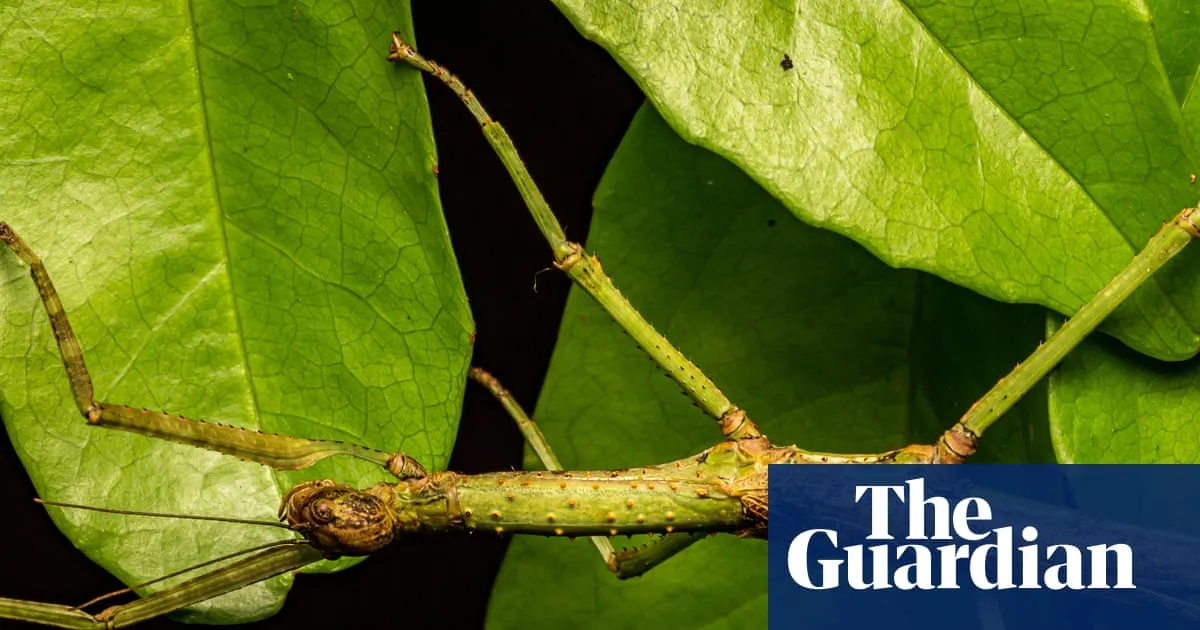
A female Anchiale robusta stick insect has been identified as being a a distinct species. Photograph: Angus Emmott/James Cook University View image in fullscreen A female Anchiale robusta stick insect has been identified as being a a distinct species. Photograph: Angus Emmott/James Cook University Discovery of new Australian stick insect species reveals case of mistaken identity New study describes two species, Anchiale robusta and Anchiale mabiensis, both found in far north Queensland Get our breaking news email, free app or daily news podcast Two new large stick insect species have been identified by Australian researchers, in a discovery they say illustrates how little we still understand about insect diversity. The two species, both found in far north Queensland, are described in a study published in Austral Entomology. One, named Anchiale robusta, was hiding in plain sight: the stick insect has long been popular among enthusiasts and scientists, but analysis has only now revealed that its previous designation was a case of mistaken identity. “When we went out into the field, and we saw a whole bunch of different individuals that looked morphologically different, and they were also living in … different habitats, that was our first hint that there was a bit more of a complicated story here,” said the study’s lead author, Dr Braxton Jones of the University of Sydney. Combining analysis of DNA and museum collections, citizen science records and surveys, the team discovered the insect had been misidentified for decades. Anchiale robusta females grow to a body length of 12 to 16cm; males reach 9 to 10cm in length. “Mostly their wings are black but some of them have a little bit of purple on the underside of their hindwing,” Jones said. “Males are always smaller than females – it’s incredibly rare for a female to be able to still fly because they are quite heavy with … eggs.” View image in fullscreen A female Anchiale robusta, during a threat display. Photograph: Paul D Brock/Natural History Museum The team also described Anchiale mabiensis, a species that lives in the critically endangered Mabi rainforest of Queensland’s Atherton tablelands. Females of the species are about 11 to 12cm long. The eggs of the species have an unusual structural “lid”, which detaches when the insects hatch, Jones said. In describing two new species and confirming the existence of a third, the research revealed that what were once considered two species are in fact five species in habitats stretching from northern New South Wales into tropical north Queensland. That finding had important conservation implications, Jones said, given that the species are found in smaller habitat ranges than previously thought. Jones said animals of the Anchiale genus were one of the most documented stick insects on citizen science platforms, because “there’s quite a lot of them and they can hatch in large proportions and population sizes”. Despite this, he said, “there’s so much we don’t know about them”. The study also identified another probable new species in Cape York, but more specimens are needed for confirmation. Last year, also on the Atherton tablelands, scientists discovered a 40cm-long new species, Acrophylla alta, which weighs slightly less than a golf ball and which they noted could be the heaviest insect in Australia. Australia’s longest species, the gargantuan stick insect, is also found in northeastern Queensland; females of the species can grow to more than half a metre in length. Explore more on these topics Queensland Breaking News Australia Insects Biology Animals Wildlife news Share Reuse this content
SRCThe Guardian - World News
LANGEN
LEANCenter-Left
WORDS583
ENT10
MON · 2026-09-21 · 15:00 GMTBRIEF NSR-2026-0921-112942
NSR-2026-0921-112942News Report·EN·Environmental
Discovery of new Australian stick insect species reveals case of mistaken identity
Australian researchers have identified two new large stick insect species, *Anchiale robusta* and *Anchiale mabiensis*, found in far north Queensland. This discovery, published in *Austral Entomology*, highlights the ongoing lack of understanding regarding insect diversity.
Donna Lu Assistant editor, climate, environment and scienceThe Guardian - World NewsFiled 2026-09-21 · 15:00 GMTLean · Center-LeftRead · 3 min
The Guardian - World NewsFIG 01
Reading time
3min
Word count
583words
Sources cited
2cited
Entities identified
10entities
Quality score
100%
§ 01
Briefing Summary
AI-generatedNEWSAR · AI
Australian researchers have identified two new large stick insect species, *Anchiale robusta* and *Anchiale mabiensis*, found in far north Queensland. This discovery, published in *Austral Entomology*, highlights the ongoing lack of understanding regarding insect diversity. *Anchiale robusta* was previously misidentified for decades, with new analysis of DNA, museum collections, and citizen science data revealing it as a distinct species. The second species, *Anchiale mabiensis*, was found in the critically endangered Mabi rainforest. The study indicates that what was thought to be two species are actually five, with implications for conservation due to smaller habitat ranges than previously understood.
Confidence 0.90Sources 2Claims 5Entities 10
§ 02
Article analysis
Model · rule-basedFraming
Environmental
Human Interest
Tone
Measured
AI-assessed
CalmNeutralAlarmist
Factuality
0.80 / 1.00
Factual
LowHigh
Sources cited
2
Limited
FewMany
§ 03
Key claims
5 extracted01
The discovery has important conservation implications as the species are found in smaller habitat ranges than previously thought.
factualDr Braxton Jones
Confidence
1.00
02
The research revealed that what were once considered two species are in fact five species in habitats stretching from northern New South Wales into tropical north Queensland.
factualDr Braxton Jones
Confidence
1.00
03
Anchiale robusta females grow to a body length of 12 to 16cm; males reach 9 to 10cm.
statisticDr Braxton Jones
Confidence
1.00
04
The insect previously identified as Anchiale robusta was a case of mistaken identity, with a distinct new species identified.
factualDr Braxton Jones
Confidence
1.00
05
Two new large stick insect species, Anchiale robusta and Anchiale mabiensis, have been identified by Australian researchers in far north Queensland.
factualAustralian researchers
Confidence
1.00
§ 04
Full report
3 min read · 583 words§ 05
Entities
10 identifiedKey playerOppositionContextPositiveNeutralNegative
Organizations4
Locations3
§ 06
Keywords & salience
10 termsstick insect species
1.00
new species discovery
0.90
insect diversity
0.80
mistaken identity
0.70
anchiale robusta
0.60
anchiale mabiensis
0.60
far north queensland
0.50
dna analysis
0.40
museum collections
0.40
citizen science
0.40
§ 07
Topic connections
Interactive graph No topic relationship data available yet. This graph will appear once topic relationships have been computed.